

OIC urges cooperation to alleviate poverty

1 / 2
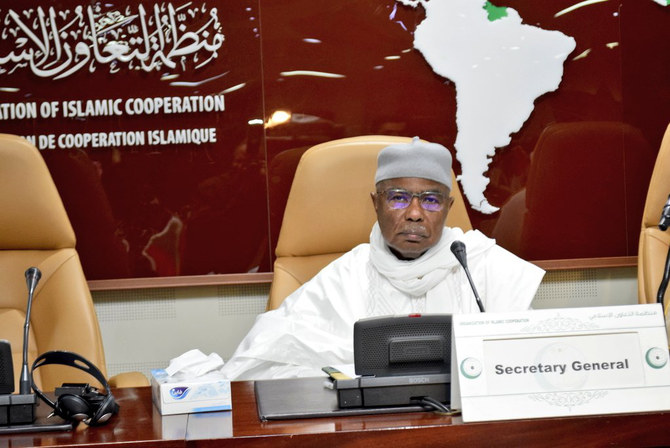
During the OIC meeting in Ankara, Secretary-General Hissein Brahim Taha called on all member states to collaborate more closely and exchange experiences towards accelerating poverty alleviation especially in the least developed states. (Twitter: @OIC_OCI)
2 / 2
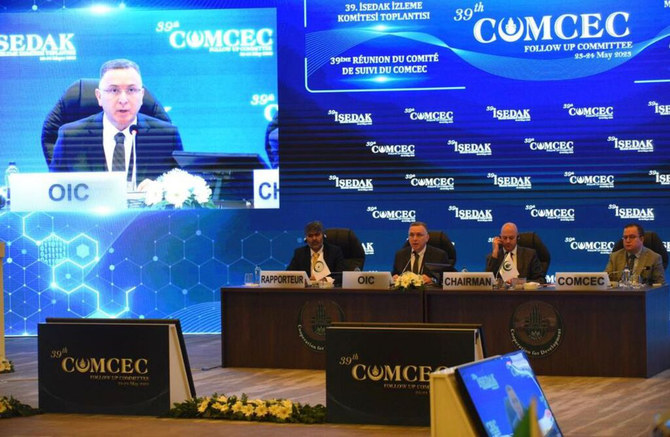
The 9th Follow-up Committee Meeting of the OIC Standing Committee for Economic and Commercial Cooperation was held in Ankara, Turkey, on May 23-24, 2023. (Twitter: @OIC_OCI)
Short Url
Updated 26 May 2023
Follow

OIC urges cooperation to alleviate poverty

JEDDAH: The Secretary-General of the Organization of Islamic Cooperation Hissein Brahim Taha has called on member states to work more closely and exchange experiences to help accelerate efforts to alleviate poverty, especially in the least developed countries.

The request came during a meeting of the OIC’s Standing Committee for Economic and Commercial Cooperation in Ankara, which was held on May 23-24.

Taha urged member states to actively participate in October’s OIC Ministerial Conference on Food Security and Agricultural Development, in Doha.

The conference aims to speed up the recovery process in the agricultural and food security sectors following the impact of the COVID-19 pandemic.

The recent meeting focused on several issues, including the implementation status of several COMCEC projects in trade, investment, agriculture, tourism, financial development, and poverty alleviation.

The meeting also approved the draft agenda for the 39th session of the COMCEC General Assembly in Istanbul, from Dec. 2-5.

The COMCEC follow-up committee meets annually to review the implementation status of the resolutions of the ministerial sessions on economic and trade development, and to prepare the necessary working documents for the forthcoming COMCEC ministerial sessions.


Japanese researchers hope to restore coral from Saudi-made structures

Updated 05 January 2026
Follow

Japanese researchers hope to restore coral from Saudi-made structures

  • Coral skeletons made for Saudi Pavilion at Japan expo last year
  • Results of Japanese study to be revealed at Riyadh Expo 2030

TOKYO: Japanese universities are seeking to restore coral reefs and marine ecosystems after receiving artificial structures that Saudi Arabia made and showcased at last year’s Osaka-Kansai Expo.

The coral skeletons were donated to the University of the Ryukyus in Okinawa and Kansai University in Osaka Prefecture, Kyodo News reported at the weekend.

The structures are made from calcium carbonate, a material on which corals are believed to grow more easily compared to artificial alternatives such as concrete or metal.

The skeletal structures were created using 3-D printers, with one piece produced a day during the expo, and displayed across an entire wall in the Saudi Arabia Pavilion, which had an area focusing on sustainable marine environments.

Coral reefs serve as habitats for much marine life, but over 40 percent of the world’s 892 species face possible extinction, according to the International Union for Conservation of Nature.

The University of the Ryukyus, which received about 150 of the artificial coral skeletons, will place them in waters off the eastern coast of Okinawa’s main island and then examine their impact on the ecosystem.

Kansai University has placed theirs in the sea around Kagoshima Prefecture’s Yoron Island to observe their growth after transplanting coral polyps onto the structures.

The results of the research are expected to be revealed at the Riyadh Expo in 2030.

“I had never imagined that Japan and Saudi Arabia would cooperate on coral research,” said Masato Ueda, a professor specializing in regenerative medicine at Kansai University.

Ueda said he wants to demonstrate to children that “humanity is attempting to restore the environment.”