

Pakistan to receive first cargo of cheap Russian oil in first half of June — oil minister

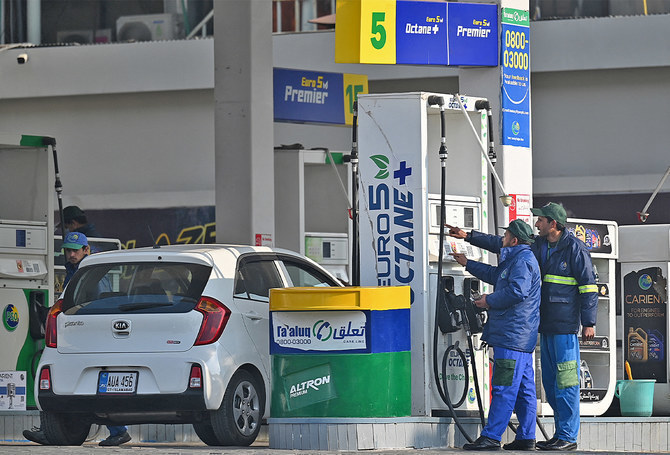
Employees at a fuel station attend to their customers in Islamabad, Pakistan, on February 16, 2022. (AFP/File)
Short Url
Updated 24 May 2023
Follow

Pakistan to receive first cargo of cheap Russian oil in first half of June — oil minister

  • A cargo containing 100,000 tons of oil will reach Oman by May 28 before the commodity is transported to Pakistan
  • Dr. Musadik Malik says the import of cheap Russian oil will create ‘different in the market,’ provide relief to people

ISLAMABAD: State Minister for Petroleum Dr. Musadik Malik on Wednesday said Pakistan would receive the first consignment of Russian oil within the first half of June, hoping the import of oil at cheaper rates would make a “difference in the market.”

The country placed its first order for Russian crude oil on April 20 after the two sides signed several memoranda of understanding in the preceding weeks. Malik said Pakistan would assess how much oil to import in the future after receiving the first shipment.

“The first cargo containing 100,000 tons of oil from Russia will reach Oman on May 27 or 28, and from there, it will be transported to Pakistan via small ships,” he said in a news conference on Wednesday.

“The Russian oil will reach Pakistan by the end of the first week or at the beginning of the second in June,” he continued, adding the import of cheap oil would make a “difference in the market.”

Pakistan’s energy procurements from the international market constitute the most significant portion of its import bill, putting immense pressure on its forex reserves which have plummeted to critically low levels over the last several months.

According to official figures, the amount stood at about $23 billion during the last fiscal year.

Asked if the government’s plan to provide cheaper oil to the public would lead to potential objections from the International Monetary Fund (IMF) which is yet to release a $1.1 billion tranche under a stalled bailout facility, Malik said he was “confident” the global money lender would not raise any issues.

Islamabad has faced procurement problems related to liquefied natural gas (LNG) from the global market due to erratic spot prices that largely remained out of its reach since the Russian invasion of Ukraine.

Local media reports maintain Pakistan’s oil supplies have remained tenuous due to issues pertaining to clearance of import payments.

Historically, Pakistan has not enjoyed strong commercial relations with Moscow, unlike neighboring India, and has remained a traditional US ally. More recently, however, the South Asian state has started giving greater importance to economic diplomacy to augment its options in the international arena.


Saudi Arabia heading toward growth exceeding global average: McKinsey partner

Updated 5 sec ago
Follow

Saudi Arabia heading toward growth exceeding global average: McKinsey partner

RIYADH: Saudi Arabia is expected to achieve growth that exceeds the global average, thanks to Vision 2030 projects, particularly in the industrial sector, which is being fueled by the metals and mining sector, according to Jeffrey Lorsch, partner at McKinsey & Co., in comments to Al-Eqtisadiah. 

He cited the growth of the mining sector as a driver, as it is linked to strategic projects, including automotive, aerospace, space, and defense industries.

A large part of its expansion depends on these projects, according to Lorsch, who stated that the available opportunities will support Saudi Arabia in achieving an annual growth rate that exceeds the global average.

However, he also warned of the negative impact of geopolitical tensions around the world on the metals sector.

“The government of Saudi Arabia’s outlook for the mining sector is quite robust,” Lorsch said. “We’ve seen a significant uptick in the sector in the last 10 years. The output of the sector has doubled or tripled since 2015, which reflects the investor confidence that we see.”

Seeking multilateral solutions

Global geopolitical tensions form the general framework for this year’s Future Minerals Forum, according to Lorsch. They are also a key factor shaping the methodology of the Future Minerals Forum Barometer, which was launched to monitor global transformations in the mining sector.

Lorsch emphasized that the large attendance at the conference clearly reflects the growing importance of critical minerals in the context of geopolitical tensions.

One of the forum’s most prominent efforts is to find multilateral solutions to develop the mining sector, both within Saudi Arabia and globally.

The FMF Barometer will analyze the impact of these tensions on mineral value chains, including the development of local and regional supply chains, after a historical reliance on global supply chains, according to Lorsch.

The McKinsey partner also emphasized the importance of involving the “super region” to ensure that the development of mineral resources in Global South countries genuinely contributes to their growth and leads to industrial development.

The barometer does not cover Saudi Arabia alone but includes the global market, where there is a massive need to significantly increase mineral supplies.

Strong future prospects for the mining sector in Saudi Arabia

Regarding the Kingdom, Lorsch confirmed that the future prospects for the mining sector are very strong, noting that the past 10 years have seen a remarkable increase in the sector’s performance.

He expected similar growth in the gold sector. “Looking forward, we’re going to see similar growth in the gold sector,” Lorsch added, pointing to Maaden’s announcement of additional gold resources that will lead to increased production capacity, alongside significant growth opportunities in phosphate, aluminum, and steel.

The McKinsey partner described the overall outlook for the sector as “very optimistic.”

Globally, Lorsch explained that McKinsey adopts a balanced approach in its growth forecasts.

“From a global economic growth perspective, I think we’re taking a fairly balanced approach. We see growth much more centered in the 2 to 3 percent, we see the Kingdom having more of a robust outlook,” he said.