Saudi orchestra, choir hits high note at Jeddah’s Islamic Arts Biennale
70 musicians, singers performed Islamic chants, instrumental pieces, traditional Saudi musical numbers
Updated 23 May 2023
Afshan Aziz
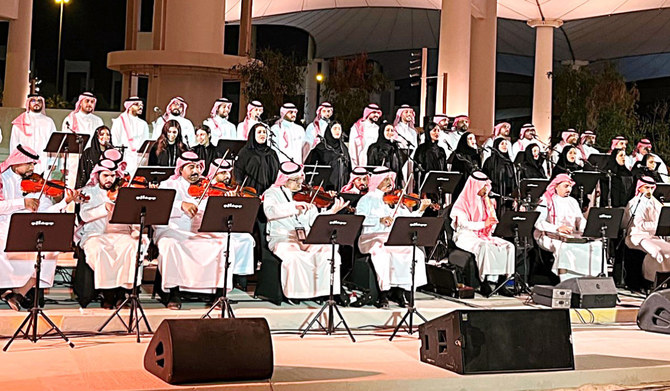
JEDDAH: The Saudi National Orchestra and Choir hit all the right notes with an “exquisite” performance at the Islamic Arts Biennale in Jeddah.
Seventy musicians and singers on Monday belted out a selection of Islamic chants, instrumental pieces, and traditional Saudi musical numbers in a show titled Beauty and Grace.
Performing under the umbrella of the Saudi Music Commission, the tunes were picked to blend with the artwork on display at the Western Hajj Terminal venue.
Aya Al-Bakree, chief executive officer of Diriyah Biennale Foundation, told Arab News: “The exquisite Saudi Orchestra’s performance is part of Diriyah Biennale Foundation’s Creative Experiences public programming series for audiences of all ages, marking the final days of the incredible Islamic Arts Biennale.
HIGHLIGHT
The contemporary arts and culture event hosted by the foundation, which ended on Tuesday, featured artworks by 60 established and emerging artists from Saudi Arabia and around the world, along with more than 60 new commissions and 280 historical artifacts.
“We are profoundly grateful to the Ministry of Culture’s Music Commission for enabling this meaningful collaboration that celebrates exceptional Saudi Arabian talent and artistic expression on an international platform, which is a central tenet of our work at the foundation,” she said.
By combining music and visual art, event organizers aimed to highlight the importance of music in local and global culture, celebrating national pieces representing the Kingdom’s rich heritage.
Donya Abdulhadi, senior adviser at the Diriyah Biennale Foundation, said: “Diriyah Biennale Foundation’s Islamic Arts Biennale was not only the first biennale dedicated to the Islamic arts in world history, but has also been recognized among the most impactful cultural initiatives in Saudi Arabia, showcasing homegrown talent on an international stage.
“Working with the Music Commission in hosting the Saudi Orchestra represents the spirit of continued collaboration within the cultural ecosystem nationwide and is symbolic of Saudi Arabia’s contribution to the arts at an international scale.”
Mohammed Ghani, who attended the event with his family, said: “We are proud of Saudi cultural music, and these kinds of platforms create not only music enthusiasm among the young people but also help in shaping the future of the country’s music scene.”
The contemporary arts and culture event hosted by the foundation, which ended on Tuesday, featured artworks by 60 established and emerging artists from Saudi Arabia and around the world, along with more than 60 new commissions and 280 historical artifacts.
Saudi House kicks off Davos with push on Vision 2030, AI platform and ‘humanizing’ tourism
Saudi ministers dominate pre-summit spotlight at Saudi pavilion, touting Vision 2030’s next phase and human capital as key to global edge
Ministry of Economy and Planning announced the SUSTAIN Platform which aims to accelerate AI-enabled, cross-sector collaboration for sustainable development
Updated 16 sec ago
GABRIELE MALVISI
DAVOS: For regulars at the World Economic Forum, Monday in Davos is usually a chance to ease into the week, a time to reconnect, plan meetings and prepare for the intense schedule ahead.
This year, Saudi Arabia moved quickly to fill that lull, taking center stage with a packed program of panels ahead of Tuesday’s official opening.
At the Saudi House — the Kingdom’s official pavilion on the Promenade, returning after its debut as a standalone venue at the 2025 WEF Annual Meeting — Saudi ministers and global executives set out how the Kingdom sees the next phase of its transformation.
Monday’s speakers at the Saudi House included Minister of Finance Mohammed Al-Jadaan, Minister of Investment Khalid Al-Falih, Minister of Tourism Ahmed Al-Khateeb, and President and Vice Chairman of Meta Dina Powell McCormick. (Supplied)
Established by the Ministry of Economy and Planning, the venue is pitched as a platform for international thought leaders to tackle the challenges, opportunities and solutions shaping the global economy.
Opening a session on the Kingdom’s role at this year’s Forum and the next phase of Vision 2030 — now in its 10th year and roughly two-thirds complete — Princess Reema bint Bandar, Saudi Arabia’s ambassador to the US, said human capital “is the actual driver if you want a competitive, modern economy.”
She described one of the biggest achievements of the past decade as the emergence of a highly qualified cohort of young Saudis who could work anywhere in the world but “choose to come home, choose to build at home and choose to deliver at home,” calling this “the biggest symbol of the success of Vision 2030.”
Who can give you optimum access to opportunities while addressing risks? I contend that Saudi Arabia has been able to provide that formula.
Khalid Al-Falih, Saudi minister of investment
On the same panel, Minister of Finance Mohammed Aljadaan said this success is rooted in a “behavioral change” that has strengthened the Kingdom’s credibility with both international partners and its own citizens.
“Credibility comes from being very pragmatic, making sure that you maintain your fiscal policy discipline, but at the same time refocus your resources where it matters,” he said, warning that “markets will call your bluff if you’re not serious.”
The Saudi House, a cross-ministerial initiative led by the Ministry of Economy and Planning, is intended to underscore the Kingdom’s “commitment to global cooperation” by offering “a platform where visionary ideas are shared and shaped,” while showcasing opportunities and lessons from its “unprecedented national transformation.”
Echoing earlier comments to Arab News, Economy and Planning Minister Faisal Alibrahim said the Kingdom’s role as an anchor of stability has helped unlock its potential, stressing that while the objective is to decouple from reliance on a single commodity, “2030 is not the finishing line.”
Khalid Al-Falih, Saudi minister of investment, said Saudi Arabia has been able to enable access to opportunities while addressing major risks, arguing that few countries can match the Kingdom’s overall mix.
“No country has all of those to 100 percent,” he said. “But who can give you the mix that gives you optimum access to opportunities while addressing all of those risks?
“I contend that Saudi Arabia has been able to provide that formula and the proof is in the pudding,” noting that local investment has doubled in recent years to reach levels comparable with India and China.
While societal transformation dominated the morning discussions, the afternoon turned to technology, tourism, sport and culture, four strategic sectors expected to spearhead Vision 2030’s next phase.
The Ministry of Economy and Planning used the day to announce the SUSTAIN Platform, due to launch in 2026, which aims to accelerate AI-enabled, cross-sector collaboration for sustainable development.
The ministry said SUSTAIN will translate the Kingdom’s public and private-sector coordination mandate into a practical national tool to help government entities, businesses, investors, academia and civil society identify credible partners, form trusted coalitions and move initiatives “from planning to implementation more efficiently,” addressing a global challenge where fragmented partnerships often slow delivery and blunt impact.
“We are in a moment in time where technology may well impact the face of humanity,” said Dina Powell McCormick, recently appointed president and vice chairman of Meta, welcoming the Kingdom’s “desire” to partner with technology companies and its embrace of innovation.
Minister of Tourism Ahmed Alkhateeb, discussing how technology is being deployed in his sector, underlined that “in travel and tourism, people are very important. We learn about other people’s culture through interacting with people. We digitalize the unnecessary and humanize the necessary.”
He added that while technological transformation is a priority, “we don’t want to replace this big workforce with technology. I think we need to protect them in Saudi Arabia, where we’re being a model. I’m an advocate of keeping the people.”
Throughout the week, Saudi House will host more than 20 sessions, including over 10 accredited by the WEF, across six themes: Bold Vision, Insights for Impact, People and Human Capability, Quality of Life, Investment and Collaboration, and Welcoming the World.
The pavilion will also launch “NextOn,” a new series of influential and educational talks featuring leading global voices.