

New Delhi hosts G20 tourism meet in Indian-administered Kashmir under heavy security 

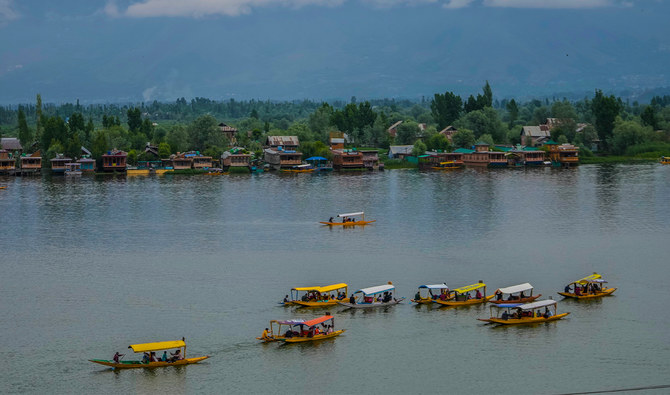
Tourists enjoy boat ride at Dal Lake in Srinagar, Indian controlled Kashmir, on May 18, 2023. (AP)
Short Url
Updated 22 May 2023
Follow

New Delhi hosts G20 tourism meet in Indian-administered Kashmir under heavy security 

  • The Muslim-majority Kashmir region has been disputed between New Delhi and Islamabad, both of which claim it in full
  • The Indian-controlled part has been roiled for decades by an insurgency seeking independence or merger with Pakistan 

Srinagar: A G20 tourism meeting was set to begin on Monday amid high security in Indian-administered Kashmir, with China and Pakistan condemning holding the event in the disputed territory. 

Muslim-majority Kashmir has been disputed between New Delhi and Islamabad, both of which claim it in full, since their independence 75 years ago. 

The Indian-controlled portion has been roiled for decades by an insurgency seeking independence or a merger with Pakistan, with tens of thousands of civilians, soldiers and Kashmiri rebels killed in the conflict. 

Police said last week that security had been beefed up "to avoid any chance of terrorist attack during the G20" meeting, the first diplomatic event in the territory since New Delhi revoked its limited autonomy and took direct control in 2019. 

The three-day gathering will take place at a sprawling, well-guarded venue on the shores of Dal Lake in Srinagar. 

Roads leading to the location have been freshly black-topped, and electricity poles lit up in the colours of India's national flag to show what officials say is "normalcy and peace returning" to the region. 

India has been promoting tourism in Kashmir and more than a million of its citizens visited last year. 

No Chinese delegates will be attending the event. 

India and its northern neighbour are locked in a military standoff along their mostly undemarcated border in the Ladakh region. 

Beijing also claims the Indian state of Arunachal Pradesh in full as part of Tibet, and it considers Kashmir a disputed territory. 

"China firmly opposes holding any form of G20 meeting in disputed territory and will not attend such meetings," foreign ministry spokesman Wang Wenbin told reporters Friday. 

Turkey, Saudi Arabia and Indonesia are reportedly also unlikely to join. 

India holds the G20 presidency for 2023 and has planned more than 100 meetings across the country. 

China has already stayed away from events in both Ladakh and Arunachal Pradesh. 

Non-G20 member Pakistan controls a smaller part of Kashmir and said holding the tourism meeting in the territory violated international law, UN Security Council resolutions and bilateral agreements. 

Pakistan's foreign minister Bilawal Bhutto Zardari said last week that India was displaying its "arrogance to the world" and that "it shows their pettiness", triggering a sharp retort from New Delhi. 

India accuses Pakistan of training and supporting militants in Kashmir, which Islamabad denies. 

Since India's 2019 constitutional changes, rebels in Kashmir have largely been crushed -- although young men continue to join the insurgency. 

But dissent has been criminalised, media freedoms curbed and public protests limited, in what critics say is a drastic curtailment of civil liberties by India. 

Last week, the UN Special Rapporteur on Minority Issues, Fernand de Varennes, said New Delhi was seeking to use the G20 meeting to "portray an international seal of approval" on a situation that "should be decried and condemned". India rejected those comments. 

Residents have chafed under the stepped-up security measures, hundreds have been detained in police stations and thousands including shopkeepers have received calls from officials warning them against any "signs of protest or trouble". 


Guatemalans enter state of siege over surge in gang violence

Updated 2 sec ago
Follow

Guatemalans enter state of siege over surge in gang violence

GUATEMALA CITY: Streets were half-empty Monday in the capital city of Guatemala, where outrage and fear lingered during the first day of the 30-day state of emergency decreed by the government in response to the murder of nine police officers and riots in several prisons.
On Sunday, suspected members of the notorious Barrio 18 gang carried out a wave of attacks on the police after security forces put down a prison mutiny.
Eight officers were killed on Sunday and a ninth died of his injuries on Monday.
President Bernardo Arevalo declared a 30-day emergency on Sunday over the violence, which caused deep shock among Guatemalans.
On Monday, he presided over a memorial ceremony for the slain police officers at the interior ministry.
The streets of the capital Guatemala City were semi-deserted and private schools, courts and universities remained shuttered.
Sitting on a bench in the historic center of Guatemala City, an octogenarian told AFP that he believed the only way to stamp out criminal gangs was by “burning them.”
“A criminal caught, a criminal killed, because there’s no other way...It’s like a tree; if you don’t pull out the roots, it will sprout again,” the man, who gave only his last name, Espana, said.
He called for Guatemala’s government to emulate the iron-fisted policies of President Nayib Bukele of neighboring El Salvador.
Bukele has imprisoned tens of thousands of men without charge, as part of a war on gangs which has led to a sharp drop in El Salvador’s murder rate but caused an outcry over human rights abuses.
Alejandra Donis, a 30-year-old shopkeeper, also held Bukele up as an example of leadership.
“There was a point in El Salvador where it was scary to just go out, right? And now it’s a place that’s quite touristy; you can go there, and it feels peaceful,” she said.

- ‘The Wolf’ -

The unrest in Guatemala began when inmates at three prisons took 45 guards and a psychiatrist hostage on Saturday to demand gang leaders be transferred from a maximum-security prison to more lenient facilities.
On Sunday, the police and army stormed all three penitentiaries and restored control.
After the first prison raid, the interior ministry published a video on X showing officers handcuffing and leading away Barrio 18’s alleged leader in Guatemala, whom authorities identified as Aldo Dupie, alias “El Lobo” (The Wolf).
In response to the crackdown, gang members attacked police stations and patrols.
The coffins of the slain police officers were draped in Guatemalan blue-and-white flags at the interior ministry and flanked by colleagues in uniform, standing to attention.
Arevalo, dressed in a black suit, greeted the grieving relatives, hugging some.

- FBI help sought -

Barrio 18 and the rival gang Mara Salvatrucha (MS-13) are blamed for much of the drug trafficking and criminal violence that plague Central America.
Washington has declared both to be terrorist organizations.
Arevalo said the declared state of emergency would allow the police and army to act against organized crime, but soldiers remained in their barracks on Monday, awaiting orders.
Since mid-2025, gang members have staged several uprisings in Guatemalan prisons to demand their leaders be held in less restrictive conditions.
In October, 20 leaders of Barrio 18 escaped from prison.
Only six have been recaptured, while another was shot and killed.
The government at the time asked for the help of the FBI to track down the remaining escapees.
Across Latin America, gang members continue to run criminal enterprises, from drug trafficking rings to extortion rackets, from behind bars — often with the collusion of corrupt prison officials.