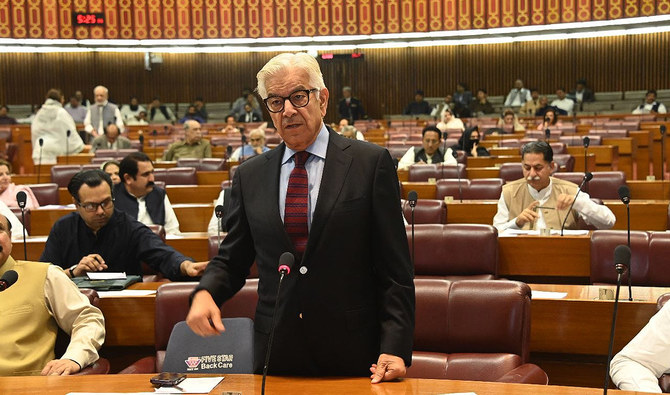

ISLAMABAD: Pakistan’s Defense Minister Khawaja Muhammad Asif said on Sunday that the government was not setting up “new” military courts to try supporters of former prime minister Imran Khan for attacking military installations on May 9.
Enraged Khan supporters attacked military installations and torched government buildings during nationwide protests on May 9 after the former prime minister was detained on corruption charges from the premises of an Islamabad court. Angered by the protests, the army to try protesters under relevant Pakistani laws, including the Pakistan Army Act.
The Pakistan Army Act of 1952 established military courts primarily to try members of the military or enemies of the state. Civilians accused of offenses such as waging war against the armed forces or law enforcement agencies, attacking military installations, or inciting mutiny, can be tried by military courts under a federal government order.
“No new military courts are being set up,” Asif said after addressing a public gathering in Pakistan’s Sialkot city. “The law is already there, the [military] courts are already there and they are functioning for the past 75 years.”
Military courts, run by military officers, have faced widespread criticism from within Pakistan and rights organizations globally because of their secretive nature and their existence alongside a functioning civilian legal system.
Asif said the government was not suppressing any citizen’s fundamental human rights.
“One has the right to appeal [the military court’s verdict] three times,” he said, adding that an accused can appeal against the verdict to the army chief, the high court, and the Supreme Court.
“We are protecting the fundamental rights that are provided by the law and the constitution,” Asif said. “But people whose faces are available, whose footage is available, whose identities are available, who can be seen attacking these [military] installations, cases against them will be heard by these [military] courts,” he added.
Asif vowed that the government would not use military courts or the law for “political aims.”
Khan, who enjoys substantial popularity across Pakistan, has increasingly attacked Pakistan’s military following his ouster from the prime minister’s office in a parliamentary vote. Khan alleges the former army chief, General Bajwa, orchestrated his ouster by colluding with his political opponents that now form the government.
Tensions between Khan and the military further increased when the former prime minister accused a senior military officer of orchestrating the attempt on his life last year and for having a hand in prominent anchor Arshad Sharif’s alleged assassination in Kenya.
The military has denied Khan’s accusations and warned him from hurling accusations against its leadership without proof.