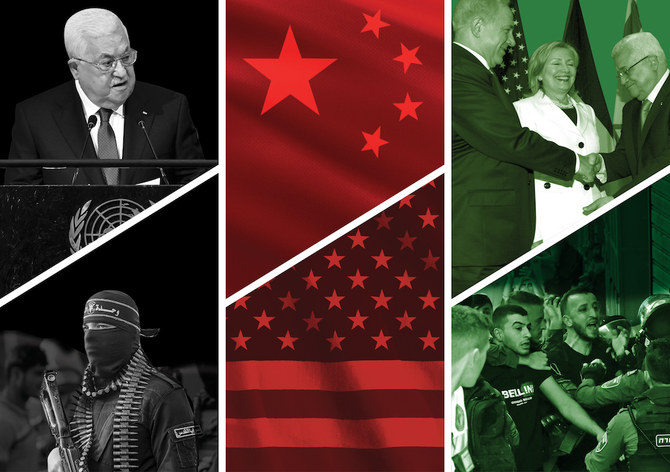
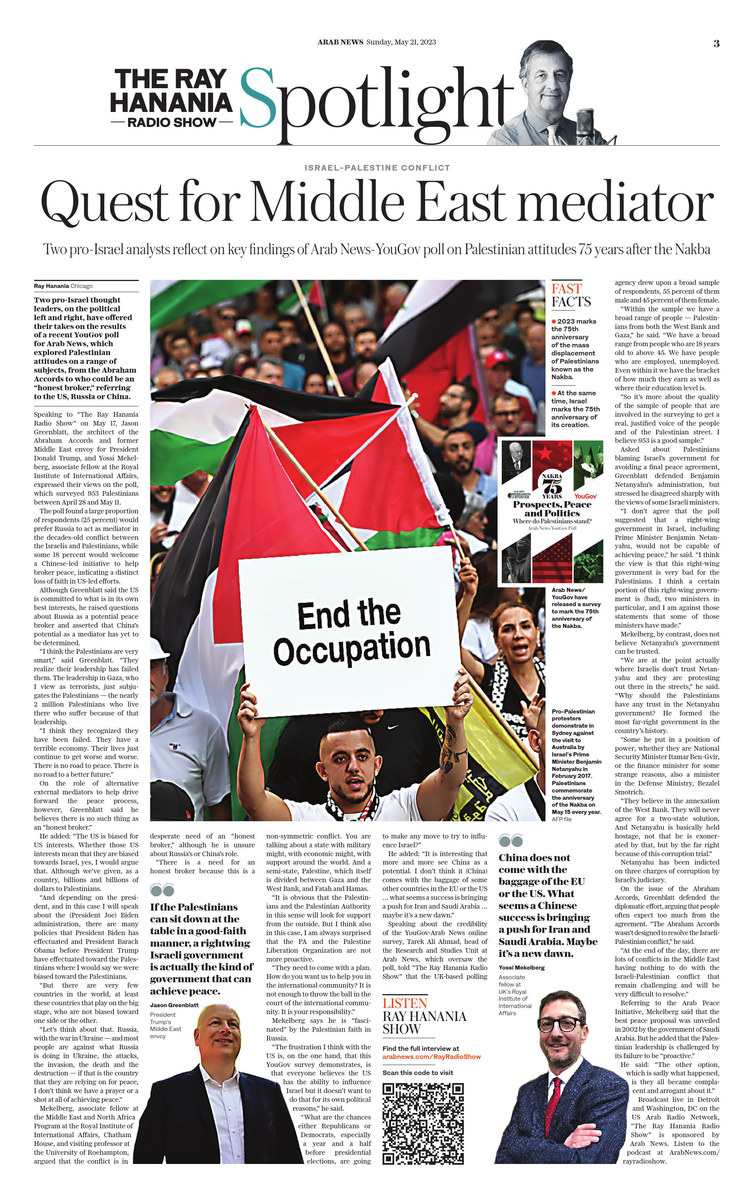
CHICAGO: Two pro-Israel thought leaders, on the political left and right, have offered their takes on the results of a recent YouGov poll for Arab News, which explored Palestinian attitudes on a range of subjects, from the Abraham Accords to who could be an “honest broker,” referring to the US, Russia or China.
Speaking to “The Ray Hanania Radio Show” on May 17, Jason Greenblatt, the architect of the Abraham Accords and former Middle East envoy for President Donald Trump, and Yossi Mekelberg, associate fellow at the Royal Institute of International Affairs, expressed their views on the poll, which surveyed 953 Palestinians between April 28 and May 11.
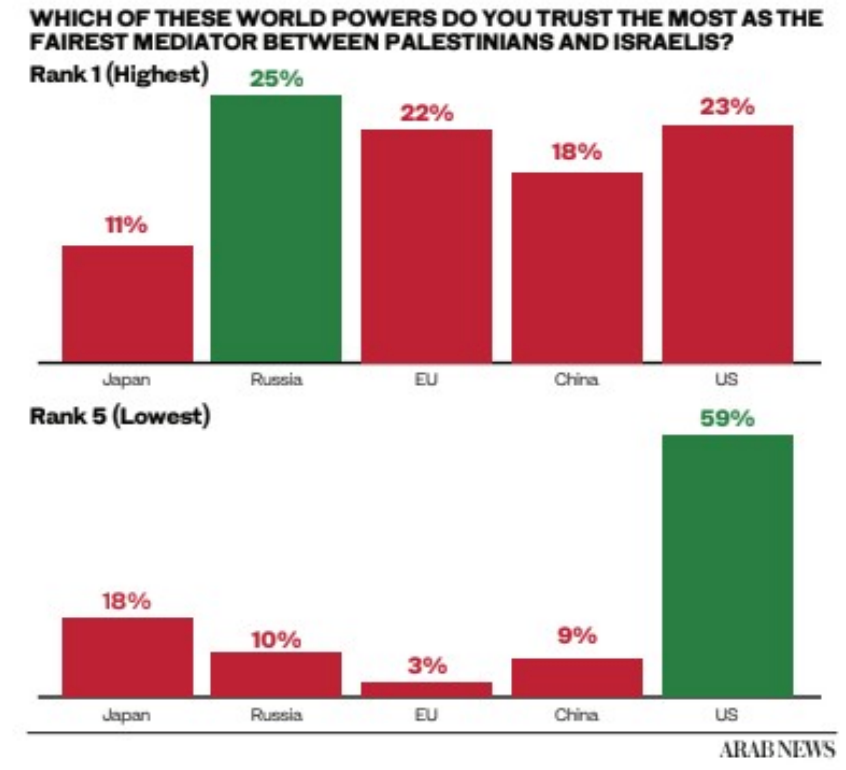
The poll found a large proportion of respondents (25 percent) would prefer Russia to act as mediator in the decades-old conflict between the Israelis and Palestinians, while some 18 percent would welcome a Chinese-led initiative to help broker peace, indicating a distinct loss of faith in US-led efforts.
Although Greenblatt said the US is committed to what is in its own best interests, he raised questions about Russia as a potential peace broker and asserted that China’s potential as a mediator has yet to be determined.
“I think the Palestinians are very smart,” said Greenblatt. “They realize their leadership has failed them. The leadership in Gaza, who I view as terrorists, just subjugates the Palestinians — the nearly 2 million Palestinians who live there who suffer because of that leadership.
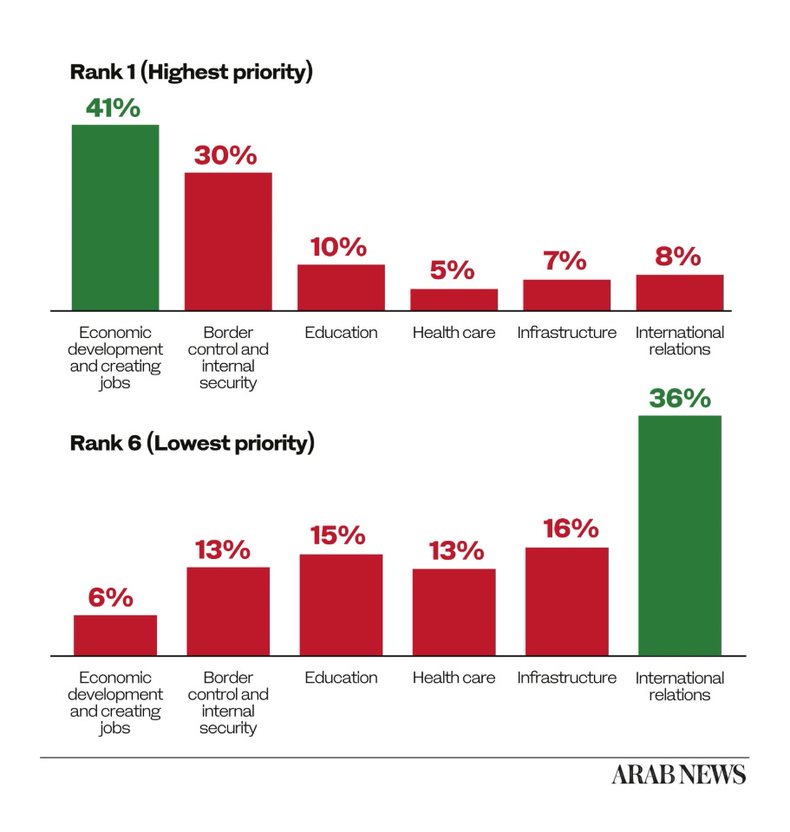
“I think they recognized they have been failed. They have a terrible economy. Their lives just continue to get worse and worse. There is no road to peace. There is no road to a better future.”
On the role of alternative external mediators to help drive forward the peace process, however, Greenblatt said he believes there is no such thing as an “honest broker.”
FASTFACTS
2023 marks the 75th anniversary of the mass displacement of Palestinians known as the Nakba.
At the same time, the State of Israel marks the 75th anniversary of its creation.
He added: “The US is biased for US interests. Whether those US interests mean that they are biased towards Israel, yes, I would argue that. Although we’ve given, as a country, billions and billions of dollars to Palestinians.
“And depending on the president, and in this case I will speak about the (President Joe) Biden administration, there are many policies that President Biden has effectuated and President Barack Obama before President Trump have effectuated toward the Palestinians where I would say we were biased toward the Palestinians.
“But there are very few countries in the world, at least these countries that play on the big stage, who are not biased toward one side or the other.
“But again, looking through the lens of that country’s side, I noticed in this YouGov poll that there was an interesting finding — that many Palestinians feel that Russia can play an outsized role in this, a good role.
“Let’s think about that. Russia, with the war in Ukraine — and most people are against what Russia is doing in Ukraine, the attacks, the invasion, the death and the destruction — if that is the country that they are relying on for peace, I don’t think we have a prayer or a shot at all of achieving peace.”
Mekelberg, associate fellow at the Middle East and North Africa Program at the Royal Institute of International Affairs, Chatham House, and visiting professor at the University of Roehampton, argued that the conflict is in desperate need of an “honest broker,” although he is unsure about Russia’s or China’s role.
“There is a need for an honest broker because this is a non-symmetric conflict. You are talking about a state with military might, with economic might, with support around the world. And a semi-state, Palestine, which itself is divided between Gaza and the West Bank, and Fatah and Hamas.
China does not come with the baggage of some other countries in the EU or the US. What seems a success is bringing a push for Iran and Saudi Arabia. Maybe it’s a new dawn
Yossi Mekelberg, Associate fellow at UK’s Royal Institute of International Affairs
“It is obvious that the Palestinians and the Palestinian Authority in this sense will look for support from the outside. But I think also in this case, I am always surprised that the PA and the Palestine Liberation Organization are not more proactive.
“They need to come with a plan. How do you want us to help you in the international community? It is not enough to throw the ball in the court of the international community. It is your responsibility.”
Mekelberg says he is “fascinated” by the Palestinian faith in Russia.
“The frustration I think with the US is, on the one hand, that this YouGov survey demonstrates, is that everyone believes the US has the ability to influence Israel but it doesn’t want to do that for its own political reasons,” he said.
“What are the chances either Republicans or Democrats, especially a year and a half before presidential elections, are going to make any move to try to influence Israel?”
He added: “It is interesting that more and more see China as a potential. I don’t think it (China) comes with the baggage of some other countries in the EU or the US … what seems a success is bringing a push for Iran and Saudi Arabia … maybe it’s a new dawn.”
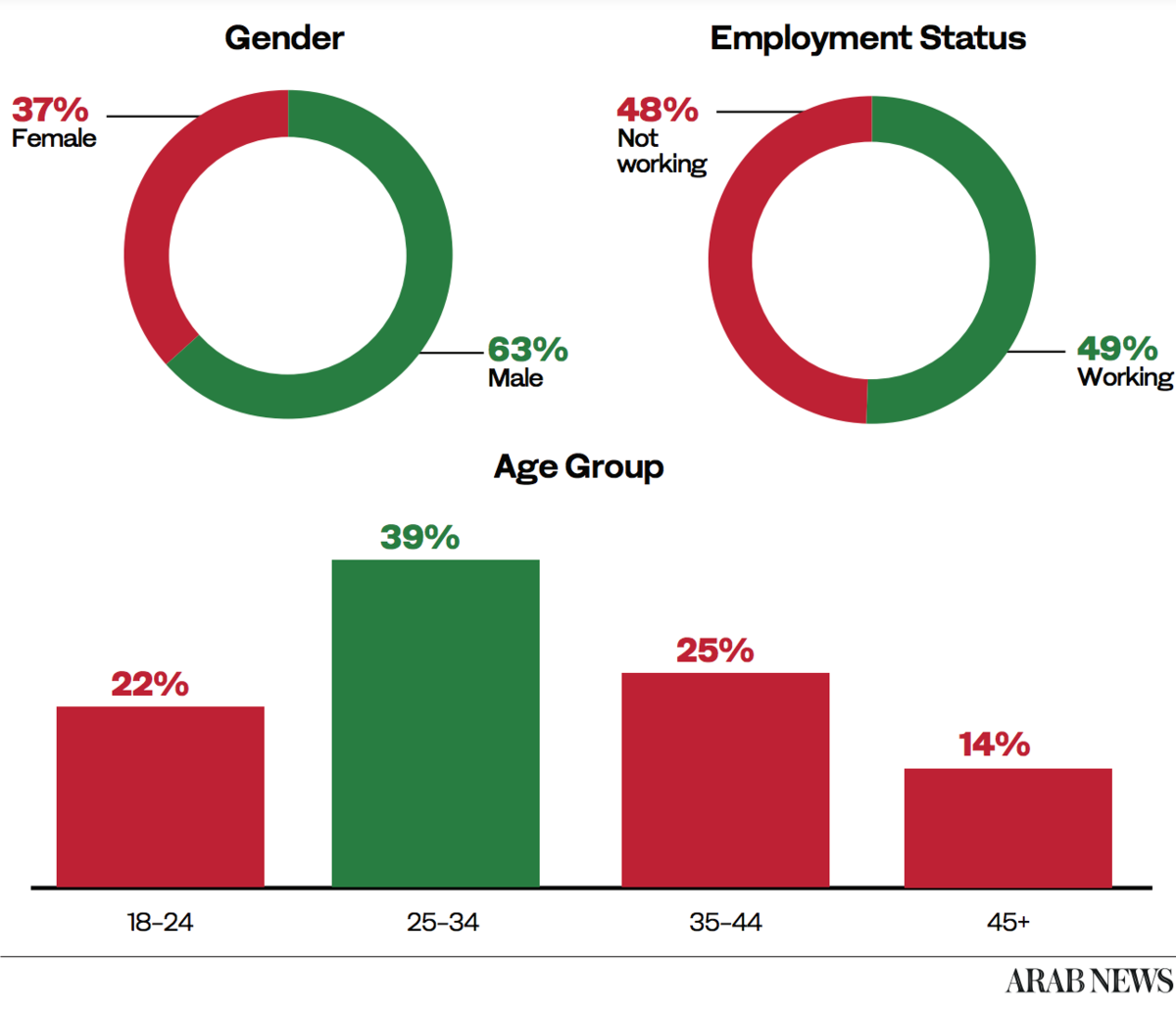
With regard to the credibility of the YouGov-Arab News online survey, Tarek Ali Ahmad, head of the Research and Studies Unit at Arab News, which oversaw the poll, told “The Ray Hanania Radio Show” that the UK-based polling agency drew upon a broad sample of respondents, 55 percent of them male and 45 percent of them female.
“Within the sample we have a broad range of people — Palestinians from both the West Bank and Gaza,” he said. “We have a broad range from people who are 18 years old to above 45. We have people who are employed, unemployed. Even within it we have the bracket of how much they earn as well as where their education level is.
“So it’s more about the quality of the sample of people that are involved in the surveying to get a real, justified voice of the people and of the Palestinian street. I believe 953 is a good sample.”
Asked about Palestinians blaming Israel’s government for avoiding a final peace agreement, Greenblatt defended Benjamin Netanyahu’s administration, but stressed he disagreed sharply with the views of some Israeli ministers.
If the Palestinians can sit down at the table in a meaningful, good faith manner, a right-wing Israeli government is actually the kind of government that can achieve peace.
Jason Greenblatt, President Trump’s Middle East envoy
“I don’t agree that the poll suggested that a right-wing government in Israel, including Prime Minister Benjamin Netanyahu, would not be capable of achieving peace,” he said.
“Netanyahu and I think alike in terms of the Israel-Palestinian conflict. But I would tell you that under the right circumstances with all of the right positions being discussed and negotiated, he is a man who could achieve peace. But it is not going to be the peace that the Palestinian leadership and so many others around the world have promised the Palestinians for over 70 years.
“If the Palestinians can understand that and sit down at the table in a meaningful, good faith manner, I think a right-wing government is actually the kind of government that can achieve peace.
“I do think the government is more right wing. There are certainly some ministers in the government who say things that shouldn’t be countenanced. I think that they say hateful things and I don’t agree with them.
“I think as a whole, the government is trying very hard under challenging circumstances even having nothing to do with the Palestinians. You have the judicial reform protests. You have all sorts of things going on in Israel. It is a challenging time.
“I think the view is that this right-wing government is very bad for the Palestinians. I think a certain portion of this right-wing government is (bad), two ministers in particular, and I am against those statements that some of those ministers have made.
“And I don’t think that people should be focusing on it because I don’t think that is what the Netanyahu government as a whole thinks.”
Mekelberg, by contrast, does not believe Netanyahu’s government can be trusted.
“We are at the point actually where Israelis don’t trust Netanyahu and they are protesting out there in the streets,” he said. “Why should the Palestinians have any trust in the Netanyahu government? He formed the most far-right government in the country’s history.
“Some he put in a position of power, whether they are National Security Minister Itamar Ben-Gvir, or the finance minister for some strange reasons; also a minister in the Defense Ministry, Bezalel Smotrich.
“They believe in the annexation of the West Bank. They will never agree for a two-state solution. And Netanyahu is basically held hostage, not that he is exonerated by that, but by the far right because of this corruption trial.”
Netanyahu has been indicted on three charges of corruption by Israel’s judiciary.
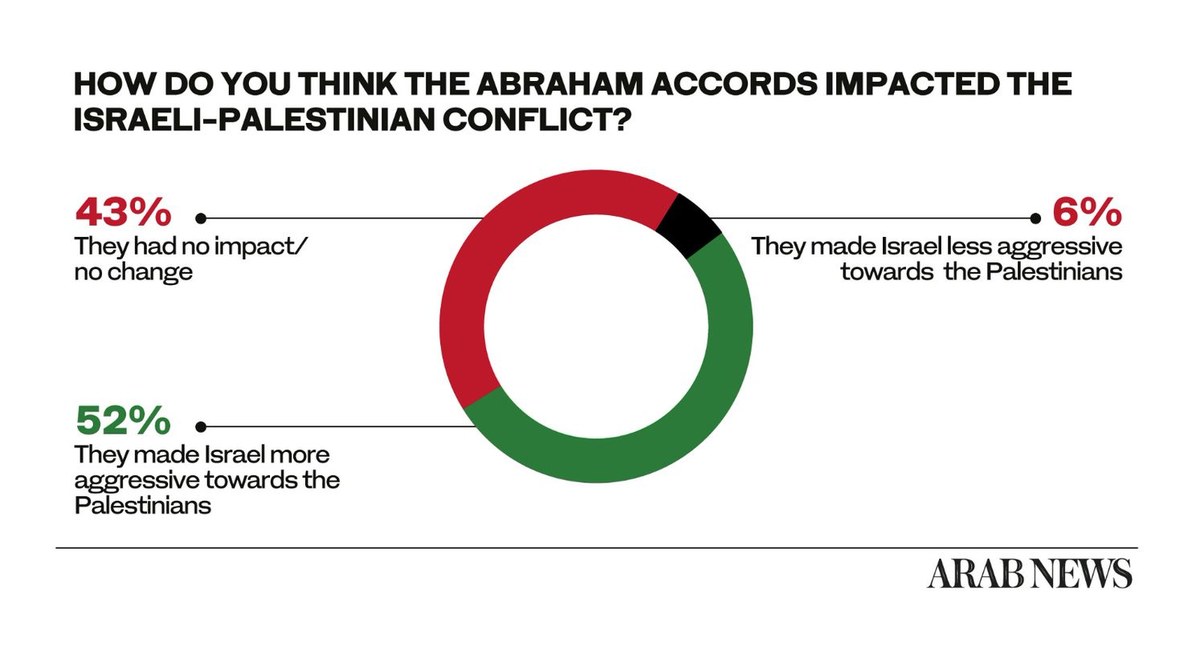
On the issue of the Abraham Accords, Greenblatt defended the diplomatic effort, arguing that people often expect too much from the agreement. “The Abraham Accords wasn’t designed to resolve the Israeli-Palestinian conflict,” he said.
“It wasn’t designed to resolve what is the terrible tragic civil war in Syria. It wasn’t designed to resolve the terrible situation in Lebanon. Lebanon is essentially occupied by the Iranian regime and the beautiful country of Lebanon is left with almost nothing. It wasn’t designed to resolve Yemen. I think people put more weight and responsibility on the Abraham Accords than is appropriate.
“It did bring down some tension. It can bring (down) more tension. But at the end of the day, there are lots of conflicts in the Middle East having nothing to do with the Israeli-Palestinian conflict that remain challenging and will be very difficult to resolve.”
Referring to the Arab Peace Initiative, Mekelberg said that the best peace proposal was unveiled in 2002 by the government of Saudi Arabia. But he added that the Palestinian leadership is challenged by its failure to be “proactive.”
He said: “The other option, which is sadly what happened, is they all became complacent and arrogant about it.”
“Why do we (Israelis) need to actually make any progress on the Palestinian issue? There is no rush. That is what we see today ... I think the Palestinians need to be proactive. They can’t wait for the world to solve it because the world is moving in the other direction.”
Indeed, in Mekelberg’s view, the “constitutional crisis” in Israel has pushed the Palestinian issue “to the sidelines.”
Broadcast live in Detroit and Washington D.C. on the US Arab Radio Network, “The Ray Hanania Radio Show” is sponsored by Arab News. Listen to the podcast at ArabNews.com/rayradioshow.