

Three soldiers killed in attack on security check-post in Pakistan’s Balochistan 

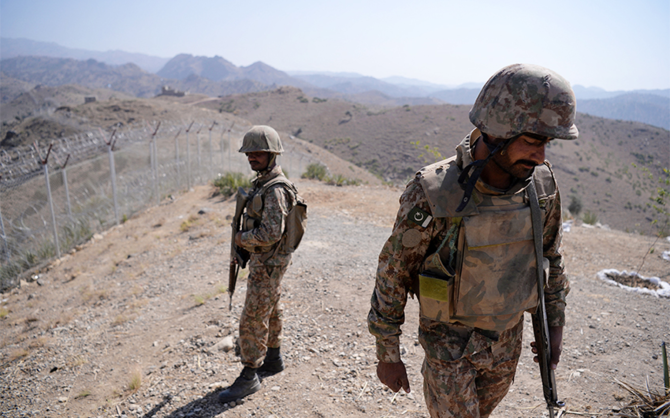
Pakistani soldiers patrol next to a newly fenced border fencing along Afghan border at Kitton Orchard Post in northwest Pakistan on October 18, 2017. (AFP/File)
Short Url
Updated 20 May 2023
Follow

Three soldiers killed in attack on security check-post in Pakistan’s Balochistan 

  • Security forces have identified a militant hideout in the nearby mountains, launched an operation 
  • On Friday, a suicide attack targeted a political leader and a cop was shot dead in the same province 

ISLAMABAD: Three soldiers were killed in an attack on a security forces’ check-post in southwest Pakistan, the Pakistani military said on Saturday, the latest in a string of attacks in the Balochistan province. 

The militants targeted the check-post in Marget area of the province early Saturday morning, according to the Inter-Services Public Relations (ISPR), the military’s media wing. 

The post had recently been established to help check extortion attempts targeting coal mines in the vicinity. 

“Troops on the post retaliated readily to the fire raid thereby, pushing back the terrorists. However, in the ensuing heavy exchange of fire three soldiers embraced shahadat (martyrdom),” the ISPR said in a statement. 

The exchange of fire left one militant dead, it added. 

Security forces have identified the militants’ hideout in nearby mountains in the rugged area and launched a sanitization operation in the vicinity, according to the statement. 

“Currently, the operation is progressing well and security forces are maintaining pressure to deny terrorists escape from the area,” the ISPR added. 

The attack came a day suicide attack on top leader of a prominent Pakistani religious party, Jamaat-e-Islami (JI), in Balochistan’s Zhob district. JI chief Sirajul Haq survived the attack, though at least seven people were injured in the explosion, a JI member confirmed on Friday. 

Also on Friday, a policeman guarding a team of anti-polio vaccinators was gunned down in the same province. 

No group has so far claimed responsibility for the recent attacks in Balochistan, Pakistan’s largest province in terms of area, which has long been the site of a low-level insurgency by separatist groups who seek independence from the central government in Islamabad. 

The separatists say they are fighting what they see as unfair exploitation of the province’s wealth by the federation. The Pakistani state denies it. 

Earlier this month, six soldiers and a civilian were killed in a militant attack on a paramilitary compound in Balochistan. 

Pakistan forces retook the Frontier Corps (FC) paramilitary camp in Muslim Bagh area of Balochistan, killing six assailants and rescuing three families taken hostage at a residential block after more than 24 hours. 


Curfew extended in Gilgit-Baltistan, probe ordered after deadly Khamenei protests

Updated 03 March 2026
Follow

Curfew extended in Gilgit-Baltistan, probe ordered after deadly Khamenei protests

  • At least 15 people were killed in clashes with law enforcement agencies over the weekend in Gilgit-Baltistan
  • Government also announces a de-weaponization campaign, crackdown on hate speech and cybercrime in region

ISLAMABAD: The government in Pakistan’s Gilgit-Baltistan (GB) region on Tuesday extended a curfew in Gilgit district and ordered a judicial probe into violent protests over the killing of Iranian Supreme Leader Ali Khamenei in US-Israeli strikes last week, an official said.

At least 15 people were killed in clashes with law enforcement agencies over the weekend in GB, where protesters torched and vandalized several buildings, including United Nations regional offices, an army-run school, software technology park and a local charity building.

The violence prompted regional authorities to impose curfew in Gilgit and Skardu districts on March 2-4 as officials urged people to stay indoors and cooperate with law enforcers, amid widespread anger in Pakistan, particularly among members of the Shiite minority, over Khamenei’s killing.

On Tuesday, the GB government convened to review the situation and announced the extension of curfew in Gilgit among a number of security measures as well as ordered the establishment of a judicial commission to investigate the weekend violence in the region.

“The government has made it clear that the law will strictly take its course against elements involved in vandalism at government institutions, private properties and incidents of vandalism in Gilgit and Skardu and no kind of mischief will be tolerated,” Shabbir Mir, a GB government spokesperson, said in a statement.

“In view of the security situation, curfew will remain in force in Gilgit, while the decision to extend the curfew in Skardu will be taken keeping the ground realities and the changing situation in view.”

The statement did not specify how long the curfew will remain in place in Gilgit.

Besides the formation of the judicial commission to investigate the violent clashes, the government also decided to launch a large-scale de-weaponization campaign in the entire Gilgit district, for which relevant institutions have been directed to immediately complete all necessary arrangements, according to Mir.

In addition, a crackdown has been ordered on hate speech, spread of fake news and cybercrime.

“The aim of these decisions is to ensure the rule of law, protect the lives and property of citizens and crack down on miscreants,” he said. “Approval has also been given to immediately survey the affected infrastructure and start their restoration work on priority basis.”

Demonstrators in Pakistan’s southern port city of Karachi also stormed the US Consulate on Sunday, smashing windows and attempting to burn the building. Police responded with batons, tear gas, and gunfire, leaving 10 people dead and more than 50 injured.

Pakistani authorities have since beefed up security at US diplomatic missions across the country, including around the US consulate building in Peshawar, to avoid any further violence.