

Army expected to launch military courts in two weeks to try rioters — Pakistan special prosecutor

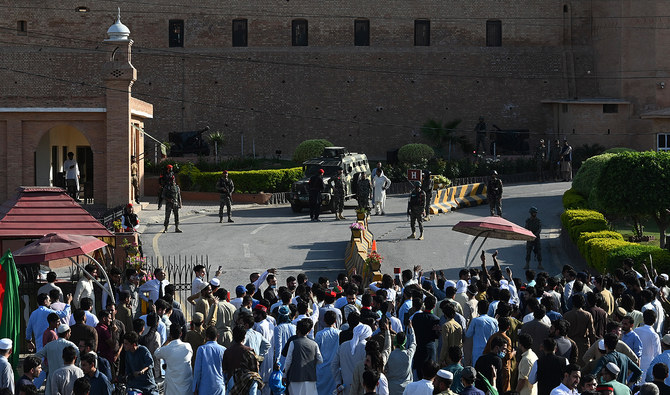
Pakistan Tehreek-e-Insaf (PTI) party activists and supporters of former Pakistan's Prime Minister Imran gather outside headquarters of the frontier corps during a protest against the arrest of their leader, in Peshawar on May 9, 2023. (Photo courtesy: AFP)
Short Url
Updated 19 May 2023
Follow

Army expected to launch military courts in two weeks to try rioters — Pakistan special prosecutor

  •  Amy has said those found involved in violence following ex-PM Khan’s arrest last week would be tried under Pakistan Army Act
  • Legal experts and rights groups say military courts deprive civilians of basic rights, including contracting lawyer of choice

ISLAMABAD: A special prosecutor of the Pakistan federal government said on Friday the army was “expected” to constitute military courts within two weeks to try suspects accused of attacking army installations during countrywide protests in the wake of the arrest of former Prime Minister Imran Khan last week.

The detention of Khan in a land fraud case on May 9 was met by days-long violent protests by his supporters, who torched cars and buildings, including military installations. Hundreds were arrested in the aftermath, with the army announcing that those found involved in the violence would be tried under relevant Pakistani laws, including the Pakistan Army Act.

The Pakistan Army Act of 1952 established military courts primarily to try members of the military or enemies of the state. Civilians accused of offenses such as waging war against the armed forces or law enforcement agencies, or attacking military installations or inciting mutiny, can be tried by military courts under a federal government order.

The army did not respond to calls and messages seeking comment for this story.

“Pakistan army is expected to constitute military courts under the army act in two weeks to try those involved in the riots,” Special Prosecutor Raja Rizwan Abbasi told Arab News on Friday, defending the trial of civilians by military courts under the Army and Official Secrets Acts.

“It is quite legal and lawful to institute the process,” the government lawyer said.

The Official Secrets Act prohibited attacks on, and the infringement and trespassing of, military installations, with those found guilt liable to be tried under the Army Act, Abbasi explained.

“Once the [military] courts are formed, the accused would have a fair chance to defend themselves to prove their innocence,” he said, adding that those convicted by military courts could appeal the judgment in an appeal court within the army, and subsequently also file “a writ petition in a high court after their mercy plea was rejected by the army chief.”

“If a convict thinks there was any malafide in the trial in military courts, he may file a writ petition in a high court,” Abbasi added.

He said the army would not need parliamentary or cabinet approval to form military courts as it was already empowered to do so under the Army Act.

“The army act empowers the military to constitute the courts and try civilians involved in abetment, planning and attacks on its installations,” he added.

Military courts operate under a separate system from the civilian legal system and are run by military officers. The judges are also military personnel and cases are tried at military installations. Trials are closed to outsiders, and no media presence is allowed.

The courts have faced widespread criticism from within Pakistan and rights organizations globally because of their secretive nature and their existence alongside a functioning civilian legal system.

“It is alarming to note that the Pakistani Army has stated its intention to try civilians under military laws, possibly in military courts. Trying civilians in military courts is contrary to international law,” Dinushika Dissanayake, Deputy Regional Director for South Asia at Amnesty International, said this week.

“This is purely an intimidation tactic, designed to crack down on dissent by exercising fear of an institution that has never been held to account for its overreach.”

The army has said in the past trials held at military courts are fair and guarantee human and legal rights.


Australia says father and son carried out Sydney beach attack as Pakistan condemns violence

Updated 5 sec ago
Follow

Australia says father and son carried out Sydney beach attack as Pakistan condemns violence

  • Australian authorities say at least 15 people were killed in the shooting, including a 10-year-old girl
  • Pakistan says it stands in solidarity with Australia, condemns terrorism in all forms and manifestations

ISLAMABAD: Australian authorities said on Monday a father and son carried out a mass shooting at Sydney’s Bondi Beach during a Jewish festival, as Pakistan expressed solidarity with Australia and condemned the attack that claimed at least 15 lives.

Police said the 50-year-old father was shot dead at the scene while his 24-year-old son was wounded and taken into custody after the gunmen opened fire on crowds gathered for a Hanukkah celebration at the popular beach.

“We want to get to the bottom of this,” New South Wales police commissioner Mal Lanyon said on Monday. “We want to understand the motives behind it.”

A 10-year-old girl was among the 15 dead in Australia’s worst mass shooting for almost 30 years, while 42 more were rushed to hospital with gunshot wounds and other injuries.

Pakistan’s government said it stood with Australia following the shooting, reiterating its opposition to such incidents amid renewed militant violence at home.

Prime Minister Shehbaz Sharif expressed condolences to the victims and said Pakistan condemned “terrorism in all its forms and manifestations.”

President Asif Ali Zardari also conveyed sympathy to the victims’ families and wished the injured a speedy recovery.

“Pakistan itself a victim of terrorism, stands in solidarity with & condemns violence against innocent civilians,” he said.

Pakistan has faced a resurgence in militant attacks in recent months, particularly in its northwest. On Sunday, Sharif praised security forces after they killed 13 militants in two separate operations in the Mohmand and Bannu districts, according to a statement from his office.

Australian police said the attackers fired from a raised boardwalk overlooking the beach, sending people fleeing in panic. Authorities later discovered what they described as an improvised explosive device in a vehicle parked near the scene, which they believe was linked to the attackers.

Prime Minister Anthony Albanese said tougher gun controls may be needed, including limits on the number of firearms an individual can own, after police confirmed the father held licenses for six weapons believed to have been used in the attack.

Mass shootings have been rare in Australia since sweeping gun law reforms were introduced after the 1996 Port Arthur massacre, but Albanese said the latest attack required authorities to reassess whether existing controls remained sufficient.

With input from AFP