


LAHORE: Former Pakistan Prime Minister Imran Khan says he has had “no dialogue” with Pakistan’s military since his campaign of defiance against the nation’s powerful generals boiled over into deadly unrest last week.
The opposition leader’s comments in an interview with AFP underscore the full-scale breakdown of relations between the country’s most popular politician and the army, which directly ruled Pakistan for more than three decades and remains hugely powerful behind the scenes.
“The current army chief clearly has some problems with me,” Khan said inside his Lahore home late Thursday. “I don’t know what will happen in the future, but right now there’s no dialogue.”
Hours after repeating accusations that a top intelligence officer was involved in a November attempt on his life, 70-year-old Khan was last week swarmed by paramilitary troops and arrested on graft charges.
Days of civil unrest followed — with government buildings set alight, military installations damaged and at least nine people killed — before the Supreme Court declared the arrest illegal.
The former cricket star said the government led by Prime Minister Shehbaz Sharif is “scared” to face his Pakistan Tehreek-e-Insaf (PTI) party in general elections due no later than October.
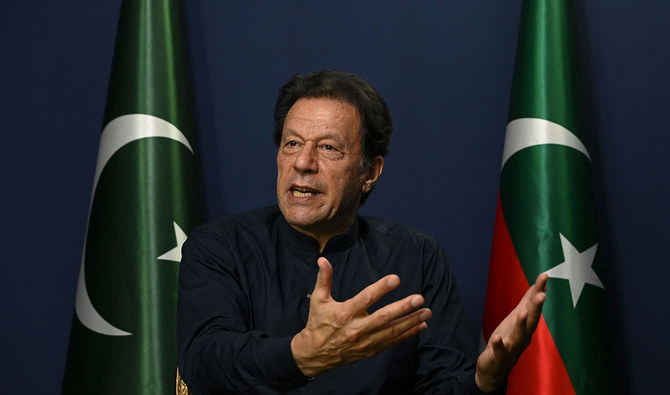
“Our party has been facing a crackdown really for one year,” said Khan, seeming tired but resolved, sitting between the twin draped flags of Pakistan and PTI. “I was removed from power through this conspiracy by the ex-army chief.”
Military support has historically been a cornerstone of stable governments in Islamabad, although the institution denies involvement in politics.
The growing chasm between Khan and the generals complicates his campaign to return to office and pits his legions of followers against the men in control of the world’s sixth-largest army.
Khan said last week’s violence was a “conspiracy” staged to justify repression of his PTI party.
More than 7,000 people were detained as the unrest broke out and at least 19 senior PTI officials were arrested, according to the party, some in overnight raids on their homes, accused of instigating violence.
“This terrorism and mobbing was all pre-planned and this was done by Khan,” Interior Minister Rana Sanaullah said last week.
Islamabad has pledged to try those accused of violence against army installations in military courts.
But Khan said there were “outside elements that were planted inside” his protest movement, designed to discredit it.
“There were elements who deliberately incited violence, they were not part of a party,” he said. “This pretext was used to crack down on a party.”
Since Khan’s release last Friday, PTI officials have continued to face arrest while some high-level party leaders have resigned under the onslaught of pressure from authorities.
“As we speak, they’re picking up more people and putting them in jail,” Khan said.
He has faced a series of further court appearances, some relating to the unrest, which his party dismisses as more political hurdles designed to keep him from power.
Khan claims the popular momentum of his party will prevail — setting the stage for more escalation between the government and the military on one side, and his movement on the other.
“Political parties cannot be destroyed by banning, by disqualifying,” he said. “Once people are with you, you are not dependent on candidates or names.”
“If anything, what will keep this country together is my party,” he said.
Khan came to power in 2018 with the backing of the military and was ousted via a parliamentary no-confidence vote last April after he fell out with the top brass over appointments and foreign policy, analysts say.
The shaky coalition which replaced him has struggled with a critical economic downturn and a worsening security situation, as charismatic Khan’s favor has improved.
“To everyone’s surprise, and I must say to my surprise, the party sort of just started getting more and more popular,” Khan said.
His campaign for a second innings has featured various claims that there are conspiracies to keep him from power.
Key among them has been the alleged role of the army, which has never been confronted so directly by a mainstream politician after being ousted.
In November, Khan was shot in the leg as he campaigned for snap polls.
His most explosive claim — repeated just hours before his arrest last week — was that the attack was planned by Sharif and top intelligence officer Major General Faisal Naseer.
Despite the rhetoric, Khan says he is open to negotiations.
“Believe me, there is no issue from my side,” he said. “The fact is, no one wants to fight with your own army.”


