YANGON: The death toll from Cyclone Mocha has reached 145 in Myanmar, its junta said Friday, with most of the dead from the persecuted Rohingya minority.
Mocha brought lashing rain and winds of 195 kilometers per hour (120 miles per hour) to Myanmar and neighboring Bangladesh on Sunday, collapsing buildings and turning streets into rivers.
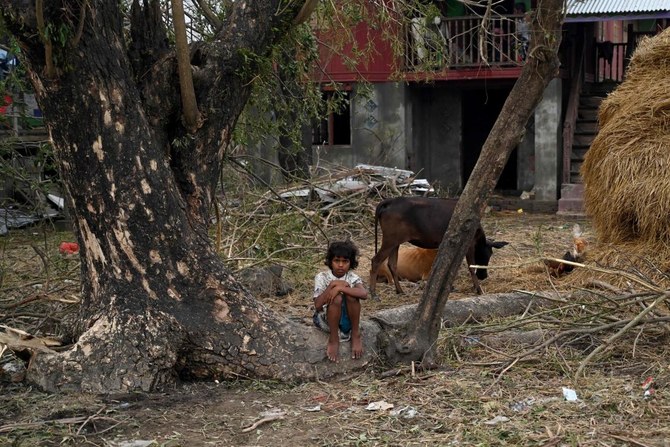
The storm churned up villages, uprooted trees and knocked out communications across much of Myanmar’s Rakhine state.
The region is home to hundreds of thousands of Rohingya refugees who live in displacement camps following decades of ethnic conflict.
“Altogether 145 local people were killed during the cyclone,” a statement from Myanmar’s junta authorities said.
The number included four soldiers, 24 locals and 117 “Bengalis,” it added, using a pejorative term for the Rohingya.
Widely viewed as interlopers from Bangladesh, Rohingya are denied citizenship and access to health care in Myanmar, and require permission to travel outside of their townships.
A Rohingya village leader previously said that more than 100 people were missing from his village alone following the storm.
Another leader based near the Rakhine state capital of Sittwe said that at least 105 Rohingya had died around the city, with counting still ongoing.
Media reports that 400 Rohingya had died were “not true,” the junta’s statement said, adding that action would be taken against the outlets that published the figure.
The junta has arrested scores of journalists and closed outlets deemed critical of its rule since the military staged a coup that ousted an elected government more than two years ago.
Junta-backed media reported Friday that naval ships and the air force had brought in thousands of bags of rice, while thousands of electricians, firefighters and rescue workers had been deployed across Rakhine.
Normal flight service had resumed at Sittwe airport on Thursday, according to newspaper the Global New Light of Myanmar.
Some international aid groups, including the United Nations World Food Programme, were working on the ground in Sittwe this week, AFP correspondents said.
A junta spokesman did not respond to questions on whether UN agencies would be granted access to displacement camps outside Sittwe that house Rohingya.
“Offers from the international community for providing aid have been accepted,” state media said Tuesday.
“But relief and rehabilitation tasks must be done through existing united strength,” said the Global New Light of Myanmar.
A military crackdown in Myanmar in 2017 sent hundreds of thousands of Rohingya fleeing into neighboring Bangladesh, with harrowing stories emerging of murder, rape and arson.
Junta chief Min Aung Hlaing — who was head of the army during the crackdown — has dismissed the term Rohingya as “imaginary.”
In neighboring Bangladesh, officials said that no one had died in the cyclone, which passed close to sprawling refugee camps that now house almost one million Rohingya.
Cyclones — the equivalent of hurricanes in the North Atlantic or typhoons in the Northwest Pacific — are a regular and deadly menace on the coast of the northern Indian Ocean where tens of millions of people live.
Cyclone Nargis devastated Myanmar’s Irrawaddy Delta in 2008, killing at least 138,000 people.
A previous junta regime faced international criticism for its response to that disaster. It was accused of blocking emergency aid and initially refusing to grant access to humanitarian workers and supplies.


![]()


Cyclone Mocha death toll reaches 145 in Myanmar
Short Url
https://arab.news/vqz3n
Cyclone Mocha death toll reaches 145 in Myanmar
- Mocha brought lashing rain and winds of 195kph to Myanmar and neighboring Bangladesh on Sunday
- Storm churned up villages, uprooted trees and knocked out communications across much of Myanmar’s Rakhine state


Autopsy finds Cuban immigrant in ICE custody died of homicide due to asphyxia
- Witness: Lunas Campos was handcuffed as at least five guards held him down and one put an arm around his neck and squeezed until he was unconscious
- The US Immigration and Customs Enforcement said Diaz was detained by ICE earlier this month during the immigration crackdown in Minneapolis
WASHINGTON: A Cuban migrant held in solitary confinement at an immigration detention facility in Texas died after guards held him down and he stopped breathing, according to an autopsy report released Wednesday that ruled the death a homicide.
Geraldo Lunas Campos died Jan. 3 following an altercation with guards. US Immigration and Customs Enforcement said the 55-year-old father of four was attempting suicide and the staff tried to save him.
But a witness said last week that Lunas Campos was handcuffed as at least five guards held him down and one put an arm around his neck and squeezed until he was unconscious.
His death was one of at least three reported in little more than a month at Camp East Montana, a sprawling tent facility in the desert on the grounds of Fort Bliss, an Army base.
The autopsy report by the El Paso County Medical Examiner’s Office found Lunas Campos’ body showed signs of a struggle, including abrasions on his chest and knees. He also had hemorrhages on his neck. The deputy medical examiner, Dr. Adam Gonzalez. determined the cause of death was asphyxia due to neck and torso compression.
The report said witnesses saw Lunas Campos “become unresponsive while being physically restrained by law enforcement.” It did not elaborate on what happened during the struggle but cited evidence of injuries to his neck, head and torso associated with physical restraint. The report also noted the presence of petechial hemorrhages — tiny blood spots from burst capillaries that can be associated with intense strain or injury — in the eyelids and skin of the neck.
Dr. Victor Weedn, a forensic pathologist who reviewed the autopsy report for AP, said the presence of petechiae in the eyes support the conclusion that asphyxia caused the death. Those injuries suggest pressure on the body and are often associated with such deaths, he said.
He said the contusions on Lunas Campos’ body may reflect physical restraint and the neck injuries were consistent with a hand or knee on the neck.
The autopsy also found the presence of prescription antidepressant and antihistamine medications, adding that Lunas Campos had a history of bipolar disorder and anxiety. It made no mention of him attempting suicide.
Government provided changing accounts of what happened
ICE’s initial account of the death, which included no mention of an altercation with guards, said Lunas Campos had become disruptive and staff moved him into a cellblock where detainees are held away from others.
“While in segregation, staff observed him in distress and contacted on-site medical personnel for assistance,” the agency said in its Jan. 9 statement. “Medical staff responded, initiated lifesaving measures, and requested emergency medical services.”
Lunas Campos was pronounced dead after paramedics arrived.
Last Thursday, after Lunas Campos’ family was first informed the death was likely to be ruled a homicide, Department of Homeland Security spokesperson Tricia McLaughlin amended the government’s account, saying he had attempted suicide and guards tried to help him.
“Campos violently resisted the security staff and continued to attempt to take his life,” she said. “During the ensuing struggle, Campos stopped breathing and lost consciousness.”
After the final autopsy report was released Wednesday, McLaughlin issued a statement emphasizing that Lunas Campos was “a criminal illegal alien and convicted child sex predator.”
New York court records show Lunas Campos was convicted in 2003 of sexual contact with a person under 11, a felony for which he was sentenced to one year in jail and placed on the state’s sex offender registry. Lunas Campos was also sentenced to five years in prison and three years of supervision in 2009 after being convicted of attempting to sell a controlled substance, according to the New York corrections records. He completed the sentence in January 2017.
“ICE takes seriously the health and safety of all those detained in our custody,” McLaughlin said Wednesday, adding that the agency was investigating the death. DHS has not responded to questions about whether any outside law enforcement agency was also investigating.
Deaths put a spotlight on Camp East Montana
The AP reported in August that the $1.2 billion contract to build and operate Camp East Montana, expected to become the largest detention facility in the US, was awarded to a private contractor headquartered in a single-family home in Richmond, Virginia. The company, Acquisition Logistics LLC, had no prior experience running a corrections facility and has subcontracted with other companies to help operate the camp.
It was not immediately clear whether the guards present when Lunas Campos died were government employees or those of a private contractor.
A final determination of homicide by the medical examiner would typically be critical in determining whether any guards are held criminally or civilly liable. The fact that Lunas Campos died on an Army base could limit state and local officials’ legal jurisdiction to investigate.
Lunas Campos was among the first detainees sent to Camp Montana East, arriving in September after ICE arrested him in Rochester, New York, where he lived for more than two decades. He was legally admitted to the US in 1996, part of a wave of Cuban immigrants seeking to reach Florida by boat.
ICE said he was picked up in July as part of a planned immigration enforcement operation due to criminal convictions that made him eligible for removal.
In addition to Lunas Campos, ICE announced that on Dec. 3 an immigrant from Guatemala held in Camp East Montana died after being transferred to a El Paso hospital for care. While the cause of death was still pending, the agency said Francisco Gaspar-Andres, 48, was suspected to have died of liver and kidney failure.
On Sunday, ICE announced that Victor Manuel Diaz, a 36-year-old immigrant from Nicaragua, died at Camp East Montana on Jan. 14 of a “presumed suicide.” The agency said Diaz was detained by ICE earlier this month during the immigration crackdown in Minneapolis.
Unlike with the two prior deaths, Diaz’s body wasn’t sent to the county medical examiner in El Paso. McLaughlin said Wednesday that the autopsy for Diaz is being performed at the Army medical center at Fort Bliss. DHS again did not respond to questions about whether any agency other than ICE will investigate the death.
Rep. Veronica Escobar, a Democrat whose district includes El Paso, called on DHS Secretary Kristi Noem and acting ICE Director Todd M. Lyons to brief Congress about the recent deaths.
“DHS must preserve all evidence — including halting their effort to deport the witnesses,” Escobar said Wednesday. “I reiterate my call for Camp East Montana to be shut down and for the contract with the corporation running it to be terminated.”
Geraldo Lunas Campos died Jan. 3 following an altercation with guards. US Immigration and Customs Enforcement said the 55-year-old father of four was attempting suicide and the staff tried to save him.
But a witness said last week that Lunas Campos was handcuffed as at least five guards held him down and one put an arm around his neck and squeezed until he was unconscious.
His death was one of at least three reported in little more than a month at Camp East Montana, a sprawling tent facility in the desert on the grounds of Fort Bliss, an Army base.
The autopsy report by the El Paso County Medical Examiner’s Office found Lunas Campos’ body showed signs of a struggle, including abrasions on his chest and knees. He also had hemorrhages on his neck. The deputy medical examiner, Dr. Adam Gonzalez. determined the cause of death was asphyxia due to neck and torso compression.
The report said witnesses saw Lunas Campos “become unresponsive while being physically restrained by law enforcement.” It did not elaborate on what happened during the struggle but cited evidence of injuries to his neck, head and torso associated with physical restraint. The report also noted the presence of petechial hemorrhages — tiny blood spots from burst capillaries that can be associated with intense strain or injury — in the eyelids and skin of the neck.
Dr. Victor Weedn, a forensic pathologist who reviewed the autopsy report for AP, said the presence of petechiae in the eyes support the conclusion that asphyxia caused the death. Those injuries suggest pressure on the body and are often associated with such deaths, he said.
He said the contusions on Lunas Campos’ body may reflect physical restraint and the neck injuries were consistent with a hand or knee on the neck.
The autopsy also found the presence of prescription antidepressant and antihistamine medications, adding that Lunas Campos had a history of bipolar disorder and anxiety. It made no mention of him attempting suicide.
Government provided changing accounts of what happened
ICE’s initial account of the death, which included no mention of an altercation with guards, said Lunas Campos had become disruptive and staff moved him into a cellblock where detainees are held away from others.
“While in segregation, staff observed him in distress and contacted on-site medical personnel for assistance,” the agency said in its Jan. 9 statement. “Medical staff responded, initiated lifesaving measures, and requested emergency medical services.”
Lunas Campos was pronounced dead after paramedics arrived.
Last Thursday, after Lunas Campos’ family was first informed the death was likely to be ruled a homicide, Department of Homeland Security spokesperson Tricia McLaughlin amended the government’s account, saying he had attempted suicide and guards tried to help him.
“Campos violently resisted the security staff and continued to attempt to take his life,” she said. “During the ensuing struggle, Campos stopped breathing and lost consciousness.”
After the final autopsy report was released Wednesday, McLaughlin issued a statement emphasizing that Lunas Campos was “a criminal illegal alien and convicted child sex predator.”
New York court records show Lunas Campos was convicted in 2003 of sexual contact with a person under 11, a felony for which he was sentenced to one year in jail and placed on the state’s sex offender registry. Lunas Campos was also sentenced to five years in prison and three years of supervision in 2009 after being convicted of attempting to sell a controlled substance, according to the New York corrections records. He completed the sentence in January 2017.
“ICE takes seriously the health and safety of all those detained in our custody,” McLaughlin said Wednesday, adding that the agency was investigating the death. DHS has not responded to questions about whether any outside law enforcement agency was also investigating.
Deaths put a spotlight on Camp East Montana
The AP reported in August that the $1.2 billion contract to build and operate Camp East Montana, expected to become the largest detention facility in the US, was awarded to a private contractor headquartered in a single-family home in Richmond, Virginia. The company, Acquisition Logistics LLC, had no prior experience running a corrections facility and has subcontracted with other companies to help operate the camp.
It was not immediately clear whether the guards present when Lunas Campos died were government employees or those of a private contractor.
A final determination of homicide by the medical examiner would typically be critical in determining whether any guards are held criminally or civilly liable. The fact that Lunas Campos died on an Army base could limit state and local officials’ legal jurisdiction to investigate.
Lunas Campos was among the first detainees sent to Camp Montana East, arriving in September after ICE arrested him in Rochester, New York, where he lived for more than two decades. He was legally admitted to the US in 1996, part of a wave of Cuban immigrants seeking to reach Florida by boat.
ICE said he was picked up in July as part of a planned immigration enforcement operation due to criminal convictions that made him eligible for removal.
In addition to Lunas Campos, ICE announced that on Dec. 3 an immigrant from Guatemala held in Camp East Montana died after being transferred to a El Paso hospital for care. While the cause of death was still pending, the agency said Francisco Gaspar-Andres, 48, was suspected to have died of liver and kidney failure.
On Sunday, ICE announced that Victor Manuel Diaz, a 36-year-old immigrant from Nicaragua, died at Camp East Montana on Jan. 14 of a “presumed suicide.” The agency said Diaz was detained by ICE earlier this month during the immigration crackdown in Minneapolis.
Unlike with the two prior deaths, Diaz’s body wasn’t sent to the county medical examiner in El Paso. McLaughlin said Wednesday that the autopsy for Diaz is being performed at the Army medical center at Fort Bliss. DHS again did not respond to questions about whether any agency other than ICE will investigate the death.
Rep. Veronica Escobar, a Democrat whose district includes El Paso, called on DHS Secretary Kristi Noem and acting ICE Director Todd M. Lyons to brief Congress about the recent deaths.
“DHS must preserve all evidence — including halting their effort to deport the witnesses,” Escobar said Wednesday. “I reiterate my call for Camp East Montana to be shut down and for the contract with the corporation running it to be terminated.”
Latest updates


© 2026 SAUDI RESEARCH & PUBLISHING COMPANY, All Rights Reserved And subject to Terms of Use Agreement.