

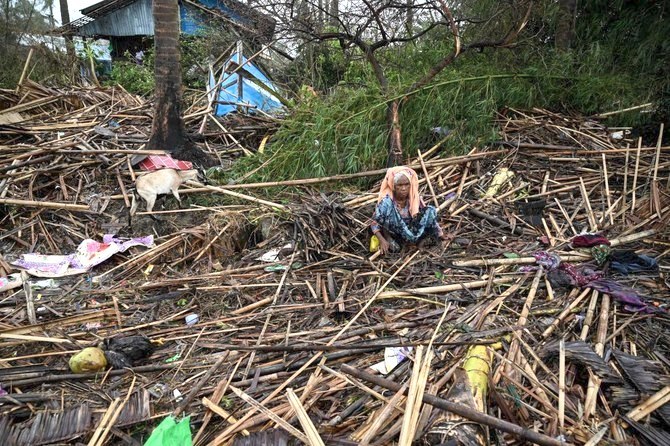

DHAKA: Heavy casualties are feared in western Myanmar after Cyclone Mocha hit the area over the weekend, sources on the ground and in neighboring Bangladesh told Arab News on Tuesday, as UN reports suggest severe destruction across the whole region.
Cyclone Mocha, classified as extremely severe, made landfall Sunday afternoon. It was one of the strongest cyclones to ever hit the Bay of Bengal. While the damaging winds, estimated to reach 250 km/h, missed the world’s largest refugee camp in Bangladesh’s Cox’s Bazar, the storm hit neighboring Rakhine State in Myanmar.
Both cellular and internet networks remained largely cut off in Rakhine on Tuesday due to extensive damage to telecommunication towers. Initial reports by the UN Office for the Coordination of Humanitarian Affairs said there was “widespread destruction,” especially across the state’s capital, Sittwe, where “few houses have escaped damage.”
Footage shared by OCHA showed demolished infrastructure, uprooted trees, and destroyed bridges. Myanmar’s state media reported on Monday that only three people had been killed, but reports on social media by activists related to Myanmar’s government in exile cited much higher figures of hundreds of casualties.
Myanmar Embassy officials in Dhaka were unavailable for comment despite repeated attempts to reach them.
Arab News could not independently verify the toll, but a source on the ground gave similar estimates as activists. In a brief phone call, Mohammad Karim, a schoolteacher and resident of Sittwe who was searching for survivors, said that “over 400 dead bodies” were recovered floating in the water. “We are still searching,” he told Arab News. “Over 200 more are still missing.”
Rakhine is home to hundreds of thousands of Rohingya, a Muslim minority, over a million of whom have fled to neighboring Bangladesh since 2017 to escape a deadly crackdown by the Myanmar military.
Mohammed Rezuwan Khan, a Rohingya activist living in Cox’s Bazar, has not been able to reach his family members remaining in Sittwe. “Since … Cyclone Mocha hit there on Sunday, we couldn’t reach anyone of that family. I have been trying again and again for the last three day, but failed to establish the call,” he told Arab News.
“I don’t know what happened with my aunt Rahima Khatun’s family. She has been living there along with my four cousins. I am praying to the Almighty for their safety.”


