RIYADH: The president of Djibouti has hailed Saudi Arabia’s support for his country, appealing for regional unity in the face of growing challenges ahead of Friday’s historic Arab League summit.
In an interview with Asharq Al-Awsat newspaper, President Ismail Omar Guelleh warned that the conflicts in Sudan and Yemen are some of the main challenges facing the Arab world, in addition to recent Israeli attacks against Islam and Christianity in Jerusalem, as well as fighting in Syria, Libya and Somalia.
Guelleh said: “We hope that the Arab summit hosted by Saudi Arabia will lead to recommendations and decisions that contribute to resolving critical situations and difficult conditions faced by the Arab world, while preserving unity and solidarity among Arab brothers.”
The Djibouti leader hailed Syria’s return to the Arab League, adding that re-engagement with Damascus could bring security and stability to the country.
He said: “It is undeniable that the absence of an Arab state and its distancing from Arab consensus and decisions is regrettable. The Syrian file has been the scene of numerous international and regional negotiations since the beginning of the crisis.
“We are convinced and remain committed to a political solution as the only way out of the Syrian crisis, responding to the aspirations of the Syrian people and supporting efforts to achieve a political settlement that ends the suffering of our Syrian brethren.
“We welcome these efforts and the progress made in ending the political isolation of Syria, thereby alleviating the suffering of the Syrian people and meeting their aspirations for security and stability.”
The attendance of Syrian President Bashar Assad at the Jeddah summit on Friday marks a natural re-integration, Guelleh said, adding: “The Arab world is not isolated from geopolitical changes, and it is natural for any Arab country to cooperate with any bloc, whether economic or military, if it sees its interest in it, provided it does not contradict common Arab action and the principles of the international community.”
Red Sea maritime security is another area of concern, the president said, hailing Saudi efforts in the sphere.
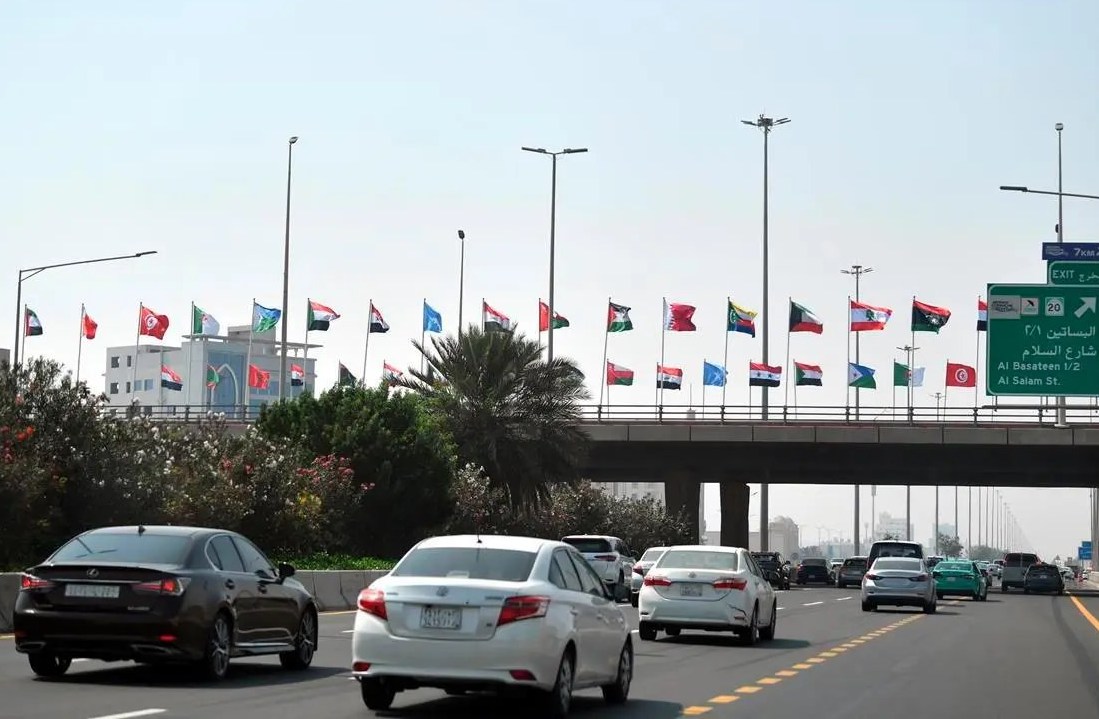
Jeddah Municipality Hoists Flags of Countries Participating in 32nd Arab Summit. Photo: (SPA)
“Saudi Arabia was one of the first countries to establish a common security regime in the Red Sea in 1956, known as the Jeddah Charter. Djibouti’s position at the entrance of the Bab Al-Mandab Strait gives it a central role in efforts to preserve security, stability, protect maritime navigation and combat terrorism,” he added.
“Djibouti was one of the first countries to ratify in January 2020 the Charter of the Council of Arab and African States bordering the Red Sea.”
But the most pressing issue, Guelleh said, is the situation in Sudan, with violence claiming the lives of more than 800 people since April 15.
He said: “We closely monitor the developments and events facing Sudan with great concern, and we express our full readiness through our membership in numerous continental and regional organizations to do everything possible to preserve the stability and unity of dear Sudan and to achieve the interest of its fraternal people. Within the Intergovernmental Authority on Development, we are ready to initiate active mediation.
“Indeed, the presidents of the Republic of Djibouti, Kenya and South Sudan have been designated to travel to Sudan, and consultations are still ongoing to begin mediation.
“However, the visit of the three presidents to Khartoum depends on the cessation of hostilities and the maintenance of the ceasefire. We hope that the organization's initiative will contribute to finding an urgent solution to the crisis, which has been worsening since mid-April. We also commend the mediation of Saudi Arabia and the US, which led to the Jeddah Agreement to protect civilians.”
Regarding tensions surrounding the Grand Ethiopian Renaissance Dam, the Djibouti president said: “Our vision regarding the Renaissance Dam issue is clear and unwavering, and it aims to reach an agreement that results in a satisfactory settlement for all parties concerned.
“We are optimistic about resolving this crisis, and we believe it will not have any impact on the relations between Arab and African countries. Thus, the concerned countries must agree on an equitable distribution of Nile waters and benefit from it in a just and sufficient manner for all. The Nile should unite all countries rather than divide them.”
Guelleh praised the “deep-rooted relations” between Djibouti and Saudi Arabia, hailing the Kingdom’s support for his country.
Saudi support has continued in political, economic, educational and other fields, he added, noting the Djibouti-Saudi Commission’s role as a general framework for bilateral cooperation, as well as a consultative council of businessmen between the two countries.
Guelleh said that Saudi support also includes humanitarian action in Djibouti, with Saudi infrastructure, through KSrelief, being built in the northern port town of Obock to accommodate a large number of Yemeni refugees.
The Djibouti president expressed his gratitude to King Salman and Crown Prince Mohammed bin Salman for their role in various international and regional domains.