



JERUSALEM The United States on Thursday condemned Israeli demonstrators’ “racist” chants against Arabs, with AFP reporters saying that many of the marchers had shouted anti-Arab slogans.
“The United States unequivocally opposes racist language of any form. We condemn the hateful chants such as ‘Death to Arabs’ during today’s marches in Jerusalem,” State Department spokesman Matthew Miller wrote on Twitter.
Tens of thousands of Israeli nationalists marched to Jerusalem’s Old City on Thursday in an annual flag-waving march commemorating Israel’s capture of it, as tensions on the Gaza border remained high.
Palestinians in annexed east Jerusalem closed their shops and were banned from the Damascus Gate entrance to the Old City, a social hub, to make way for the marchers, some of whom attacked journalists with rocks and bottles.
Police said they had made two arrests over the attack, one of an adult and one of a minor.
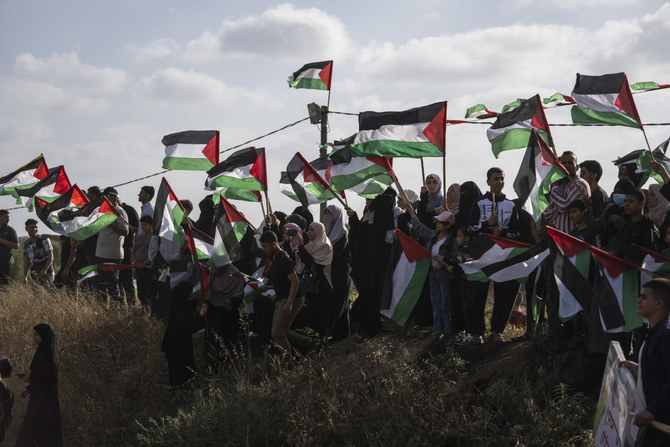
In Gaza, thousands gathered for a rival flag day on the Israeli border, many of them holding Palestinian flags. Israeli troops fired tear gas toward anyone approaching the border fence.
A Palestinian security source in Gaza said the territory’s Islamist rulers, Hamas, fired a “warning rocket” into the sea, without elaborating.
Ahead of the Israeli march, the militant group said it “condemns the campaign of the Zionist occupation (Israel) against our Palestinian people in occupied Jerusalem.”
Two years ago, after weeks of violence in Jerusalem in which scores of Palestinians were wounded, a war between Hamas and Israel erupted during the march.
Speaking late Thursday morning, Israeli Prime Minister Benjamin Netanyahu said the celebrations were being held in Jerusalem “75 years after it was re-established as the capital of the reborn state of Israel, and 56 years after being reunited.”
Two of his extreme-right cabinet members, Itamar Ben-Gvir and Bezalel Smotrich, attended Thursday’s march, one of the events marking what Israelis refer to as Jerusalem Day.
“Today, we say to Hamas who threatened us: ‘Jerusalem is ours,’” Ben-Gvir said in a statement.
Following the Six-Day War of 1967, Israel annexed east Jerusalem and its Old City in a move never recognized by the international community.
Thursday’s rally took place days into a cease-fire that ended deadly cross-border fighting with Islamic Jihad militants in Gaza.
Thirty-three people, including multiple civilians, were killed in the blockaded Palestinian enclave and two in Israel, a citizen and a Gazan laborer.
Some 2,500 police officers secured the march, which began in the western part of the city before passing into east Jerusalem and through the Old City to the Western Wall, where it wrapped up.
Before the march began, Palestinians with shops in the Old City closed up for the day.
Resident Abu Al-Abed, 72, said he wanted “to go home.” The marchers “are harmful, they’re walking and start to hit the doors of the shops and the doors of our houses,” he told AFP.
Scuffles between Jewish and Palestinian youths took place as early marchers arrived in the Old City, with police saying that in some cases forces “were required to act to prevent friction and provocations.”
But the violence was greatly reduced from last year, when at least 79 people were wounded as police clashed with Palestinian counter-protesters outside Damascus Gate.
Officials who manage the holy site estimated that 50,000 people took part in Jewish prayers at the Western Wall in the evening.
Prior to the march, dozens of Jews — including at least three lawmakers from Netanyahu’s right-wing Likud party and a minister from Ben-Gvir’s Jewish Power faction — visited Jerusalem’s Al-Aqsa mosque compound, Islam’s third holiest site.
Jews, who call it the Temple Mount and revere it as their religion’s holiest site, are allowed to visit but not pray.
One of them, Tom Nissani, was sitting at Jaffa Gate with an Israeli flag, awaiting the march.
“It’s our capital city, we have to show it, to enjoy it, to fight for it,” the 34-year-old West Bank settler who works for an organization promoting Jewish presence on the flashpoint site told AFP.
Transport Minister Miri Regev, from Netanyahu’s Likud, was among Israelis waving flags at Damascus Gate hours before the official rally.
A spokesman for Palestinian president Mahmud Abbas warned Israel “against insisting on organizing the provocative flag march.”
Pushing ahead with the parade “confirms the acquiescence of the Israeli government to Jewish extremists,” spokesman Nabil Abu Rudeineh said Wednesday.
Since last year’s rally, Israel’s leadership has taken a marked shift to the far-right.
Ben-Gvir, the country’s national security minister, was convicted in 2007 of supporting a terrorist group and inciting racism.
Far-right ally Smotrich holds the finance portfolio along with some powers in the occupied West Bank, and also has a history of inflammatory remarks about Palestinians.


