

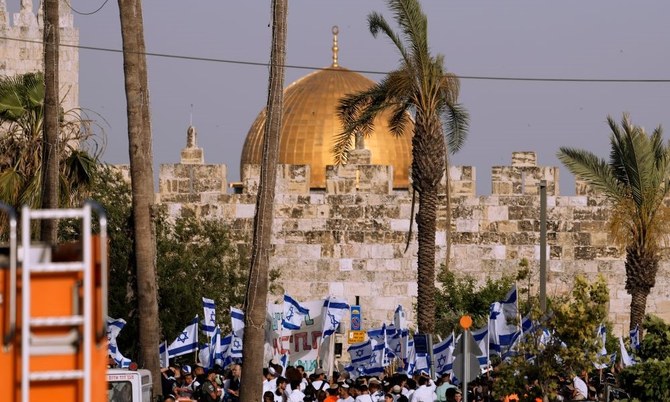

RAMALLAH: On the eve of the Jerusalem “flag day” march, tensions were running high all over Israel, the West Bank and the Gaza Strip on Wednesday. They threatened to disrupt the ceasefire agreement between Palestinian Islamic Jihad and Israel, amid fears of violent clashes in Jerusalem.
Thursday afternoon’s march is an annual Israeli, far-right parade that celebrates the capture in 1967 of East Jerusalem and its subsequent occupation, which the Israeli government refers to as the “reunification” of Jerusalem.
On Wednesday, Israeli police ramped up security in East Jerusalem and the Old City, with military checkpoints set up along main roads and 3,000 personnel deployed to secure the route of the march.
Israeli Prime Minister Benjamin Netanyahu said his government would not alter the route of the controversial march and so it will pass through the Damascus Gate and the Old City.
Israeli sources said seven ministers and members of the Knesset belonging to the ruling coalition would join the march, led by National Security Minister Itamar Ben-Gvir.
“Tomorrow, with God’s help, we will celebrate Jerusalem Day in our eternal capital,” Ben-Gvir said. “We have deployed our guards to secure the march, and tomorrow Jerusalem will be covered in blue and white.”
Jewish “Temple” organizations and settler groups reportedly sought to recruit more than 5,000 settlers to storm the courtyards of Al-Aqsa Mosque ahead of the provocative march.
The Palestinian presidency said the decision not to reroute the march away from Jerusalem’s Old City was a deliberate provocation.
Nabil Abu Rudeineh, a spokesperson for the presidency, said the calls from extremists to storm Al-Aqsa would ignite the region, with dire consequences. He said the Israeli government was fully responsible for the escalation in tensions that could lead to an explosion of violence.
The government’s actions confirms its acquiescence to the demands of extremists, he added. He called on the administration of US President Joe Biden to turn its words into actions by clearly and frankly condemning such Israeli provocations.
The Palestinian Foreign Ministry said Thursday’s march offers conclusive evidence to help those in Israel and within the international community understand that Jerusalem is occupied, not unified, and remains an integral part of the Occupied Palestinian Territories.
Meanwhile, there were calls for Palestinians in the West Bank, the Gaza Strip, Jerusalem and inside Israel to raise the Palestinian flag at all possible locations, and display it online, in response to Israel’s “flag day” provocations.
Khaled Al-Kurdi, an activist in Jerusalem’s Old City, told Arab News the situation there is tense and Israeli police were forcing about 1,500 shops in the Old City and at Damascus Gate to close.
“The situation is agitated as all of the Israeli extreme right will be present in the Old City to impose a fait accompli that they control East Jerusalem,” he said.
About 350,000 Palestinians live in East Jerusalem. Hazem Qassem, a spokesperson for Hamas, described the march as inciteful and said it would force Hamas to respond to the “Israeli attempt to change and enforce a Jewish identity on the city of Jerusalem … which includes Muslim and Christian holy sites.”
Kamal Al-Khatib, the deputy head of the Islamic Movement in Israel, called for the march to be confronted and for Al-Aqsa Mosque to be defended from Judaization efforts by settlers.
“Tomorrow, Al-Aqsa will be exposed to new provocations,” he said.
Shawky Allam, a senior cleric from Egypt, warned that the march could inflame tensions and create an atmosphere of confrontation.
Between 100,000 and 200,000 young Orthodox Jewish men are expected to take part in the march. The Israeli army has strengthened its Iron Dome defense system over fears of rocket attacks from the Gaza Strip in response to the march.
The White House urged Israelis and Palestinians to remain calm and restrained and avoid any actions or rhetoric surrounding the march that could cause tensions to rise.


