CESENA, Italy: Rescue workers searched Thursday for people still trapped by floodwaters in northeast Italy as more residents were evacuated after downpours which killed nine people and devastated homes and farms.
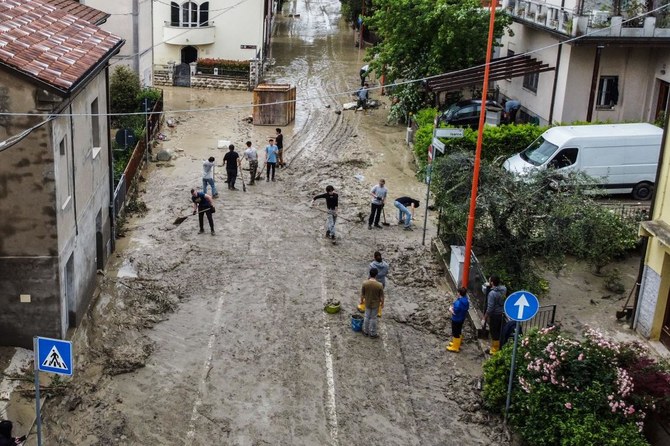
Residents waded through dirty water or reclaimed what they could from sodden houses in towns across the wealthy Emilia Romagna region, famed for its historic cities and prized gastronomy.
As mammoth clean-up efforts got underway in some areas, authorities said electricity had been partly restored, but some 27,000 people were still in the dark.
Nearly two dozen rivers and streams flooded across the southeast of the low-lying region following heavy rain earlier this week, submerging entire neighborhoods and farmland, and damaging 400 roads.
Agricultural lobby Coldiretti said Thursday that more than 5,000 farms were under water, with drowned animals and tens of thousands of hectares of vineyards, fruit trees, vegetables and grain flooded.
As the water receded, residents were left cleaning homes and streets thick with mud and filled with debris.
“I’ve lived here since 1979, I’ve seen floods go by, but I’ve never seen anything like that,” Edoardo Amadori, a resident of the city of Cesena, told AFP on Wednesday.
Some of the over 10,000 people evacuated were being allowed to return home, though authorities in Ravenna issued an immediate evacuation order early Thursday morning for three more villages threatened by floods.
The mayor of Ravenna, Michele De Pascale, announced that residents of about a half dozen towns could return, but warned them “to exercise the utmost caution.”
Cracks in river embankments still posed a risk to other areas, which were being closely monitored, he said.
The dead included a couple believed to have been hit by a wall of water as they went to check on their aromatic herb farm.
The body of the woman, in her 60s, was pulled 20 kilometers (12.5 miles) by rushing waters to the beach in Cesenatico, according to SkyTG24.
There was little significant rainfall on Thursday and only light rain expected Friday, though authorities said the high level alert for rivers remained.
Two people died in the same region earlier this month after two days of almost continuous rain.
“We had an estimated two billion (euros) of damages two weeks ago... the ground no longer absorbs anything,” Stefano Bonaccini, president of the Emilia Romagna region, told La7 television channel late Wednesday.
“When we have six months of rain in 36 hours, falling where there had already been record rain two weeks ago, there is no territory that can hold out.”
On Thursday Bonaccini compared the floods to the earthquake that hit the region on May 20, 2012, almost 11 years ago to the day.
Fixing the damage would be “a gigantic undertaking,” he said, and the region launched a fundraising effort.
Bonaccini said Ferrari, the luxury carmaker whose Maranello base is not far from the flooded areas, had pledged one million euros.
The flooding caused the cancelation of Sunday’s Formula One Emilia Romagna Grand Prix in Imola.
Italy’s armed forces and the coast guard joined the rescue effort, deploying helicopters to lift desperate residents from their homes and inflatable boats to reach houses surrounded on all sides by water.
Pope Francis offered his prayers for those affected and thanked everyone on the ground helping those hit by the “shocking disaster.”
Agriculture Minister Francesco Lollobrigida said Wednesday that the government could not yet quantify the overall damage to the region while vast areas were still flooded.

Fresh rescue efforts as Italy counts cost of deadly floods
https://arab.news/9hv46
Fresh rescue efforts as Italy counts cost of deadly floods
- Residents waded through dirty water or reclaimed what they could from sodden houses in towns across the wealthy Emilia Romagna region
- As mammoth clean-up efforts got underway in some areas, authorities said electricity had been partly restored, but some 27,000 people were still in the dark
UK veterans are ‘ticking time bomb’ after Iraq war chemical exposure
- Fifteen former RAF personnel were deployed to the Qarmat Ali water plant in 2003, which was contaminated with sodium dichromate
- Veterans say they were not screened or protected, and are now living with serious health conditions
LONDON: Fifteen British servicemen who worked on a carcinogen-contaminated water treatment site during the Iraq war say they were not offered biological screening despite official guidance saying they should have been.
The former Royal Air Force members, who have suffered from ailments including cancer, tumors and nosebleeds, told Sky News they were offered no medical assistance or subsequent treatment after having been exposed to toxic sodium dichromate at the Qarmat Ali water treatment plant in 2003.
The channel said it had seen a letter from the RAF’s medical authority stating that senior officers knew of the dangers posed by the substance.
Peter Lewis, 53, was one of 88 personnel deployed to guard the site, which was deemed vital for getting Iraq’s oil industry up and running. He told Sky: “I’ve had eight or nine operations to remove cancer.
“I’ve had so many lumps taken out of my neck, one on my face. This is something I’m literally fighting every year now. It’s constant.”
Qarmat Ali, the former troops say, was covered in ripped bags of bright orange sodium dichromate.
“We were never warned what the bags of chemicals were,” Jon Caunt, another former serviceman, said. “We were breathing this stuff in.”
His former comrade Tony Watters added: “I never thought about what it was. We were told the site is safe.”
Several months after deployment to the site, however, the servicemen were joined by two workers wearing protective gear who placed signs around it reading: “Warning. Chemical hazard. Full protective equipment and chemical respirator required. Sodium dichromate exposure.”
Watters said: “When you left the site, your uniform was contaminated, your webbing was contaminated.
“You went in your sleeping bag, and that was contaminated. And you were contaminating other people with it back at camp.”
Andy Tosh, who has led the group of veterans as they sought answers from the Ministry of Defence, said: “Even with the warning signs going up … they kept us there. They knowingly kept us exposed.”
The RAF gave some of the men a leaflet on their return to the UK, warning of the dangers of the substance, but not all were told.
The letter seen by Sky acknowledging the dangers posed to the veterans made a “strong” link to “increased risk of lung and nose cancer” as well as numerous other issues. It suggested personnel sent to Qarmat Ali should have their medical records altered to mention their exposure to sodium dichromate.
“Offer biological screening. This cannot be detailed until the numbers exposed are confirmed,” the letter also said.
An inquiry into US personnel deployed to Qarmat Ali found that 830 people were “unintentionally exposed” to sodium dichromate, giving them access to support from the US Department of Veterans Affairs. This came after the death of Lt. Col. James Gentry from cancer in 2009, which the US Army determined came “in line of duty for exposure to sodium dichromate.”
There has been no such inquiry by UK authorities despite British personnel being deployed at the site for longer than their American counterparts.
Thirteen of them have suffered from cancer and similar symptoms, including one who developed a brain tumor.
Jim Garth told Sky: “My skin cancer will never go away … It’s treatable, but when the treatment is finished, it comes back, so I’ve got that for life really.”
Lewis added: “I’m actually getting to the point now where I don’t care anymore … sooner or later, it’s going to do me.”
Caunt described his former colleagues’ conditions as a “ticking time bomb.”
He added: “We do not know what’s going to happen in the future."
The MoD insists medical screening was offered to personnel at the time, despite the men stating that it was not. In 2024, several met with Labour MPs about the issue. One, John Healey, who is now the UK defence secretary, said at the time the veterans should have “answers to their important questions.”
In a statement, the MoD said: “We take very seriously the concerns raised by veterans who were deployed to guard the Qarmat Ali Water Treatment Plant in 2003.
“As soon as we were alerted to the possible exposure of Sodium Dichromate, an environmental survey was conducted to evaluate typical exposure at Qarmat Ali. Results showed that the levels at the time were significantly below UK government guidance levels.”
A 2004 letter seen by Sky News suggested, however, that the MoD knew the levels of sodium dichromate were higher.
“Anyone who requires medical treatment can receive it through the Defence Medical Services and other appropriate services,” the MoD said.
“Veterans who believe they have suffered ill health due to service can apply for no-fault compensation under the War Pensions Scheme.”
Watters called on the government to hold an investigation into what happened at Qarmat Ali.
“We are the working class, we are ex-soldiers who have put our lives on the line and you’re turning a blind eye to us,” he said.
Garth added: “We felt let down at Qarmat Ali all those years ago, and we still feel let down now.”


