

Pakistan’s mango crop may face 20 percent reduction due to climate change this year

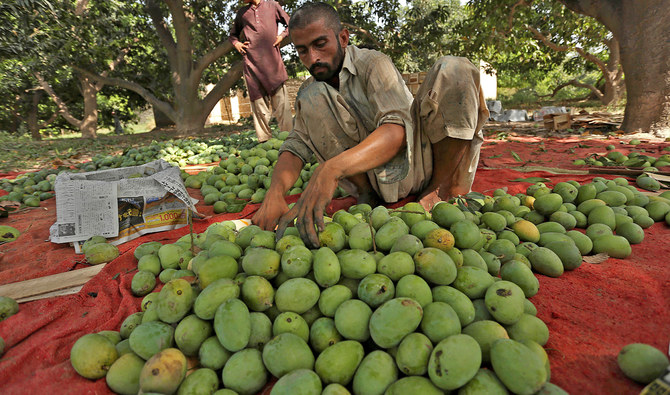
In this picture taken on June 22, 2020, a labourer sorts mangoes before packing them into boxes at a farm in Multan. (AFP/File)
Short Url
Updated 18 May 2023
Follow

Pakistan’s mango crop may face 20 percent reduction due to climate change this year

  • The country’s annual mango production capacity is about 1.8 million metric tons, which may reduce to about 1.44 million
  • Pakistan will export 125,000 metric tons during the course of this year and hopes to earn a revenue of about $100 million

KARACHI: Pakistan’s fruit and vegetable exporters suspect the country’s mango crop may be reduced by 20 percent this year since the country continues to face the adverse climate change effects during the ongoing season.

According to official statistics, the country’s annual mango production capacity is around 1.8 million metric tons. Given the erratic weather patterns caused by the challenge of climate change, however, the overall yield is expected to be 1.44 million metric tons.

“Mango crop in Pakistan is facing the adverse effect of climate change during the current mango season, leading to a likely drop of 20 percent in production,” Waheed Ahmed, patron-in-chief of All Pakistan Fruit and Vegetable Exporters Association said in a statement on Thursday.

Ahmed warned that due to a prolonged winter and delayed summer season, mango production was decreasing, adding that the production of the fruit was directly affected by changing weather patterns.

He urged research institutes and provincial agriculture departments to provide resources and awareness to mango farmers to help them avert the negative impact of climate change.

Ahmed said the country had set the mango export target of 125,000 metric tons this year which could help earn it about $100 million.

Pakistan will start exporting the fruit from May 20.

The country’s biggest mango buyers are in the Middle East, Central Asia along with other countries like China and the United Kingdom.

Pakistan produces 70 percent mangoes in Punjab province while 29 percent of the fruit is cultivated in Sindh. The country’s Khyber Pakhtunkhwa province also has a one percent production share.

Ahmed said 50 percent mangoes were exported from Pakistan by sea, 35 percent by land, and 15 percent by air.


No casualties as blast derails Jaffar Express train in Pakistan’s south

Updated 26 January 2026
Follow

No casualties as blast derails Jaffar Express train in Pakistan’s south

  • Passengers were stranded and railway staffers were clearing the track after blast, official says
  • In March 2025, separatist militants hijacked the same train with hundreds of passengers aboard

QUETTA: A blast hit Jaffar Express and derailed four carriages of the passenger train in Pakistan’s southern Sindh province on Monday, officials said, with no casualties reported.

The blast occurred at the Abad railway station when the Peshawar-bound train was on its way to Sindh’s Sukkur city from Quetta, according to Pakistan Railways’ Quetta Division controller Muhammad Kashif.

No group immediately claimed responsibility for the bomb attack, but passenger trains have often been targeted by Baloch separatist outfits in the restive Balochistan province that borders Sindh.

“Four bogies of the train were derailed due to the intensity of the explosion,” Kashif told Arab News. “No casualty was reported in the latest attack on passenger train.”

The Jaffar Express stands derailed near Abad Railway Station in Jacobabad following a blast on January 26, 2026. (AN Photo/Saadullah Akhtar)

Another railway employee, who was aboard the train and requested anonymity, said the train was heading toward Sukkur from Jacobabad when they heard the powerful explosion, which derailed power van among four bogies.

“A small piece of the railway track has been destroyed,” he said, adding that passengers were now standing outside the train and railway staffers were busy clearing the track.

In March last year, fighters belonging to the Balochistan Liberation Army (BLA) separatist group had stormed Jaffar Express with hundreds of passengers on board and took them hostage. The military had rescued them after an hours-long operation that left 33 militants, 23 soldiers, three railway staff and five passengers dead.

The passenger train, which runs between Balochistan’s provincial capital of Quetta and Peshawar in the country’s northwest, had been targeted in at least four bomb attacks last year since the March hijacking, according to an Arab News tally.

The Jaffar Express stands derailed near Abad Railway Station in Jacobabad following a blast on January 26, 2026. (AN Photo/Saadullah Akhtar)

Pakistan Railways says it has beefed up security arrangements for passenger trains in the province and increased the number of paramilitary troops on Jaffar Express since the hijacking in March, but militants have continued to target them in the restive region.

Balochistan, Pakistan’s southwestern province that borders Iran and Afghanistan, is the site of a decades-long insurgency waged by Baloch separatist groups who often attack security forces and foreigners, and kidnap government officials.

The separatists accuse the central government of stealing the region’s resources to fund development elsewhere in the country. The Pakistani government denies the allegations and says it is working for the uplift of local communities in Balochistan.