

65 US Congress members write to Secretary Blinken, raise concern over human rights in Pakistan

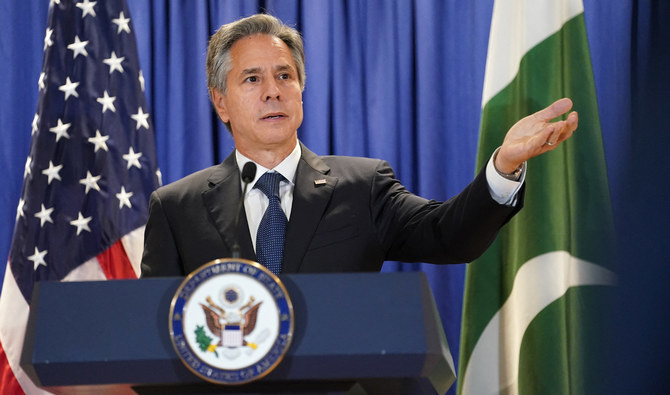
US Secretary of State Antony Blinken speaks after his meeting with Pakistan's Foreign Minister Bilawal Bhutto-Zardari at the State Department in Washington, DC, September 26, 2022. (AFP/File)
Short Url
Updated 18 May 2023
Follow

65 US Congress members write to Secretary Blinken, raise concern over human rights in Pakistan

  • In a bipartisan letter to Secretary Blinken, American politicians want their government to build diplomatic pressure on Pakistan
  • Over 65 members of Congress say protesters in Pakistan should be able to assert their rights in a peaceful and non-violent manner

ISLAMABAD: Over 65 members of US Congress have written a bipartisan letter to Secretary Antony Blinken, announced the Pakistan-American Political Action Committee (PAKPAC) on Thursday, to raise concern over the state of democracy and human rights in Pakistan over the past few months.

While the text of the letter does not explicitly mention the government crackdown on former prime minister Imran Khan’s Pakistan Tehreek-e-Insaf (PTI) party, it asks the administration in Washington to use “diplomatic tools” to push the Pakistani authorities to uphold democratic values, human rights and rule of law.

Pakistan’s coalition administration has periodically arrested PTI leaders since the downfall of Khan’s administration in a parliamentary vote of no-confidence last year in April. The ex-premier attributed his ouster from power to an international conspiracy hatched against him by officials of the Biden administration in Washington, though the US has frequently denied the allegation.

“Over the past several months, we have become increasingly concerned by the blanket bans on demonstrations and deaths of several prominent critics of the government,” said the letter. “We ask for your help pressuring the Government of Pakistan to ensure protesters can assert their demands in a peaceful and non-violent way, free from harassment, intimidation, and arbitrary detention.”

“As both Democrats and Republicans who care about the bilateral relationship [with Pakistan], we are concerned that violence and increased political tension could spiral into a deteriorating security situation in Pakistan,” it added.


The members of Congress urged Secretary Blinken to use all diplomatic tools, “including calls, visits, and public statements,” to address the ongoing situation in Pakistan.

“Supporting democracy in Pakistan is in the national interest of the United States,” they maintained.

The PAKPAC commended the Congress members who signed the letters and said Khan’s arrest on corruption charges last week had thrown “the nation into chaos” and brought out “millions to the streets in protests.

“The alarming turn of events has sparked immense concern among the Pakistani-American community,” it said in a statement, “and amplified the urgency for immediate action to protect democratic institutions, independent judiciary, freedom of press and human rights in Pakistan.”

It added the letter to Secretary Blinken highlighted the need for the US “to push Pakistan to curb democratic backsliding while also advocating for robust measures to protect human rights, freedom of speech, press freedom, and the rule of law.”


Pakistan army chief meets world leaders in rare Davos appearance

Updated 6 sec ago
Follow

Pakistan army chief meets world leaders in rare Davos appearance

  • Field Marshal Asim Munir attends World Economic Forum alongside prime minister
  • Pakistan delegation holds meetings with US, Saudi and Azerbaijani leaders

ISLAMABAD: Pakistan’s Chief of Army Staff Field Marshal Syed Asim Munir is attending the World Economic Forum’s annual meeting in Davos this week alongside Prime Minister Shehbaz Sharif, marking a rare appearance by a serving army chief at the global gathering of political and business leaders.

Pakistan’s participation at Davos comes as Islamabad seeks to attract investment, project economic stability and deepen engagement with key international partners following recent reforms aimed at stabilizing the economy. 

While Pakistani leaders routinely attend the World Economic Forum, it is uncommon for a serving army chief to be present. In 2017, former army chief Raheel Sharif addressed the forum only after his retirement, while General Pervez Musharraf spoke at Davos on a number of occasions in his role as president, not as military chief. 

Pakistan’s governance structure has evolved in recent years, particularly through the expanded role of the military in economic decision-making through bodies such as the Special Investment Facilitation Council, a civil-military platform designed to fast-track foreign investment in sectors including minerals, energy, agriculture and technology.

“The Prime Minister and the Field Marshal met with the President of Azerbaijan Ilham Aliyev, United States Secretary of State Marco Rubio, and Saudi Arabia’s Foreign Minister Prince Faisal bin Farhan Al Saud,” Sharif’s office said in a statement.

Officials say the delegation’s engagements focused on strengthening economic ties and maintaining high-level contact with partners in the Middle East, Central Asia and the United States at a time of shifting global economic and strategic alignments.

The World Economic Forum’s annual meeting brings together heads of state, ministers, investors and corporate leaders to discuss global economic risks, investment trends and geopolitical challenges. Davos is not a military forum, and while security issues are discussed there, the physical presence of a serving military chief remains the exception, not the norm, across countries. When military figures do appear, it is usually because they are heads of state or government, retired and speaking as security experts or hold a civilian defense portfolio such as defense minister or national security adviser.