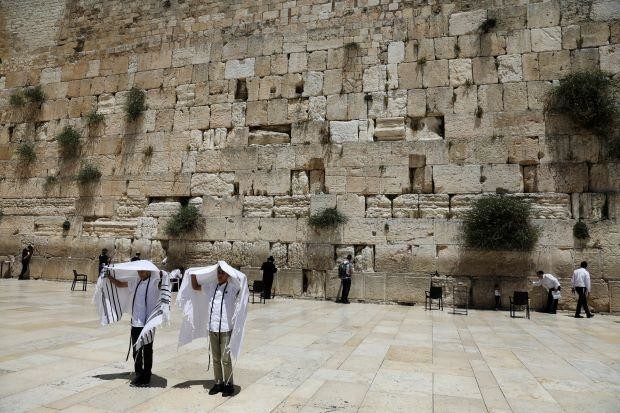
JERUSALEM: Days after capturing Jerusalem’s Old City in a 1967 war, Israel razed the Moroccan Quarter, a ramshackle neighborhood of Palestinian homes in front of the Western Wall, aiming to create an open space for Jews to pray at one of their holiest sites.
The 50th anniversary of that conflict has rekindled memories of the event, when the flattened district’s 650 Palestinians residents, mostly poor migrants, were urged to move to Shuafat, a refugee camp, or fled further, to camps in Lebanon and Jordan.
But some stayed and a half-century later are determined to retain their presence in the Old City.
“Israel brought buses to Damascus Gate and said people can take free rides if they wanted to quit Jerusalem,” recalls Mohammad Assawaf, now 90, who was running a bakery in the neighborhood when the Six-Day War broke out on June 5, 1967.
“All those who left regretted it.”
Assawaf’s bakery was in the Jewish Quarter, which had been cleared of its Jewish residents by Jordanian forces when they seized the Old City and the rest of East Jerusalem in 1948, during the war that followed Israel’s creation.
Israel’s sweeping victory nearly two decades later allowed Jews back into the Old City for the first time, and fueled the desire to reclaim all of the Jewish Quarter, including the area where the razed Arab neighborhood had taken root over the centuries.
Assawaf, a father of 15 children, was forced to leave his house, which was one of those bulldozed on June 10 and 11 to make space for the marbled Western Wall plaza. But he refused to give up his nearby bakery, despite large offers of cash from Israel.
“I stayed in the bakery and continued to work there. They offered me 250,000 Jordanian dinars, but I refused,” he said, mentioning a sum that would have been vast at the time.
Eventually Assawaf gave up the bakery, following a court battle in the 1980s, but he is still living in the Jewish Quarter, one of the few Arab residents to do so, and is determined to stay put in the place where he was born.
“Jerusalem as a place did not change, but the people changed,” he said, referring to the return of Jews to the neighborhood. “Now there is occupation, life before was easier.”
In Shuafat, a camp of high-rise buildings rife with poverty and unemployment, there are regrets among Palestinians who took the decision to leave the Old City. Shuafat is only around eight km (five miles) to the north, on the outskirts of Jerusalem, but it feels a world away.
Mohammad Ali, 77, grew up in the Jewish Quarter when it was empty of Jewish residents. But in the immediate aftermath of the 1967 war, he decided to leave, thinking life would improve.
“I left my heart and my life in the Old City,” he said.
Mohammad Abu Znaid was 10 years old when the 1967 war erupted. When Israeli troops seized the Old City, he and his family were forced to flee the Jewish Quarter, he said. They walked barefoot to Shuafat, a journey he regrets.
“We are today living in a refugee camp, you can say fatherless and motherless,” he said, using a term to suggest that there is no support or sense of belonging.

In Jerusalem’s Old City, Palestinians recall 1967 uprooting
Israeli-backed group kills a senior Hamas police officer in Gaza, threatens more attacks
- Hussam Al-Astal, leader of an anti-Hamas group based in an area under Israeli control east of Khan Younis, claimed responsibility for the killing
CAIRO: An Israeli-backed Palestinian militia said on Monday it had killed a senior Hamas police officer in the southern Gaza Strip, an incident which Hamas blamed on “Israeli collaborators.”
A statement from the Hamas-run interior ministry said gunmen opened fire from a passing car, killing Mahmoud Al-Astal, head of the criminal police unit in Khan Younis, in the south of the enclave. It described the attackers as “collaborators with the occupation.”
Hussam Al-Astal, leader of an anti-Hamas group based in an area under Israeli control east of Khan Younis, claimed responsibility for the killing in a video he posted on his Facebook page. The surname he shares with the dead man, Al-Astal, is common in that part of Gaza.
“To those who work with Hamas, your destiny is to be killed. Death is coming to you,” he said, dressed in a black military-style uniform and clutching an assault rifle.
Reuters could not independently verify the circumstances of the attack. An Israeli military official said the army was not aware of any operations in the area.
The emergence of armed anti-Hamas groups, though still small and localized, has added pressure on the Islamists and could complicate efforts to stabilize and unify a divided Gaza, shattered by two years of war.
These groups remain unpopular among the local population as they operate in areas under Israeli control, although they publicly deny they take Israeli orders. Hamas has held public executions of people it accuses of collaboration.
Under a ceasefire in place since October, Israel has withdrawn from nearly half of the Gaza Strip, but its troops remain in control of the other half, largely a wasteland where virtually all buildings have been levelled.
Nearly all of the territory’s two million people now live in Hamas-held areas, mostly in makeshift tents or damaged buildings, where the group has been reasserting its grip. Four Hamas sources said it continues to command thousands of fighters despite suffering heavy losses during the war.
Israel has been allowing rivals of Hamas to operate in areas it controls. In later phases, US President Donald Trump’s plan for Gaza calls for Israel to withdraw further and for Hamas to yield power to an internationally backed administration, but there has so far been no progress toward those steps.
Prime Minister Benjamin Netanyahu acknowledged Israeli backing for anti-Hamas groups in June, saying Israel had “activated” clans, but has given few details since then.
The ceasefire has ended major combat in Gaza over the past three months, but both sides have accused the other of regular violations. More than 440 Palestinians and three Israeli soldiers have been killed since the truce took effect.
Gaza health authorities said on Monday Israeli drone fire killed at least three people near the center of Khan Younis.
The Israeli military did not have an immediate comment on the drone incident.
The war erupted on October 7, 2023 when Gazan militants invaded Israel, killing about 1,200 people and taking some 250 hostages, according to Israeli tallies.
Israel’s subsequent military assault on Gaza has killed more than 71,000 Palestinians, according to the enclave’s health ministry, and led to accusations of genocide and war crimes, which Israel denies.
A statement from the Hamas-run interior ministry said gunmen opened fire from a passing car, killing Mahmoud Al-Astal, head of the criminal police unit in Khan Younis, in the south of the enclave. It described the attackers as “collaborators with the occupation.”
Hussam Al-Astal, leader of an anti-Hamas group based in an area under Israeli control east of Khan Younis, claimed responsibility for the killing in a video he posted on his Facebook page. The surname he shares with the dead man, Al-Astal, is common in that part of Gaza.
“To those who work with Hamas, your destiny is to be killed. Death is coming to you,” he said, dressed in a black military-style uniform and clutching an assault rifle.
Reuters could not independently verify the circumstances of the attack. An Israeli military official said the army was not aware of any operations in the area.
The emergence of armed anti-Hamas groups, though still small and localized, has added pressure on the Islamists and could complicate efforts to stabilize and unify a divided Gaza, shattered by two years of war.
These groups remain unpopular among the local population as they operate in areas under Israeli control, although they publicly deny they take Israeli orders. Hamas has held public executions of people it accuses of collaboration.
Under a ceasefire in place since October, Israel has withdrawn from nearly half of the Gaza Strip, but its troops remain in control of the other half, largely a wasteland where virtually all buildings have been levelled.
Nearly all of the territory’s two million people now live in Hamas-held areas, mostly in makeshift tents or damaged buildings, where the group has been reasserting its grip. Four Hamas sources said it continues to command thousands of fighters despite suffering heavy losses during the war.
Israel has been allowing rivals of Hamas to operate in areas it controls. In later phases, US President Donald Trump’s plan for Gaza calls for Israel to withdraw further and for Hamas to yield power to an internationally backed administration, but there has so far been no progress toward those steps.
Prime Minister Benjamin Netanyahu acknowledged Israeli backing for anti-Hamas groups in June, saying Israel had “activated” clans, but has given few details since then.
The ceasefire has ended major combat in Gaza over the past three months, but both sides have accused the other of regular violations. More than 440 Palestinians and three Israeli soldiers have been killed since the truce took effect.
Gaza health authorities said on Monday Israeli drone fire killed at least three people near the center of Khan Younis.
The Israeli military did not have an immediate comment on the drone incident.
The war erupted on October 7, 2023 when Gazan militants invaded Israel, killing about 1,200 people and taking some 250 hostages, according to Israeli tallies.
Israel’s subsequent military assault on Gaza has killed more than 71,000 Palestinians, according to the enclave’s health ministry, and led to accusations of genocide and war crimes, which Israel denies.
© 2026 SAUDI RESEARCH & PUBLISHING COMPANY, All Rights Reserved And subject to Terms of Use Agreement.