Millions of children in Turkiye, Syria require aid 100 days after earthquake: UNICEF

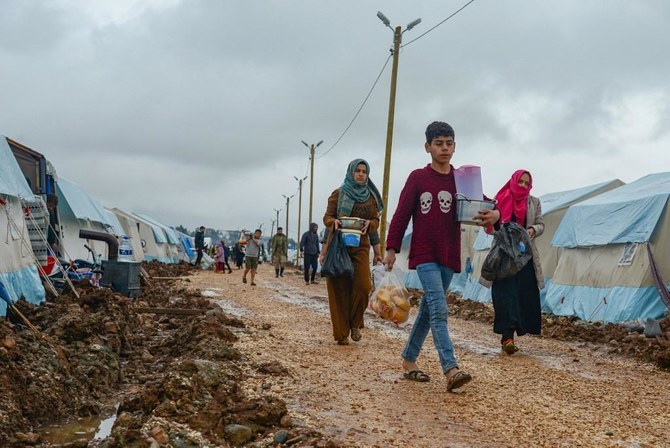
People carry food on a muddy path next to tents donated by Turkish Turk Kizilay humanitarian organization. (File/AFP)
Short Url
Updated 17 May 2023
Follow

Millions of children in Turkiye, Syria require aid 100 days after earthquake: UNICEF

  • Almost 4 million students faced education disruption after disaster
  • UN children’s fund appeals for $172.7 million in Syria, $85.4 million in Turkiye

AMMAN: More than 6 million children in Turkiye and Syria remain in need of humanitarian aid 100 days after the devastating February earthquakes, the UN International Children’s Emergency Fund warned on Wednesday.

The earthquake and aftershocks on Feb 6. left thousands of children homeless and without access to basic amenities such as safe drinking water, schooling and medical care.

“In the aftermath of the earthquakes, children in both countries have experienced unimaginable loss and grief,” UNICEF Executive Director Catherine Russell said.

“The earthquakes struck areas where many families were already incredibly vulnerable. Children have lost family and loved ones, and seen their homes, schools and communities devastated and their entire lives turned upside down,” she added.

Vulnerable children in affected areas face growing exposure to violence and forced marriage or labor, which has endangered their education.

Almost 4 million children enrolled in school, including over 350,000 refugee and migrant children, had their education disrupted by the earthquake.

UNICEF added that many families in affected areas were already struggling before the disaster, with 40 percent of Turkish households in the quake zone living below the poverty line. Without sustained local and international support, this figure could rise to more than 50 percent, according to estimates.

Meanwhile, in Syria, children were already suffering as a result of the 12-year-long war that had destroyed infrastructure and impaired public services. The massive quake in February caused additional damage to schools, hospitals and other critical sites.

Water and sewage infrastructure have also been severely damaged in Syria, putting 6.5 million people in danger of contracting waterborne diseases such as cholera.

Russell added: “The long-term impacts of the disaster, including soaring food and energy prices combined with loss of livelihoods and access to services, will push hundreds of thousands of children deeper into poverty.

“Unless financial assistance and essential services are prioritized for these children and families as part of the immediate and long-term recovery plan, then children will remain at greater risk of exploitation and abuse.”

UNICEF has called on the international community to ensure that children’s needs are met within funding allocations, urging continued investment toward the most marginalized.

The UN agency is appealing for $172.7 million to implement its Immediate Response Plan for the Earthquake in Syria. To date, $78.1 million has been received, leaving nutrition, health and education needs severely underfunded.

In Turkiye, UNICEF still requires more than $85 million as part of a $196 million appeal to provide critical services to children in need.


UN rights chief urges Iran to end violent crackdown, warns against death penalty

Updated 9 sec ago
Follow

UN rights chief urges Iran to end violent crackdown, warns against death penalty

  • Volker Turk: ‘The killing of peaceful demonstrators must stop’
  • Iranians’ grievances must be heard and addressed, and ‘not instrumentalized by anyone’

NEW YORK: The UN high commissioner for human rights on Tuesday urged Iran to immediately halt violence and repression against peaceful protesters, restore full access to the internet and telecommunications, and ensure accountability for serious human rights violations.

Volker Turk said he is horrified by reports of mounting violence by security forces against demonstrators across Iran, with hundreds reported killed and thousands arrested since protests erupted earlier this month.

“The killing of peaceful demonstrators must stop, and the labeling of protesters as ‘terrorists’ to justify violence against them is unacceptable,” he added.

It is “extremely worrying” to see public statements by Iranian judicial officials indicating the possible use of the death penalty against protesters through expedited judicial proceedings, Turk said.

He added that the protests echo mass demonstrations seen in 2022, with broad segments of the population demanding fundamental changes in governance.

He also criticized authorities for responding with what he described as brutal force to suppress legitimate demands.

“This cycle of horrific violence cannot continue,” he said, adding that all killings, violence against protesters and other alleged abuses must be investigated in line with international human rights standards, and those responsible held to account.

Turk also expressed alarm over reports that hospitals are overwhelmed by casualties, including children, and said nationwide internet and telecommunications shutdowns have hampered verification of events and obstructed independent human rights monitoring.

Iranian authorities imposed a nationwide internet shutdown on Jan. 8, which the UN said has disrupted freedom of expression, access to information, and emergency and lifesaving services. There are also reports that members of Iran’s security forces have been killed during the unrest.

Iranians have the right to demonstrate peacefully, Turk said, adding that their grievances must be heard and addressed, and “not instrumentalized by anyone.”