

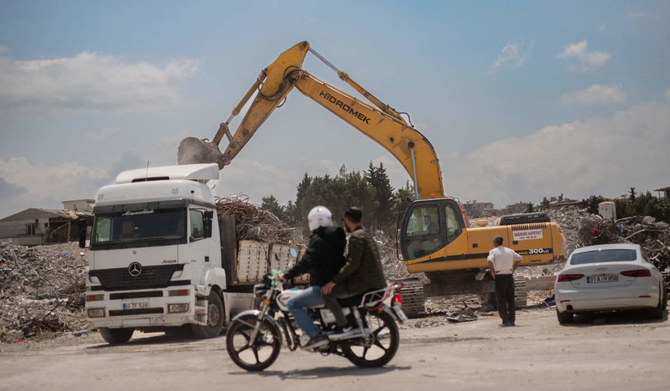

ANTAKYA: At a bus station in Antakya, a city razed to the ground by Turkiye’s devastating earthquake, emotions remain raw and voters divided ahead of Sunday’s pivotal elections.
The Yener family’s building partially collapsed in February’s 7.8-magnitude tremor, which killed more than 50,000 people and unleashed a wave of anger at the government’s delayed rescue and recovery work.
Like many others forced to flee their homes in this ancient cradle of civilizations near the Syrian border, they returned to take part in Turkiye’s biggest vote of modern times.
Metin Yener and his wife Zubeyde will vote for Kemal Kilicdaroglu, the secular rival to long-serving Recep Tayyip Erdogan, whose government is fighting for its political life.
“These elections are important. We have hope,” Metin said with a smile, as his family waited at the station after braving a five-hour bus journey.
In his tiny store stacked with water bottles, crisp packets and batteries sold to time-pressed travelers, shopkeeper Mithat cannot wait to have his say in the presidential and legislative polls.
“During the earthquake, the state abandoned us. In the first three days, no one came to our aid,” the 55-year-old said, withholding his surname for fear of getting into trouble.
Mithat also declined to state his voting preference, wanting to keep it a secret.
“But I will vote with my conscience,” he said.
Serdal Anil has no qualms about openly showing his support for Kilicdaroglu, leader of the secular Republican People’s Party or CHP and head of a six-party opposition alliance seeking to end more than two decades of Erdogan rule.
The 21-year-old has been living in a tent with his parents for three months, regretting how tough life had become since the earthquake and an economic crisis experts say was exacerbated by Erdogan’s unorthodox policies.
With the situation becoming more difficult and snakes trying to slither into his makeshift accommodation, Anil does not fear a change of leadership will hamper the massive reconstruction effort.
“Both (candidates) can do it, they are the state,” he said.
A short distance away, the CHP has set up its provincial leadership under four large tents erected alongside a major road — its headquarters were not spared by the quake either.
Hakan Tiryaki, CHP president for Hatay province, of which Antakya is the capital, said “a change of government is the only glimmer of hope” residents had, despite Erdogan’s promises of rapid reconstruction.
Widespread public anger at the state’s slow response to the tragedy leads Tiryaki to believe that many of Hatay’s one million electors will vote differently this year.
Even in the 2018 presidential ballot, Erdogan won 48.5 percent of the vote in the province — four points below the national average.
Those who previously plumped for Erdogan’s Justice and Development Party or AKP now see it as “killers” of their loved ones, Tiryaki said.
“Voters are doing everything to come and vote. There are sick people who are putting their treatment on hold. They’re banking everything on this election,” he said.
But back at Antakya’s bus station, outrage against the government’s handling of the quake will not motivate coach driver Mehmet Kuyumcu to punish Erdogan and the AKP at the ballot box — he’ll be working instead.
“I will not vote. I have never even voted,” he told AFP.
“I lost five members of my family. Do the political parties have anything to do with it? My vote isn’t going to bring them back to life.”
Cansel Dogruel said she was thinking of voting for Erdogan, just as she did in 2018.
Speaking under her tent with her young child in her arms, she admitted she had only loosely followed the campaigning.
“We don’t know what the candidates are saying, we don’t have a TV or a telephone anymore,” she said.
“We waited for a tent for weeks and it wasn’t even the state that gave it to us,” she said.
The protracted limbo is making the young woman have second thoughts about backing Erdogan, the man who has dominated Turkish politics since 2003.
“Actually, given the situation we’re in, I don’t know anymore — I’m in two minds.”


