

Container volumes surge 13.34% at Saudi ports: Mawani

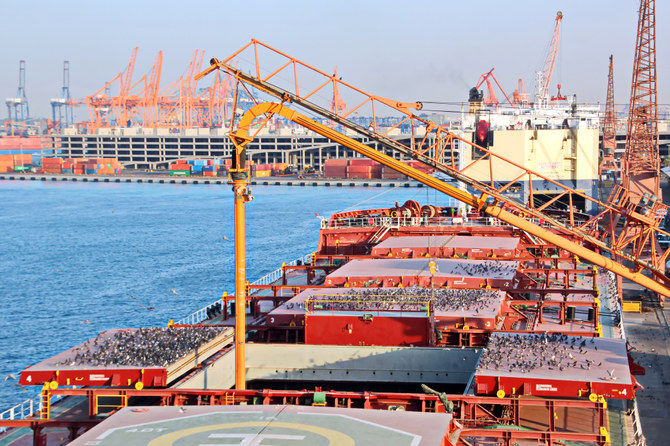
Imports inched up 3.12 percent to reach 208,080 TEUs in April (Shutterstock)
Short Url
Updated 17 May 2023
Follow

Container volumes surge 13.34% at Saudi ports: Mawani

RIYADH: Improved efficiency at Saudi ports led to a 13.34 percent year-on-year surge in container throughput during April, according to the Kingdom’s General Authority for Ports, also known as Mawani.

Figures released by the organization showed the number of containers going through Saudi harbors reached 681,663 twenty-foot equivalent units last month, compared to 601,429 TEUs in April 2022.

This falls in line with Mawani’s objectives to develop a sustainable and prosperous maritime sector and further propel trade and economic development in the Kingdom.

It also aligns with the objectives of the National Transport and Logistics Strategy to position the Kingdom as a global logistics hub connecting three continents in support of the Saudi Vision 2030.

The increase includes the number of exported containers which grew 16.97 percent in April to reach 108,738 TEUs, as opposed to the 178,450 TEUs recorded in the same period a year ago.

Imports inched up 3.12 percent to reach 208,080 TEUs compared to the 201,784 TEUs in the corresponding month a year earlier.

As for transshipments, they reached 264,845 TEUs during April, reflecting a 19.73 percent jump from the 221,195 TEUs recorded in April 2022.

The authority also revealed that there was a 6.63 percent drop in cargo numbers at its ports.

The national maritime regulator disclosed that Saudi ports handled about 24.965 million tons in April in contrast to 26.73 million tons during the same month in 2022.

The total cargo count for April stood at an estimated 543,496 tons of general cargo, 4.13 million tons of dry bulk cargo, and 13.02 million tons of liquid bulk cargo.

When it comes to the trade of food commodities, there was a 1.26 percent drop from 1.53 million tons in April 2022 to 1.531 million tons in April 2023.

Despite this, livestock figures reached 446,539 cattle heads in April this year, up from 458,280 in the corresponding period a year earlier, reflecting a 2.63 percent climb.

The number of vehicle units passing through the port stood at 91,083 automobiles during April, reflecting a 52.8 percent surge when compared to the 59,608 automobiles recorded in the same month a year ago.


Kuwait to boost Islamic finance with sukuk regulation

Updated 11 min 26 sec ago
Follow

Kuwait to boost Islamic finance with sukuk regulation

  • The move supports sustainable financing and is part of Kuwait’s efforts to diversify its oil-dependent economy

RIYADH: Kuwait is planning to introduce legislation to regulate the issuance of sukuk, or Islamic bonds, both domestically and internationally, as part of efforts to support more sustainable financing for the oil-rich Gulf nation, Prime Minister Sheikh Ahmad Abdullah Al-Ahmad Al-Sabah said on Wednesday.

Speaking at the World Governments Summit in Dubai, Al-Sabah highlighted that Kuwait is exploring a variety of debt instruments to diversify its economy. The country has been implementing fiscal reforms aimed at stimulating growth and controlling its budget deficit amid persistently low oil prices. Hydrocarbons continue to dominate Kuwait’s revenue stream, accounting for nearly 90 percent of government income in 2024.

The Gulf Cooperation Council’s debt capital market is projected to exceed $1.25 trillion by 2026, driven by project funding and government initiatives, representing a 13.6 percent expansion, according to Fitch Ratings.

The region is expected to remain one of the largest sources of US dollar-denominated debt and sukuk issuance among emerging markets. Fitch also noted that cross-sector economic diversification, refinancing needs, and deficit funding are key factors behind this growth.

“We are about to approve the first legislation regulating issuance of government sukuk locally and internationally, in accordance with Islamic laws,” Al-Sabah said.

“This enables us to deal with financial challenges flexibly and responsibly, and to plan for medium and long-term finances.”

Kuwait returned to global debt markets last year with strong results, raising $11.25 billion through a three-part bond sale — the country’s first US dollar issuance since 2017 — drawing substantial investor demand. In March, a new public debt law raised the borrowing ceiling to 30 billion dinars ($98 billion) from 10 billion dinars, enabling longer-term borrowing.

The Gulf’s debt capital markets, which totaled $1.1 trillion at the end of the third quarter of 2025, have evolved from primarily sovereign funding tools into increasingly sophisticated instruments serving governments, banks, and corporates alike. As diversification efforts accelerate and refinancing cycles intensify, regional issuers have become regular participants in global debt markets, reinforcing the GCC’s role in emerging-market capital flows.

In 2025, GCC countries accounted for 35 percent of all emerging-market US dollar debt issuance, excluding China, with growth in US dollar sukuk issuance notably outpacing conventional bonds. The region’s total outstanding debt capital markets grew more than 14 percent year on year, reaching $1.1 trillion.