Amid government-judiciary standoff, Pakistan passes bill against 'contempt of parliament' 

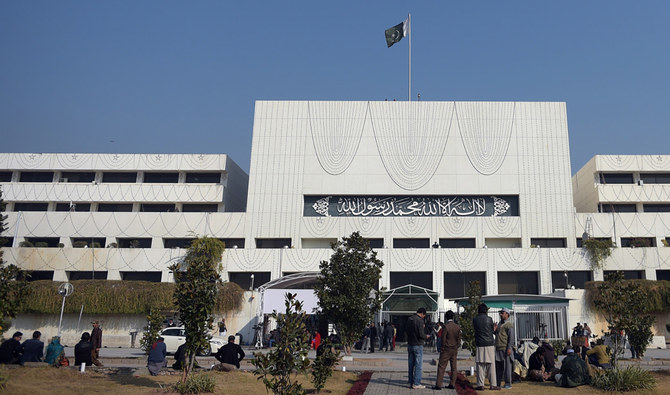
Pakistani security and media officials gather in front of the Parliament House building in Islamabad on January 6, 2015. (AFP/File)
Short Url
Updated 16 May 2023
Follow

Amid government-judiciary standoff, Pakistan passes bill against 'contempt of parliament' 

  • The government and the judiciary have been at loggerheads over Punjab polls, alleged leniency to ex-PM Khan in cases 
  • The new law will ‘ensure supremacy of parliament which was mother of all institutions,’ says lawmaker who moved it 

ISLAMABAD: The National Assembly, the lower house of Pakistan parliament, on Tuesday passed a bill aimed at condemning and awarding punishment for actions that accounted for the breach of the sovereignty and integrity of parliament, amid a stand-off between the government and the judiciary in the South Asian country. 

The development comes as the rift deepens between the government of Prime Minister Shehbaz Sharif and the judiciary over delay in provincial elections and alleged leniency demonstrated to ex-premier Imran Khan, a bitter Sharif opponent, in a number of legal cases. 

An alliance of political parties backing the government held on Monday a rare protest outside the Supreme Court building in the Pakistani capital of Islamabad and demanded Chief Justice Umar Ata Bandial step down, accusing him of “bias and misconduct.” 

On Tuesday, Rana Muhammad Qasim Noon, who chairs the lower house’s standing committee on rules of procedure and privileges, tabled the “contempt of parliament” bill that was adopted the Nation Assembly. 

“A person is said to have committed contempt of Majlis-e-Shoora (parliament) if he is found to have willfully breached the privilege of a member, a House or a Committee, in any manner whatsoever it may be; willfully violated any law guarantying the immunities or privileges of the members; willfully failed or refused to obey any order or direction of a House or a Committee thereof,” read the bill, a copy of which was seen by Arab News. 

The bill states that a person is also found guilty if he “refused to give evidence or recorded false statement before a Committee; attempted or influenced a witness either by intimidation, threat or use of force to prevent him from providing evidence, producing document or appearing before the Committee; and failed to provide any documents or submitted tempered documents.” 

After the passage of the bill, Noon said it was a historical moment in the parliamentary history of the country. 

“It would ensure the supremacy of parliament which was mother of all the institutions,” he was quoted as saying by the state-run APP news agency. 

The house through a motion may charge any person for contempt and the speaker or the chairman of the Senate may refer the matter to the contempt committee. The NA speaker shall constitute a contempt committee for the purposes mentioned in the bill within 30 days of its passage. The contempt committee shall comprise 24 members having equal representation from both houses of parliament, the Senate and the National Assembly, according to the bill. 

The contempt committee shall have 14 members from the treasury, both from the Senate and the National Assembly, and 10 from the opposition benches. The members shall be nominated by the respective leaders of the house and the opposition. 

A political and constitutional crisis has gripped the country since Khan’s PTI party and its allies dissolved provincial assemblies in the Punjab and Khyber Pakhtunkhwa provinces in January. The Supreme Court subsequently ruled that the polls should be held in both the provinces within 90 days of the dissolution of their assemblies, as per the constitution, while the Sharif government insists all elections in the country should be held on the same date in October, when general elections are scheduled. 

In defiance of court orders, the government refused to release funds worth Rs21 billion and arrange security in time for Punjab elections on May 14, the date given by the Supreme Court. 

Tensions rose further high after the Supreme Court last week declared Khan’s arrest on corruption charges “illegal” and ordered his immediate release amid violent protests by his supporters. 


Pakistan expands pilgrim travel system for Iran, Iraq with licenses to 67 new operators

Updated 9 sec ago
Follow

Pakistan expands pilgrim travel system for Iran, Iraq with licenses to 67 new operators

  • New system requires all Iraq-Iran pilgrimages to be organized by licensed groups under state oversight
  • Long-running “Salar” model relied on informal caravan leaders, leading to overstays and missing pilgrims

ISLAMABAD: Pakistan has issued registration certificates to 67 additional licensed pilgrimage companies, expanding a tightly regulated travel system designed to curb overstays, undocumented migration and security risks linked to religious travel to Iran and Iraq, the ministry of religious affairs said on Tuesday.

The move is part of a broader overhaul of Pakistan’s pilgrim management framework after authorities confirmed that tens of thousands of Pakistani pilgrims had overstayed or gone missing abroad over the past decade, raising concerns with host governments and triggering diplomatic pressure on Islamabad to tighten oversight.

“The dream of safe travel for pilgrims to Iran and Iraq through better facilities and a transparent mechanism is set to be realized,” the religious affairs ministry said in a statement, quoting Federal Minister for Religious Affairs Sardar Muhammad Yousaf, who announced that 67 new Ziyarat Group Organizers had been registered.

Pakistan’s government has dismantled the decades-old “Salar” system, under which informal caravan leaders arranged pilgrimages with limited state oversight. The model was blamed for weak documentation, poor accountability and widespread overstays, particularly during peak pilgrimage seasons. 

Under the new framework, only licensed companies are allowed to organize pilgrimages, and they are held directly responsible for ensuring pilgrims return within approved timelines.

Authorities say pilgrimages to Iran and Iraq will be conducted exclusively under the new system from January 2026, marking a full transition to regulated travel. The religion ministry said it has now completed registration of 24 operators in the first phase and 67 more in the second, with remaining applicants urged to complete documentation to obtain licenses.

The religious affairs ministry said a digital management system is being developed with the National Information Technology Board to monitor pilgrim movements and operator compliance, while a licensed ferry operator has also secured approval to explore future sea travel options.

The overhaul has been accompanied by tighter coordination with host countries. Earlier this month, Pakistan and Iraq agreed to share verified pilgrim data and restrict entry to travelers cleared under the new system, following talks between interior ministers in Islamabad and Baghdad. Pakistan has also barred overland pilgrim travel for major religious events, citing security risks in its southwestern Balochistan province, meaning travel to Iran and Iraq is now limited to approved air routes.

Officials say the reforms are aimed at balancing facilitation with accountability, as tens of thousands of Pakistani pilgrims travel annually to key Shia shrines, including Karbala and Najaf in Iraq and Mashhad and Qom in Iran. Travel peaks during religious occasions such as Arbaeen, when millions of worshippers converge on Iraq, placing heavy logistical and security demands on regional authorities.

The government says the new system is intended to restore confidence among host countries while ensuring safer, more transparent travel for Pakistani pilgrims.