

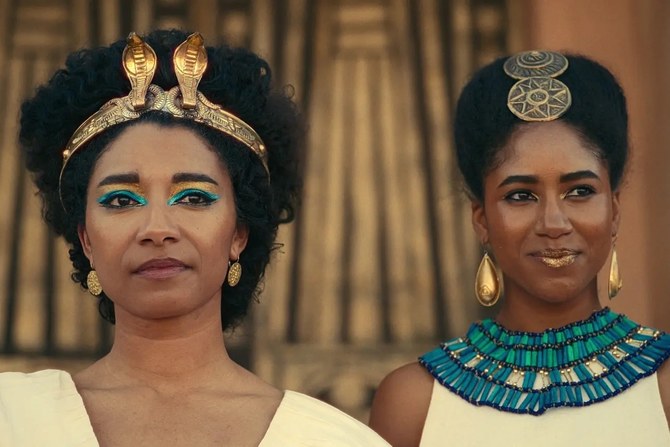
Legal team takes action over Netflix’s ‘Queen Cleopatra’ in Egypt

“Queen Cleopatra” is on Netflix. (Supplied)
Short Url
Updated 17 May 2023
Follow

Legal team takes action over Netflix’s ‘Queen Cleopatra’ in Egypt

CAIRO: In the latest development in the uproar against Netflix’s “Queen Cleopatra,”  Egyptian lawyers and archaeologists are calling for legal action against the streaming platform.   

The group is demanding the documentary be banned over the streaming giant’s depiction of Cleopatra as a woman of sub-Saharan origin.

Cleopatra VII Philopathor was the ruler of Egypt prior to Roman rule. According to historians, she is a descendant of Ptolemy I Soter, a Macedonian Greek general. 

Egyptian lawyers have filed a lawsuit before the Administrative Court of the State Council to compel the Egyptian government, represented by the Ministry of Foreign Affairs, to take all diplomatic measures and communicate with relevant international organizations to ban the recent documentary.  

Arab News met with the Egyptian lawyer Mahmoud Al-Semary, who is one of the litigators in the lawsuit against Netflix.

“The events of the film contain a great falsification of historical facts and it is a severe insult to the Ancient Egyptians. These are not my words, but the words of academic figures, specialists in Egyptology and archaeology,” he told Arab News.

The lawsuit was filed before the documentary’s May 10 premiere on the streaming platform, with Al-Semary telling Arab News: “the promo minutes were sufficient to move because they were full of inaccuracies. With my full respect for the continent of Africa, to which we belong geographically, they (the Ptolemy dynasty from which Cleopatra hailed) were not part of the African people, as the promo depicted them … the drawings on the temples and the remaining monuments from the different eras and the murals in the west of the city of Alexandria confirm this.”

“On April 16, I made my decision to file a lawsuit against Netflix and accused it of forgery. On April 29, I was directed by the Public Prosecutor’s Office to the Economic Court and the Administrative Judiciary Authority to file what is called a “satellite broadcasting disputes” memorandum. I called on the Egyptian Ministry of Culture, in its capacity as the authority concerned with the protection of heritage and history, to assume its responsibility in this matter, as well as the Ministry of Foreign Affairs as an authority responsible for international political relations,” the lawyer explained.

After viewing the documentary, he said he “became more insistent on suing Netflix because it insulted the Egyptians and deliberately falsified history. Every day, the number of lawyers and parties joining the lawsuit increases, and one of them demanded two billion dollars in compensation for the damage to the reputation of the state.”



Mini op-ed: Recognising a shift in how people relate to wellness, self-care

Updated 05 March 2026
Follow

Mini op-ed: Recognising a shift in how people relate to wellness, self-care

DUBAI: I have spent nearly a decade working in the beauty industry in Saudi Arabia and the UAE, and Ramadan always has a way of prompting change; in habits, in priorities, and in the routines people have been carrying without question. Speaking from my own corner of the industry, one of these habits is often hair removal.

Saudi Arabia’s beauty and personal care market was valued at about $7.56 billion in 2025 and is set to grow to an estimated $8.03 billion in 2026. Within that growth, personal care encompassing the daily (sometimes unglamorous) routines hold the largest share. But market size alone does not tell the full story. A study conducted at King Abdulaziz University Hospital, Jeddah, found that three quarters of Saudi women experienced complications from temporary hair removal methods, including skin irritation, in-grown hairs and hyperpigmentation. A separate 2025 study published in the Majmaah Journal of Health Sciences found that laser hair removal was both the most considered and most commonly undergone cosmetic procedure among Saudi respondents, yet dissatisfaction with cosmetic procedure outcomes was reported by nearly half of all participants. The numbers point to a gap not in demand, but in results. 

When I launched a specialized electrolysis practice in the UAE in 2016, it was with a clear gap in mind; safe, regulated, permanent hair removal for the region’s specific needs. The range of hair types here and the prevalence of conditions such as polycystic ovary syndrome, or PCOS, demanded a method that works across all of them.  Electrolysis is the only method recognized by the US Food and Drug Administration and American Marketing Association as achieving true permanent results, regardless of hair color or type. 

Despite this, awareness in Saudi Arabia remains limited. Part of this is familiarity, laser has dominated the conversation for years, and electrolysis, which requires more sessions and a licensed electrologist’s precision, has struggled to break through. Part of it is education. Many clients who come to us have never heard of electrolysis; they come because they have exhausted everything else. 

Right now, Saudi Arabia is in the middle of a genuine transformation in how people relate to wellness and self-care. The beauty market is maturing, consumers are asking harder questions of the brands they choose and Vision 2030 has not just shaped the economy, it has shaped how Saudis are showing up in their own lives. In that context, the idea of choosing permanence over repetition lands differently.
 
Mariela Marcantetti is a beauty industry entrepreneur based between Saudi Arabia and the UAE.