

Pakistan slashes price of petrol by Rs12 per liter to provide ‘maximum relief’ to masses

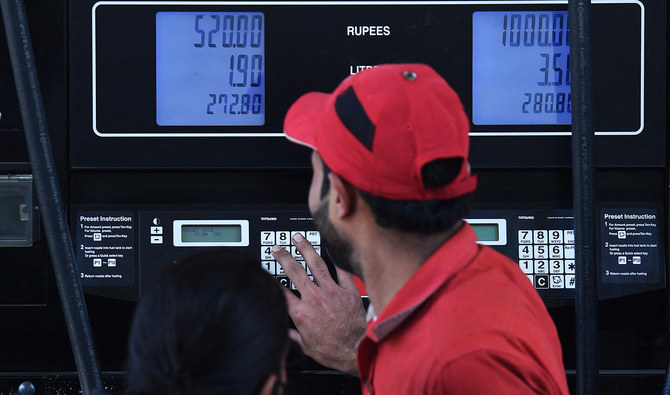
An employee of a petrol station fills the tank of a customer in Karachi on February 16, 2023. (Photo courtesy: AFP/File)
Short Url
Updated 16 May 2023
Follow

Pakistan slashes price of petrol by Rs12 per liter to provide ‘maximum relief’ to masses

  • After latest price cut, petrol is now being sold for Rs270 per liter, High Speed Diesel for Rs258 per liter
  • Finance Minister Ishaq Dar urges transporters to pass on impact of price cut to customers by reducing fares

KARACHI: Pakistan's Finance Minister Ishaq Dar announced the government's decision to slash the price of petrol by Rs12 per liter and High Speed Diesel (HSD) by Rs30 per liter on Monday, saying that the measure was taken to provide "maximum relief" to the masses amid declining prices of petroleum products in the international market.

Fuel and energy prices in Pakistan soared over the past one year as the South Asian country took tough fiscal measures in hopes of reviving a stalled $6.5 billion loan program of the International Monetary Fund (IMF). For a staff-level agreement to take place between the two sides which would unlock $1.1 billion in funds for Pakistan, the IMF asked Islamabad to scrap subsidies worth billions of rupees on fuel and energy, and raise taxes.

Subsequently, inflation increased to a historic high of 36.4 percent in Pakistan in April 2023, the highest since 1964. Weekly inflation reported an increase of 48.2 percent during the week ended on May 11, 2023 on an annual basis, according to the Pakistan Bureau of Statistics.

In a brief televised address, Dar said after the latest price reduction, petrol would cost Rs270 per liter, while HSD, kerosene and Light Diesel Oil would cost Rs258, Rs164.07, and Rs152.68 per liter respectively.    

“Prime Minister Shehbaz Sharif and his government tried to provide maximum relief to the public on the basis of price changes [of petroleum products] in the international market," the finance minister said.

Dar requested transporters and departments utilizing diesel to pass on the impact of the price cut to the public by lowering their fares so that all income segments of the society could benefit from the price reduction. 

The government's move to slash prices of petroleum products also comes at a time when Pakistan's import of petroleum products has decreased by 48% on an annual basis and 22% on a month-on-month basis during April 2023. 

Oil imports declined by 48% to 1.07 million tons during April 2023 as compared to 2.05 million tons during April 2022, according to a research report released by Pakistan's largest securities brokerage company, Arif Habib Limited, on Monday. 

Imports of Mogas, HSD, and crude oil decreased by 24%, 57%, and 43% respectively on an annual basis while RLNG imports also declined by 33% and 11% on an annual and monthly basis to 1.8 million tons during April 2023.


Pakistan Navy chief in Malaysia to strengthen operational cooperation, discuss maritime security

Updated 5 sec ago
Follow

Pakistan Navy chief in Malaysia to strengthen operational cooperation, discuss maritime security

  • Pakistan Navy chief in Malaysia to strengthen operational cooperation, discuss maritime security
  • Navy chief calls for strengthened cooperation between hydrographic offices of both countries 

ISLAMABAD: Pakistan Navy chief Admiral Naveed Ashraf is in Malaysia where he held talks with the leadership of the Royal Malaysian Navy (RMN) to enhance operational cooperation, capacity building and responses to maritime security challenges, the Pakistani Navy said on Sunday.

Pakistan and Malaysia have historically enjoyed close ties ever since they established diplomatic ties in 1957. Both countries have strengthened cooperation in various sectors such as defense, trade, economy, manpower exports and education over the years.

Ashraf was received at the RMN’s headquarters by Admiral Tan Sri (Dr.) Zulhelmy bin Ithnain, the RMN chief, Pakistan’s Navy said in a statement. 

“Discussions focused on aligning strategic perspectives and enhancing operational cooperation, capacity building, and coordinated responses to maritime security challenges,” the statement said. 

Ashraf highlighted Pakistan Navy’s contributions to regional stability through the Regional Maritime Security Patrols and its participation in the Combined Maritime Forces.

He also visited Malaysia’s National Hydrographic Center, calling for strengthened cooperation with Pakistan’s National Hydrographic Office in training, data exchange, and professional collaboration.

“The visit reaffirmed the enduring Pakistan-Malaysia naval partnership and commitment to future-oriented maritime cooperation,” Pakistan Navy said. 

Pakistan’s army, navy and air force have aimed to strengthen bilateral cooperation with their counterparts since last year when Pakistan and India were embroiled in a brief military confrontation. 

Both countries pounded each other with missiles, drone strikes, fighter jets and artillery fire for four days until Washington brokered a ceasefire between them on May 10.