

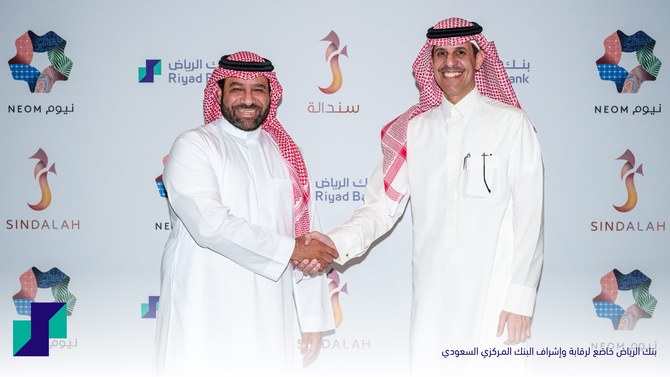
Riyad Bank partners with NEOM to provide $800m finance for Sindalah island

Riyad Bank announced the funding deal in a tweet (Twitter/Riyad Bank)
Short Url
Updated 16 May 2023
Follow

Riyad Bank partners with NEOM to provide $800m finance for Sindalah island

RIYADH: Luxury tourist destination Sindalah island has received a SR3 billion ($800 million) boost thanks to a new partnership with Riyad Bank. 

The development project, unveiled by Saudi Crown Prince Mohammed bin Salman last December, is the first luxury marine tourism destination in the giga-project NEOM. 

Riyad Bank announced the funding deal in a tweet, and the money will help towards the goal of having $1 trillion invested in the Kingdom’s tourism industry to achieve 100 million tourists visiting annually by 2030.

The Sindalah development is estimated to generate 3,500 jobs in the tourism, hotel, and leisure sectors, and travelers are expected to begin arriving on the island in early 2024. 

In December, the crown prince said that “this is another significant moment for NEOM and a major step in the Kingdom realizing its tourism ambitions under Vision 2030.” 

He added: “Sindalah will be NEOM’s first luxury island and yacht club destination in the Red Sea, providing a scenic gateway to the Red Sea that will become the region’s most exciting and attractive tourism location.”

Because of its position, the island has become a popular stop for many regional and European boat and yacht owners. Sindalah is a short distance from the Mediterranean Sea, making it possible to reach several sailing sites in less than a day through the Suez Canal. 

Luca Dini, CEO of Luca Dini Design and Architecture — tasked with designing the resort — told Arab News in April: “The destination will create a new season for superyachts, a dream alternative for yacht owners who want to spend the winter in an easily accessible location. With a prestigious 86-berth marina for yachts up to 75 meters and serviced buoys for superyachts up to 180 meters, a glamorous yacht club, luxury hotels, a golf club, an extensive retail precinct and exceptional food and beverage offerings, everything proposed in Sindalah is unique and cannot be found anywhere else in the world.” 

NEOM, the $500 billion smart city, is one of the most significant initiatives supporting Saudi Arabia’s national tourist plan as the country gradually diversifies its economy away from oil.


Saudi Arabia’s non-oil exports surge 32.3% in October: GASTAT  

Updated 12 sec ago
Follow

Saudi Arabia’s non-oil exports surge 32.3% in October: GASTAT  

RIYADH: Saudi Arabia’s non-oil exports, including re-exports, rose 32.3 percent year on year in October to reach SR33.88 billion ($9.03 billion), according to official data. 

Preliminary figures released by the General Authority for Statistics showed that national non-oil exports, excluding re-exports, increased by 2.4 percent in October compared to the same period a year earlier. 

The rise in non-oil exports underscores progress under Saudi Arabia’s Vision 2030 program, which aims to diversify the economy by reducing reliance on crude oil revenues. 

In its latest report, GASTAT stated: “The ratio of non-oil exports (including re-exports) to imports increased to 42.3 percent in October 2025 from 33.4 percent in October 2024. This was due to a 32.3 percent increase in non-oil exports and a 4.3 percent increase in imports during the same period.”  

It added: “The value of re-exported goods increased by 130.7 percent during the same period, driven by a 387.5 percent increase in transportation equipment and parts, which represented 37.4 percent of total re-exports.” 

The report showed that machinery, electrical equipment, and parts led the non-oil export basket, accounting for 23.6 percent of outbound shipments and recording an 82.5 percent year-on-year increase. 

Chemical products followed with a 19.4 percent share of non-oil exports. 

In October, Moody’s said in a report that Saudi Arabia is on course to sustain annual non-oil sector growth of between 4.5 percent and 5.5 percent over the next five to 10 years as its Vision 2030 diversification program gathers pace. 

Earlier this month, GASTAT reported that Saudi Arabia’s gross domestic product expanded by 4.8 percent in the third quarter compared to the same period in 2024, driven by growth in both oil and non-oil activities. 

The authority added that oil activities advanced by 8.3 percent year on year in the third quarter, while the non-oil sector grew by 4.3 percent over the same period. 

Top non-oil destinations 

China was the top destination for Saudi non-oil goods, with shipments totaling SR14.68 billion. 

The UAE ranked second, receiving goods worth SR11.37 billion, followed by India at SR10.25 billion, Japan at SR8.37 billion, and South Korea at SR7.37 billion. 

In October, Saudi Arabia exported non-oil goods valued at SR5.20 billion to the US, while Bahrain and Egypt received products worth SR5.02 billion and SR4.01 billion, respectively. 

Export gateways  

GASTAT said ports played a crucial role in facilitating non-oil shipments during October. 

Jeddah Islamic Seaport handled the largest volume of non-oil exports at SR3.76 billion, followed by Ras Al Khair Seaport at SR3.64 billion and King Fahad Industrial Seaport in Jubail at SR3.21 billion. 

Jubail Seaport was the exit point for goods worth SR2.88 billion, while Ras Tanura Seaport and King Abdulaziz Seaport in Dammam handled non-oil shipments valued at SR2.53 billion and SR2.21 billion, respectively. 
 
Overall merchandise exports 

Saudi Arabia’s total merchandise exports stood at SR103.98 billion in October, representing an 11.8 percent increase compared to the same month a year earlier. 

The share of oil exports in total exports declined to 67.4 percent in October 2025, from 72.5 percent in October 2024. 

China was the Kingdom’s largest export destination, accounting for 14.1 percent of total exports. The UAE and India followed with shares of 10.9 percent and 9.9 percent, respectively. 

Japan, South Korea, the US, Bahrain, Egypt, Singapore, and Poland were also among the top 10 export destinations. 

“Exports of the Kingdom to those 10 countries account for 70.4 percent of total exports,” added GASTAT.  

Imports in October 

Imports rose 4.3 percent year on year in October to SR80.07 billion, while the merchandise trade surplus increased by 47.4 percent compared to the same month last year, according to the report. 

China was the Kingdom’s largest source of imports, accounting for 24.8 percent of total inbound shipments, followed by the US at 8.7 percent and the UAE at 6.4 percent. 

Switzerland, India, Germany, Japan, Italy, France, and Egypt were also among the top 10 countries exporting goods to Saudi Arabia. 

Sea routes remained the dominant entry channel for imports, handling SR44.49 billion worth of goods, while air and land routes accounted for SR27.25 billion and SR8.33 billion, respectively. 

King Abdulaziz Seaport in Dammam was the leading sea entry point with imports valued at SR20.57 billion. 

Jeddah Islamic Seaport handled inbound shipments worth SR15.82 billion, followed by Jubail Seaport at SR1.83 billion and King Fahad Industrial Seaport in Jubail at SR854.9 million. 

Among land entry points, Al-Batha Port processed SR3.75 billion worth of goods, while Riyadh Dry Port and the King Fahad Bridge handled SR2.13 billion and SR822.9 million, respectively. 

By air, King Khalid International Airport received SR11.99 billion in imports during October, while King Abdulaziz International Airport and King Fahad International Airport handled SR10.38 billion and SR4.65 billion, respectively.