Younger Palestinians less interested in the ‘cause’? — not according to Arab News-YouGov findings 

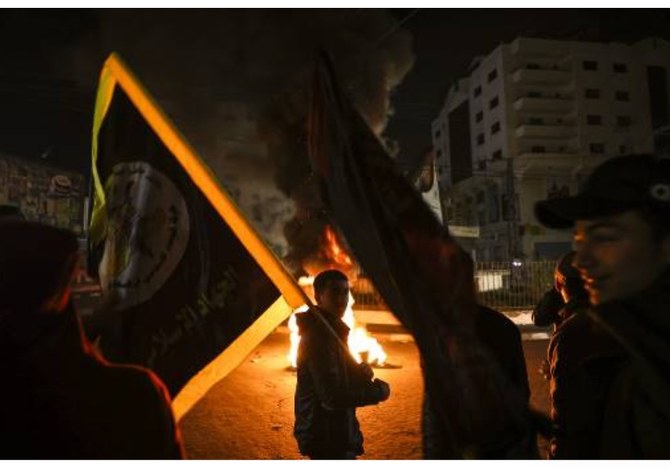
A Palestinian youth holds a flag as he walks past burning tires during a protest near the Israel-Gaza border east of Gaza City on February 26, 2023. (AFP/File Photo)
Short Url
Updated 15 May 2023
Follow

Younger Palestinians less interested in the ‘cause’? — not according to Arab News-YouGov findings 

  • Survey shows Palestinian youth believe return of Jerusalem is a non-negotiable with only 1 percent allowing Israelis to have it to themselves 

DUBAI: A YouGov survey of Palestinian residents of different ages shows that younger people are far less likely to support a two-state solution: the creation of an independent Palestinian state alongside the state of Israel.   

The survey, a special Arab News-YouGov collaboration, showed that Palestinians between the ages of 18 to 24 make up 42 percent of those who support the idea, while more than 63 percent of those above the age of 45 are willing to support the initiative.  

Chris Doyle, director of the London-based Council for Arab-British Understanding, told Arab News: “Palestinian youth showed not least in 2021 that they refuse to give up on their rights. Their efforts to obstruct the demolitions and dispossessions in Sheikh Jarrah were incredible. It reminds us of the 1987 intifada when it was Palestinian youth who led and orchestrated the uprising.”   

In 2017, US President Donald Trump moved the American embassy from Tel Aviv to Jerusalem, reversing nearly seven decades of American foreign policy and declaring the city the official capital of Israel.   

It was a bold move that attracted criticism from Palestinians, Arab leaders and the EU alike.

The survey shows that Palestinian youth found the official return of Jerusalem a non-negotiable with only 1 percent allowing Israelis to have it fully and with the creation of a Palestinian capital elsewhere.    

Other proposed solutions such as dividing the city, with East Jerusalem as the capital of the Palestinian state and West Jerusalem as the capital of Israel, was favored at only 15 percent; at odds with the 35 percent above the age of 45 who also supported this solution.   

The reason why older generations prefer to compromise is unclear.  

Doyle believes: “It may well be fatigue that prompts some of the elderly to compromise but also it may be born of realism, too, that for them the two-state solution appears to be the only possible option. The trouble is that all these options are unclear. The Palestinian people are not being offered a clearly defined deal. So what are they accepting or refusing?”   

Establishing a united Jerusalem under UN management and supervision also drew a low score with youth (5 percent) at odds with the 16 percent score of those above 45 years of age.

Another issue tackled in the survey was Palestinian views on the Abraham Accords.

The accords, a series of official joint normalization statements between the UAE, Israel, Bahrain, Sudan and Morocco that was rendered effective in 2020, showed a fundamental shift in Arab-Israeli relations. 

Three years on, the initiative failed to bring in new Arab member states to normalize relations with Israel. The survey shows that Palestinians of all age groups continue to view the normalization negatively. 

Assuming a Palestinian state was founded, economic development and creating jobs ranked the highest among citizens’ priorities.

Today, both the West Bank and the Gaza strip remain heavily dependent on foreign aid.

A World Bank report released last month estimated that the Palestinian economy will slump further this year. The bleak economic situation of Palestine is due to restrictions on mobility, imports and trade imposed by Israel.

Recent military escalations and tensions as well as the global effect of the Russia invasion of Ukraine are factors that negatively impact Palestinian standards of living as well as the economy.

Stefan Emblad, World Bank country director for the West Bank and Gaza, said that “raising living standards, improving the sustainability of fiscal accounts and reducing unemployment in a meaningful manner will all require significantly higher growth rates. Exogenous sources of risks, such as in the areas of food and energy prices, mean the overall economic outlook remains bleak.” 


Israel aims to ensure more Palestinians are let out of Gaza than back in

Updated 4 sec ago
Follow

Israel aims to ensure more Palestinians are let out of Gaza than back in

  • It was still not clear how Israel planned to enforce limits on the number of Palestinians entering Gaza from Egypt
  • Sources said Israeli officials had insisted on setting up a military checkpoint in Gaza to screen Palestinians moving in and out

TEL AVIV: Israel wants to restrict the number of Palestinians entering Gaza through the border crossing with Egypt to ensure that more are allowed out than in, three sources briefed on the matter said ahead of the border’s expected opening next week.
The head of a transitional Palestinian committee backed by the US to temporarily administer Gaza, Ali Shaath, announced on Thursday that the Rafah Border Crossing — effectively the sole route in or out of Gaza for nearly all of the more than 2 million people who live there — would open next week.
The border was supposed to have opened during the initial phase of President Donald Trump’s plan to end the war, under a ceasefire reached in October between Israel and Hamas.
Earlier this month, Washington announced that the plan had now moved into the second phase, under which Israel is expected to withdraw troops further from Gaza ⁠and Hamas is due to yield control of the territory’s administration. The Gaza side of the crossing has been under Israeli military control since 2024.
The three sources, who spoke on condition of anonymity due to the sensitivity of the issue, said it was still not clear how Israel planned to enforce limits on the number of Palestinians entering Gaza from Egypt, or what ratio of exits to entries it aimed to achieve.
Israeli officials have spoken in the past about encouraging Palestinians to emigrate from Gaza, although they deny intending to transfer the population out by force. Palestinians ⁠are highly sensitive to any suggestion that Gazans could be expelled, or that those who leave temporarily could be barred from returning.
The Rafah Crossing is expected to be staffed by Palestinians affiliated with the Ramallah-based Palestinian Authority and monitored by EU personnel, as took place during an earlier, weeks-long ceasefire between Israel and Hamas early last year.
The Israeli prime minister’s office did not immediately respond to a request for comment for this story. The military referred questions to the government, declining to comment.
The three sources said that Israel also wants to establish a military checkpoint inside Gaza near the border, through which all Palestinians entering or leaving would be required to pass and be subjected to Israeli security checks.
Two other sources also said that Israeli officials had insisted on setting up a military checkpoint in Gaza to screen Palestinians moving in and out.
The US Embassy in ⁠Israel did not immediately respond to a request for comment on whether Washington supported Israel in limiting the number of Palestinians entering Gaza or setting up a checkpoint to screen those entering and leaving.
Under the initial phase of Trump’s plan, the Israeli military partially pulled back its forces within Gaza but retained control of 53 percent of the territory including the entire land border with Egypt. Nearly all of the territory’s population lives in the rest of Gaza, under Hamas control and mostly in makeshift tents or damaged buildings.
The sources said that it was not clear how individuals would be dealt with if they were blocked by Israel’s military from passing through its checkpoint, particularly those entering from Egypt.
The Israeli government has repeatedly objected to the opening of the border, with some officials saying Hamas must first return the body of an Israeli police officer held in Gaza, the final human remains of a hostage due to be transferred under the ceasefire’s first phase.
US officials in private say that Washington, not Israel, is driving the rollout of the president’s plan to end the war.