KARACHI: The provincial administration of Pakistan’s southern Sindh province is planning to locally manufacture luxury buses for its Bus Rapid Transit (BRT) systems besides the introduction of electric buses, officials say, as they aim to restructure the transport system and save fuel costs in the country’s commercial hub of Karachi.
The BRT is a high-capacity public transportation mode that utilizes dedicated bus lanes, efficient boarding processes among other measures to provide fast and reliable service, resembling the features of a light rail or metro system at a lower cost.
In recent years, Sindh launched major BRT projects with the support of the federal government, the World Bank and the Asian Development Bank (ADB). Similar transport systems are already functional in other parts of the country, including Islamabad, Lahore and Peshawar cities.
Sindh Information Minister Sharjeel Memon told Arab News this week that provincial authorities had completed the Orange Line project and started working on Red Line, which would take about two more years. The Yellow Line BRT would be initiated in the next few days, he added.
“I have started talking to different manufacturers and, at the moment, I am talking to two companies and our dialogues are underway,” Memon said in an interview with Arab News.
“The government will buy the buses, a certain number of buses from them, but our condition is they must start manufacturing [these vehicles] in our own country, in our own province, in our own city so it will be to the benefit of the people of the province.”
Memon said local manufacturing of such buses would have multiple benefits.
“Your foreign reserves will be saved and we will be able to create job opportunities for skilled labor,” he continued.
“I am very much hopeful that we will [soon] give some good news to the public [in this regard].”
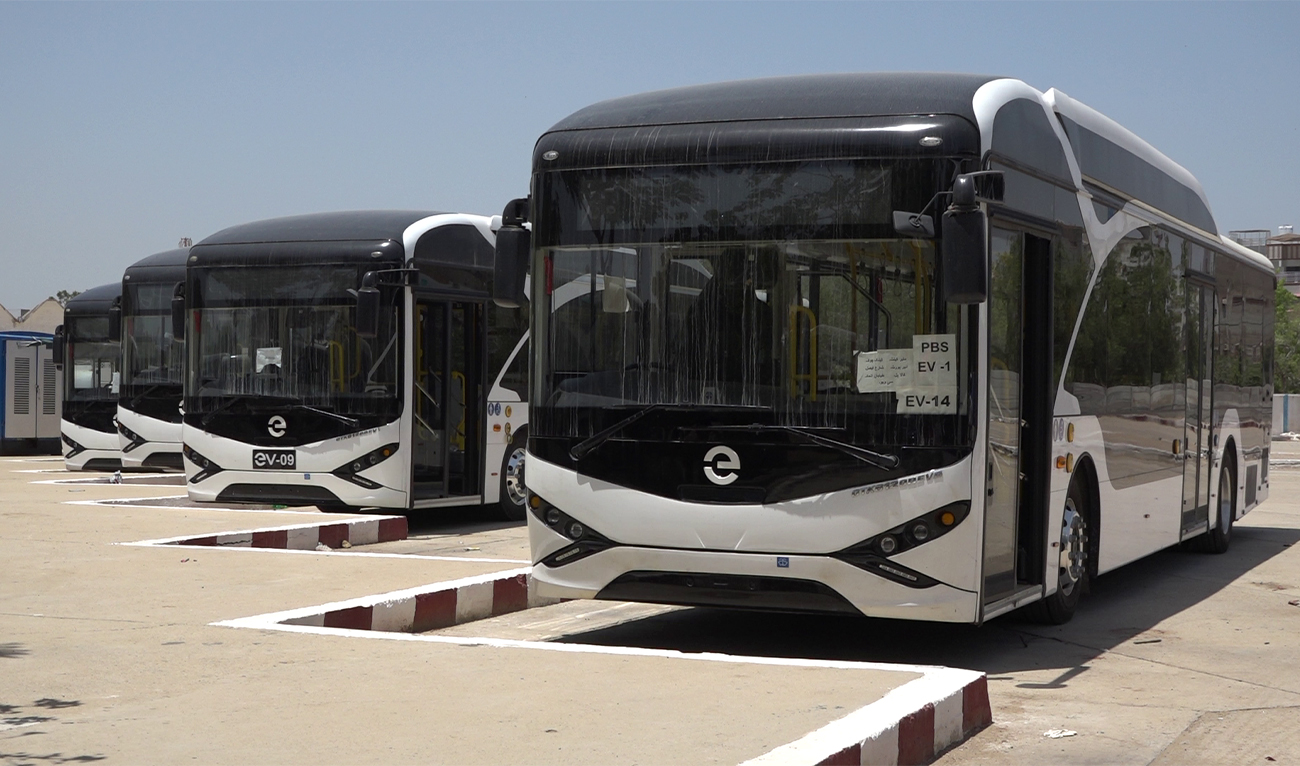
The picture taken on May 10, 2023, shows electric buses parked at a station in Karachi, Pakistan. (AN Photo)
Pakistan’s transport imports stood at more than $1.5 billion during the current fiscal year between July and March. This was 54 percent lower than the year before due to the general import restrictions imposed by the federal authorities to control dollar outflows.
The local manufacturing initiative planned by the Sindh government represents a significant step toward self-sufficiency in the production of luxury buses for public transit systems.
The Sindh government is also charging Rs50 ($0.18) per passenger which is a highly subsidized rate.
“It is completely subsidized because 100 percent investment on buses was done by the government of Sindh,” Memon said. “Now, we have given this project to an operator.”
Focus on electric vehicles
With the help of the World Bank and the ADB, the minister said, the provincial government intended to introduce more electric buses in Karachi, a city of roughly 15 million people, to bring down the fuel costs and reduce the amount of subsidy given to the transport sector.
At present, there are 25 electric buses operating in Karachi, while 35 more will hit the roads soon. The fare of these buses ranges from Rs50 to Rs100 – or about 18 to 36 cents – depending on the distance.
“We are 100 percent focusing on EV buses [because] the government will give less subsidy [and] our cost of oil will be reduced,” he said. “My priority was to make the transport cost-effective for the public.”
These electric buses are 9-12-meter long with a seating capacity of 35 to 45 people. They are wheelchair friendly and offer a separate seating arrangement for differently-abled persons. The buses have fire alerts, emergency exits, and mobile charging ports for commuters.
Sohaib Shafiq, the director of the Red Line bus service, said the project was financed through foreign direct investment. He said they would bring another 200 buses on roads for different BRT projects once approved by the provincial cabinet.
“The remaining 300 buses will be there within four months.”
Shafiq said EV buses were not just cost-effective but also “low maintenance.”
Electric buses take an hour and a half to fully charge and the one-time charge lasts for over 200 kilometers, according to the official. The power requirement for electric buses is 60 megawatts per 1,000 yards and currently, they are buying electricity from K-Electric but will be shifted on solar power in the future.
Fauzia Sajid, a Karachi-based teacher who has been using the new vehicles for a few days, said the electric buses were more comfortable as compared to outdated, fuel-run buses.
“The doors are comfortable to enter or exit. The fare is less as compared to other modes of transport,” she told Arab News.
“These [buses] are environment-friendly and are necessary for Karachi because the population is too big.”

The picture taken on May 10, 2023, shows commuters traveling on an electric bus in Karachi, Pakistan. (AN Photo)