

‘I want to live in peace like the rest of the world’s children’: Palestinian teen’s plea to Pope Francis

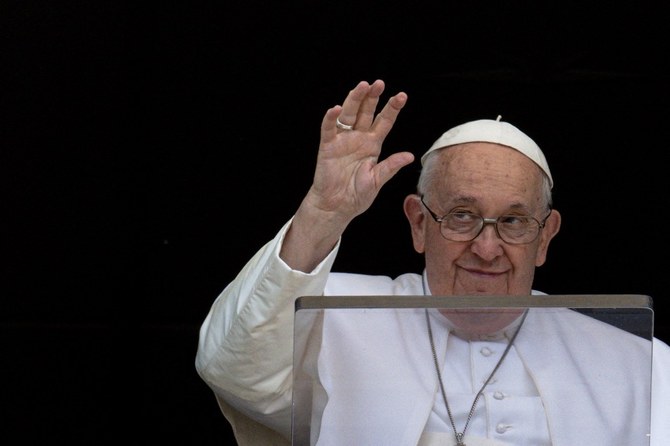
Pope Francis waves as he leads Regina Caeli prayer from his window at the Vatican. (Reuters)
Short Url
Updated 12 May 2023
Follow

‘I want to live in peace like the rest of the world’s children’: Palestinian teen’s plea to Pope Francis

  • Head of the UN agency for Palestinian refugees delivered the letter from the 15-year-old girl, who lives in a refugee camp and dreams of building a better life for herself and others
  • During their meeting at the Vatican, Philippe Lazzarini asked the pope for help ensuring the plight of 5.9 million Palestinian refugees is not forgotten and their rights are protected

LONDON: Pope Francis received a moving letter from a young Palestinian refugee when Philippe Lazzarini, commissioner-general of the UN Relief and Works Agency for Palestine Refugees in the Near East, visited the pontiff at the Vatican on Thursday.

During their meeting, Lazzarini detailed the unprecedented challenges Palestine refugees continue to face, particularly in light of the lack of any prospect of a solution to their plight.

“As we approach the 75th anniversary of UNRWA, support for the human rights of Palestine Refugees and the work of UNRWA is more vital than ever to help them achieve a dignified life,” Lazzarini said.

“The serious financial crisis that the agency continues to face risks undoing the human development gains of Palestine refugees.”

Lazzarini shared with the pope firsthand testimonies gathered from refugees during recent visits to Syria and Lebanon in the aftermath of the devastating earthquakes that hit parts in Syria and Turkiye in February.

He also presented Pope Francis with a letter written by a 15-year-old girl called Leen, a UNRWA student parliamentarian who lives in the Dheisheh refugee camp near the occupied West Bank city of Bethlehem.

She wrote: “Like other children in the camp, I want to complete my education so I can build a good future for myself and help my family and the people in the camp improve their lives.

“As a Palestine refugee, I want to live in peace like the rest of the world’s children. We want our rights, we want to live in freedom, peace and security, and we want to go to school in peace and without fear.”

Lazzarini also briefed the pope on the vital work carried out by UNRWA, including education projects in more than 700 schools serving more than half a million young refugees. The education program is the single largest program the agency operates and is, it says, shaped by the values of peace and tolerance.

Lazzarini asked the Pope for his help in ensuring that the plight of 5.9 million Palestinian refugees is not forgotten and their right to live in peace and dignity is protected.


Iraq says it will prosecute Daesh detainees sent from Syria

Updated 8 sec ago
Follow

Iraq says it will prosecute Daesh detainees sent from Syria

  • Iraq government says transfer was pre-emptive step to protect national security
  • Prosoners have been held for years in prisons and camps guarded by the Kurdish-led SDF
BAGHDAD: Iraq’s Supreme Judicial Council said on Thursday it would begin ​legal proceedings against Daesh detainees transferred from Syria, after the rapid collapse of Kurdish-led forces in northeast Syria triggered concerns over prison security.
More than 10,000 members of the ultra-hard-line militant group have been held for years in about a dozen prisons and detention camps guarded by the Kurdish-led Syrian Democratic Forces (SDF) in Syria’s northeast.
The US military said on Tuesday its forces had transferred 150 Daesh detainees from Syria to Iraq and that the operation could eventually see up to 7,000 detainees moved out of Syria.
It cited concerns over security at the prisons, which also hold thousands more women and children with ties to the militant group, after military setbacks ‌suffered by the ‌SDF.
A US official told Reuters on Tuesday that about 200 low-level ‌Daesh ⁠fighters ​escaped from ‌Syria’s Shaddadi prison, although Syrian government forces had recaptured many of them.
Iraqi officials said Prime Minister Mohammed Shia Al-Sudani mentioned the transfer of Daesh prisoners to Iraq in a phone call with Syrian President Ahmad Al-Sharaa on Tuesday, adding that the transfers went ahead following a formal request by the Iraqi government to Syrian authorities.
Iraqi government spokesperson Basim Al-Awadi said the transfer was “a pre-emptive step to protect Iraq’s national security,” adding that Baghdad could not delay action given the rapid pace of security and political developments in Syria.
Daesh emerged in Iraq and Syria, and at the ⁠height of its power from 2014-2017 held swathes of the two countries. The group was defeated after a military campaign by ‌a US-led coalition.
An Iraqi military spokesperson confirmed that Iraq had received ‍a first batch of 150 Daesh detainees, including ‍Iraqis and foreigners, and said the number of future transfers would depend on security and field assessments. The ‍spokesperson described the detainees as senior figures within the group.
In a statement, the Supreme Judicial Council said Iraqi courts would take “due legal measures” against the detainees once they are handed over and placed in specialized correctional facilities, citing the Iraqi constitution and criminal laws.
“All suspects, regardless of their nationalities or positions within the terrorist ​organization, are subject exclusively to the authority of the Iraqi judiciary,” the statement said.
Iraqi officials say under the legal measures, Daesh detainees will be separated, with senior figures including foreign nationals to ⁠be held at a high-security detention facility near Baghdad airport that was previously used by US forces.
Two Iraqi legal sources said the Daesh detainees sent from Syria include a mix of nationalities, with Iraqis making up the largest group, alongside Arab fighters from other countries as well as European and other ‌Western nationals.
The sources said the detainees include nationals of Britain, Germany, France, Belgium and Sweden, and other European Union countries, and will be prosecuted under Iraqi jurisdiction.