Indonesia says ASEAN credibility at stake as Myanmar crisis worsens

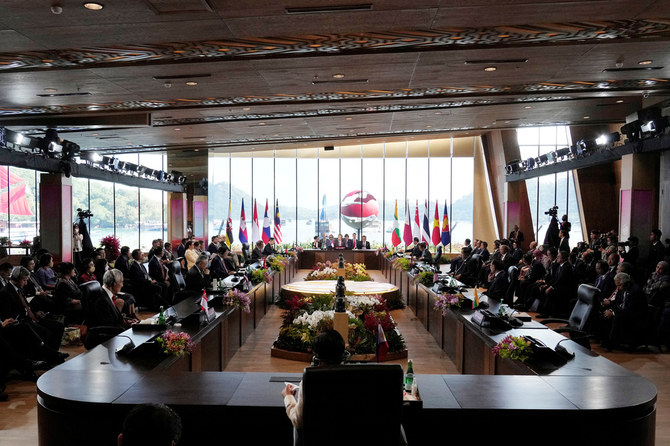
ASEAN leaders attend the 42nd ASEAN Summit in Labuan Bajo, East Nusa Tenggara province, Indonesia, on May 10, 2023. (Reuters)
Short Url
Updated 12 May 2023
Follow

Indonesia says ASEAN credibility at stake as Myanmar crisis worsens

  • Indonesia acknowledges lack of progress in Myanmar peace plan
  • Jakarta says ready to engage anyone, including junta, other groups

JAKARTA: Indonesian President Joko Widodo said on Thursday that the credibility of the Association of Southeast Asian Nations is at stake, as the bloc comes under increasing pressure over the lack of progress in ending ongoing deadly violence in Myanmar.
ASEAN leaders met this week for the first of their biannual summits in Labuan Bajo, East Nusa Tenggara, with the exception of Myanmar’s junta leaders who have been barred from attending over their lack of progress in implementing a peace plan endorsed by the regional grouping in 2021.
More than two years since the military junta seized power and unleashed a bloody crackdown on opponents, violence in Myanmar has been on the rise. One of the most recent incidents included an attack on an aid convoy comprised of Indonesian and Singaporean diplomats.
“ASEAN’s credibility is at stake, and Indonesia is ready to talk with anyone, including with the junta, and all the stakeholders in Myanmar for the sake of humanity,” Widodo told a press briefing at the summit’s conclusion.
He added that “engagement doesn’t mean recognition.”
As ASEAN chair this year, Indonesia said it has engaged many stakeholders in Myanmar to discuss possible solutions, as it continues to push for dialogue and the implementation of its peace plan, which has not been enforced since the bloc forged it with Myanmar’s top general in April 2021.
The Five-Point Consensus plan, also referred to as 5PC, called for an immediate end to the violence in Myanmar and dialogue among contending parties to seek a peaceful solution, to be brokered by an ASEAN special envoy.
“I have to be honest, there has been no significant progress in the implementation of the Five-Point Consensus, so we need ASEAN unity to formulate our next steps,” Widodo told Southeast Asian leaders.
More than 3,450 people have been killed by security forces since the junta took power, and thousands more remain imprisoned, according to the Assistance Association for Political Prisoners, a non-governmental organization that tracks killings and arrests.
In April, an airstrike killed at least 100 people, who were mostly civilians and included many children. Human Rights Watch on Tuesday described the attack as a war crime.
“There is disunity within ASEAN regarding on how it should actually deal with Myanmar crisis to some extent,” Lina Alexandra, senior researcher at the Center for Strategic and International Studies, told Arab News.
“This is a very crucial time for Indonesia and the fact that there is no progress that means Indonesia needs to work harder,” she said. “Indonesia (needs) to be much more bold … and also to be more brave, particularly to discuss this further with the other ASEAN leaders … to push for a breakthrough.”
In a review meeting held last November, ASEAN leaders highlighted the “need for an implementation plan that outlines concrete, practical and measurable indicators with a specific timeline to support the Five-Point Consensus” and delegated their foreign ministers to develop one.
“If Indonesia chairmanship this year, you know, can really say ‘this is the implementation plan that ASEAN has decided on how we can implement the 5PC’ — that will be a major achievement,” Alexandra said.
Even though Indonesia has acknowledged the lack of progress, a solution to the problem remains to be found.
“Restating the problem is not really solving the problem, right?” Alexandra said. “Here’s the problem, so what’s your solution, proposed solution to that?”


US immigration officials grilled by Congress over Trump crackdown

Updated 2 sec ago
Follow

US immigration officials grilled by Congress over Trump crackdown

  • Trump administration officials faced a barrage of criticism and tough questions from Democratic lawmakers over the major crackdown on migrants in multiple US cities
  • Rodney Scott hailed efforts on the southern US frontier, saying CBP ‘spent the last year rebuilding what was an intentionally broken border’
WASHINGTON: The heads of US immigration agencies faced heavy criticism in Congress Tuesday as they defended President Donald Trump’s mass deportation drive and fielded questions about the fatal shootings of two protesters in Minneapolis.
Trump acknowledged in the wake of the Minneapolis killings that a “softer touch” may be needed on immigration, and his administration announced concessions including the withdrawal of hundreds of officers from the Midwestern city.
But the issue remains far from resolved, with Democrats demanding changes to the way the Department of Homeland Security (DHS) conducts its immigration sweeps and threatening to block its funding, while Trump’s administration vows to maintain its deportation efforts, with backing from Republican lawmakers.
“The president tasked us with mass deportation, and we are fulfilling that mandate,” Todd Lyons, the acting head of Immigration and Customs Enforcement (ICE), said in his opening remarks during the Tuesday hearing on DHS oversight.
He testified alongside Rodney Scott, the head of US Customs and Border Protection (CBP), and Citizenship and Immigration Services director Joseph Edlow.
Scott hailed efforts on the southern US frontier, saying CBP “spent the last year rebuilding what was an intentionally broken border” and that “the United States... enjoys the most secure border in our nation’s history.”
The Trump administration officials faced a barrage of criticism and tough questions from Democratic lawmakers over the major crackdown on migrants in multiple US cities, which Republican representatives largely defended.
“This administration and the agencies represented before us have shown a complete and utter disregard for the law and the Constitution,” Democratic Representative Tim Kennedy said.
Representative Eli Crane, a Republican, pushed back on criticism of immigration enforcement, accusing Democrats of seeking to “demonize ICE and Homeland Security.”

‘Days, not weeks’

In Minneapolis, thousands of federal agents have in recent weeks conducted raids in what the administration claims are targeted operations against criminals.
Minnesota Governor Tim Walz said Tuesday that he expects the crackdown — which has seen detentions of broad categories of immigrants and sometimes citizens — to end soon.
“We’re very much in a ‘trust but verify’ mode. But it’s my expectation... that we are talking days, not weeks and months, of this occupation,” Walz said.
The operations have sparked mass protests in Minneapolis, and the fatal shootings of US citizens Renee Good and Alex Pretti less than three weeks apart last month led to a wave of outrage.
When Democratic Representative Eric Swalwell asked Tuesday if Lyons would apologize to Good and Pretti’s families over the Trump administration’s initial description of them as “domestic terrorists,” he declined, saying he would not comment on active investigations.
Opposition Democrats have been calling for sweeping reforms to ICE operations, including ending mobile patrols, prohibiting agents from concealing their faces, and requiring warrants.
Democratic leaders in Congress are also threatening to block the 2026 funding bill for DHS. The White House has indicated it is willing to negotiate, but its response has failed to satisfy opposition lawmakers so far.
“Republicans shared an outline of a counterproposal, which included neither details nor legislative text,” House Minority Leader Hakeem Jeffries and Senate Minority Leader Chuck Schumer said in a statement.
They denounced the White House response as “incomplete and insufficient in terms of addressing the concerns Americans have about ICE’s lawless conduct,” and said they were awaiting further details.
If negotiations fail, DHS could face a funding shortfall starting Saturday. CBP and ICE operations could continue using funds approved by Congress last year, but other sub-agencies such as federal disaster organization FEMA could be affected.