

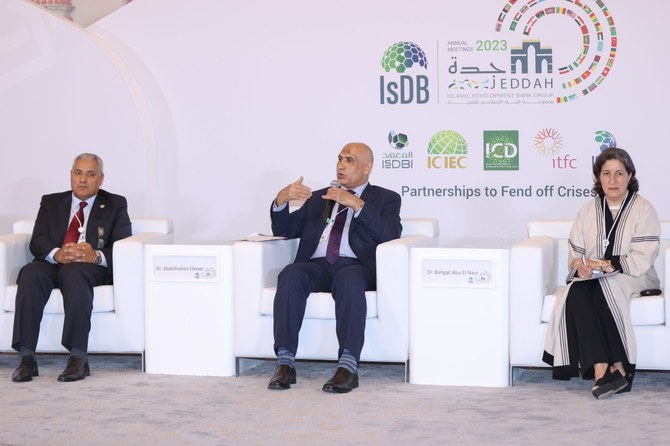

JEDDAH: High-level representatives of Islamic Development Bank Group member countries, and other regional and international experts gathered in Jeddah on May 10 for the 48th Annual Meetings of the group, which included the launch of its Integration Report for Arab Countries.
In his keynote speech, the chairman of the group, Mohammed Al-Jasser, said it is working to overcome the obstacles to economic integration and capitalize on available opportunities at the regional and international levels, while helping to improve revenues across the Arab world and increase the region’s contributions to the global economy.
Trade and investment are two vital areas through which the group aims to support member countries, by effectively implementing regional agreements, he added.
The discussions revolved around the contents of the group’s latest Integration Report, which includes information about the extent of economic integration in the Arab world in a number of sectors, including trade and investment, the financial markets, IT connectivity, and logistics.
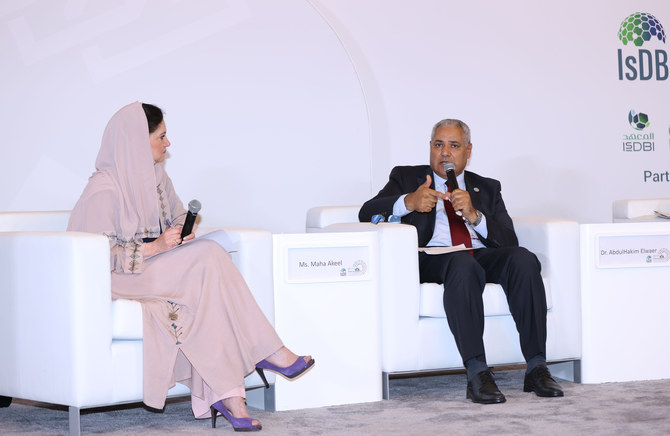
Abdul Hakim Elwaer, assistant director-general of the UN’s Food and Agriculture Organization, said that economic integration can help improve food security in the Arab region. There are a number of challenges to achieving this, he added, some of which are political and some social or environmental.

Abdul Hakim Elwaer, assistant director-general of the UN’s Food and Agriculture Organization. (AN photo)
“The Arab region is the most arid region in the world and with the increasing effects of climate change, coupled with scarcity of water resources, urban encroachment and overpopulation, the situation will not improve in the future but rather it will worsen and the region will have to face several challenges,” Elwaer said.
It is important to create more opportunities for economic integration in the Arab world, and river basin countries in particular, as they are better placed to supply food and water resources to countries that need them, he added.
Sami Al-Suwailem, acting director-general of the Islamic Development Bank Group Institute and its chief economist, said that economic and trade integration play a major role in building stable economies and boosting the wealth of countries.

Sami Al-Suwailem, acting director-general of the Islamic Development Bank Group Institute and its chief economist. (AN photo)
“It is important to focus more on efficiency and productivity to achieve economic integration, and on sharing best practices among the member countries through South-South Cooperation,” he said.
Bahgat Abu El-Nasr, director of the Arab League’s Arab Economic Integration Department, talked about the role of trade in regional economic integration, including the need for the political will to develop trade relationships, and highlighted the implementation of major regional integration initiatives, including the Greater Arab Free Trade Area and the Arab Customs Union.
Lilia Hachem Naas, chief officer for the Middle East and North Africa at the International Trade Centre in Geneva, discussed the effects that economic integration can have in increasing productivity in the Arab world. She said trade is a key tool for strengthening regional integration and can act as a driver for the creation of job opportunities.
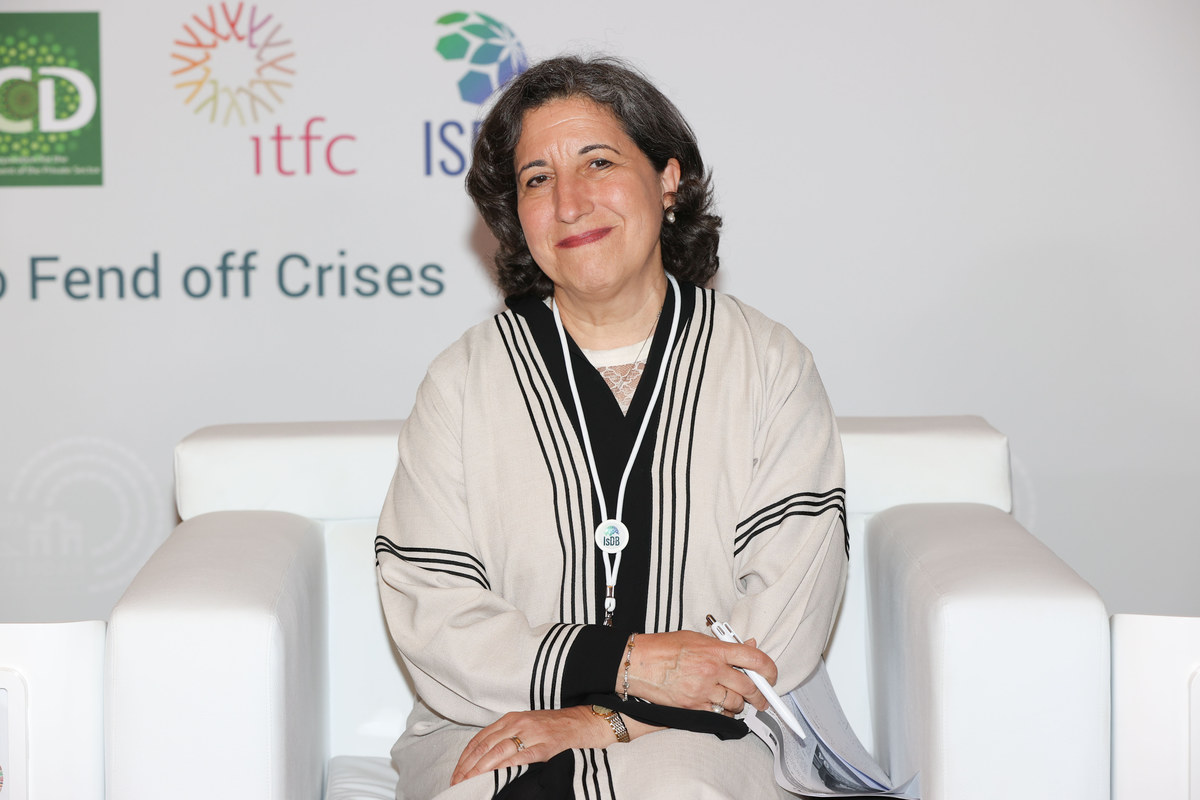
Lilia Hachem Naas, chief officer for the Middle East and North Africa at the International Trade Centre in Geneva. (AN photo)
“To overcome this obstacle of regional integration, a mechanism for transparency should be established between the public and the private sectors,” Naas added.


