

Saudi IsDB approves $1.12bn for development projects in 9 countries

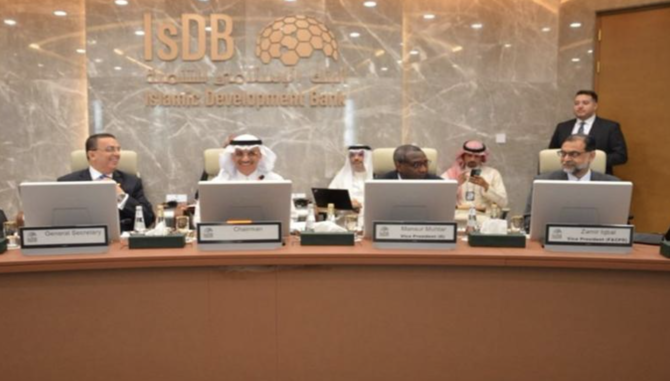
The bank’s board of executive directors approved this funding during its 347th session held on Sept. 10 in Jeddah. (Supplied)
Short Url
Updated 11 September 2022
Follow

Saudi IsDB approves $1.12bn for development projects in 9 countries

RIYADH: Saudi Arabia-based Islamic Development Bank has approved $1.12 billion for financing development projects for various sectors in nine member countries, according to a statement. 

It has also approved a grant worth $1.79 million for a number of other projects including market access readiness in Yemen and special assistance grants to Muslim communities in three non-member countries.

The bank’s board of executive directors approved this funding during its 347th session held on Sept. 10 in Jeddah.

In the session, headed by the bank’s president and chairman Muhammad Al-Jasser, the bank also discussed the existing financing gap in the energy infrastructure of some of the member countries.

Accordingly, the lender approved two energy sector public-private partnership projects for Uzbekistan and Uganda.

This happens as the countries’ governments use the PPP financing model to attract private sector investment expertise to deliver improved public services and accelerate economic growth.

The 100 million euro ($101 million) Surkhandarya Combined Cycle Power Plant Project in Uzbekistan is expected to meet the growing demand for the country’s energy consumption. 

It will also enable the country to phase out its aging and inefficient fleet of gas-fired thermal power plants, the lender said.

With regards to Uganda, the $100 million financing, which is part of the Islamic tranche, will allow the country to capitalize on its oil reserves and export oil to international markets through a 1443-kilometer cross-border buried-heated crude oil pipeline.

In the sustainable transport sector, IsDB approved $601.7 million as sovereign financing for transport projects in Guyana, Uzbekistan, and Uganda. 

These projects are expected to enhance transport infrastructure, facilitate market access for farmers and traders, and boost tourism.

In August, the bank’s President Mohammed Al-Jasser met with Uzbekistan President Shavkat Mirziyoyev to discuss strengthening cooperation between both parties, Saudi Press Agency reported.

A letter of intent was signed during the meeting to provide a framework for facilitating cooperation, promoting rapid processing and approval of projects and operations that are part of the work program of the IsDB Group for Uzbekistan in 2022.

During their meeting, the two sides also emphasized the need to facilitate the joining of more co-financiers to participate in financing large projects.


Foreigners buy $453m in shares in 2nd week after Tadawul opens to global investors 

Updated 9 sec ago
Follow

Foreigners buy $453m in shares in 2nd week after Tadawul opens to global investors 

RIYADH: Foreign investors made net purchases of approximately SR1.7 billion ($453 million) in Saudi stocks last week, the second week after the market was opened to all categories of non-resident foreign investors — both individuals and institutions — from around the world, directly and without conditions. 

According to the Financial Analysis Unit at Al-Eqtisadiah newspaper, the purchases came primarily from foreign institutions, including those qualified under the previous definition as well as institutions newly permitted to invest after the market opening that manage assets of less than $500 million.  

Individuals who were allowed to invest directly in the market for the first time recorded net sales — the difference between total sales and purchases — of approximately SR31 million in the second week, after purchases of SR39 million in the first week. 

$2.13bn since market opening 

Following last week’s activity, net foreign buying of Saudi stocks rose to SR3.1 billion in the first two weeks since the market opened, and nearly SR8 billion since the opening was announced on Jan. 6. 

Foreign investors recorded net purchases of SR5 billion in January, the largest monthly buying since 2022, excluding June 2024 — which saw the Aramco secondary offering — and September 2025, when a Bloomberg report said the Saudi Capital Market Authority was considering allowing foreigners to own majority stakes in listed companies. 

The new amendments, which came into effect on Feb. 1, eliminated the regulatory framework for swap agreements that had allowed non-resident investors to gain only economic exposure to listed securities. The changes now permit direct investment in shares listed on the main market. 

Foreign buying over the past month and week was likely driven by active funds. With restrictions eased, the market’s weighting in emerging market indices is expected to increase, potentially attracting additional liquidity from passive funds that track index weightings. 

The most significant impact on the Tadawul All Share Index’s weighting in emerging market benchmarks is expected after the Capital Market Authority approves amendments to foreign ownership limits in listed companies. 

Gradual improvement in investments 

The decision, effective from the start of this month, is expected to gradually improve foreign investment and market liquidity in the medium and long term. It could also support fairer valuations, broaden the investor base, increase market depth and enhance efficiency. 

The market value of foreign ownership in Saudi stocks reached approximately SR458 billion by the end of last week, representing 4.85 percent of total market capitalization and 12.65 percent of the Tadawul All Share Index’s free float. 

Foreign investment rules in Saudi stocks 

Foreign investments remain subject to several limits. Non-resident foreign investors — excluding strategic investors — may not own 10 percent or more of shares in any listed issuer or its convertible debt instruments. 

Foreign investors collectively — whether resident or non-resident, and excluding strategic investors — may not own more than 49 percent of any listed company or its convertible debt instruments. 

Additional restrictions may arise from company bylaws, sector regulations or instructions issued by relevant authorities. 

Evolution of foreign flows 

Saudi stocks attracted net foreign inflows of SR20.7 billion during 2025, a slight 1 percent decline from 2024, though foreigners remained the largest buyers as the index fell 13 percent. 

These purchases lifted cumulative net foreign direct investment in Saudi equities to SR235 billion since the Kingdom joined emerging market indices in early 2019. 

Foreign purchases declined in 2020 during the pandemic and again in 2023, while 2025 marked the third year of decline. In other years, inflows increased. 

The strongest inflows came in 2019, totaling about SR91.2 billion following emerging market inclusion, while 2023 recorded the lowest at SR14.2 billion.