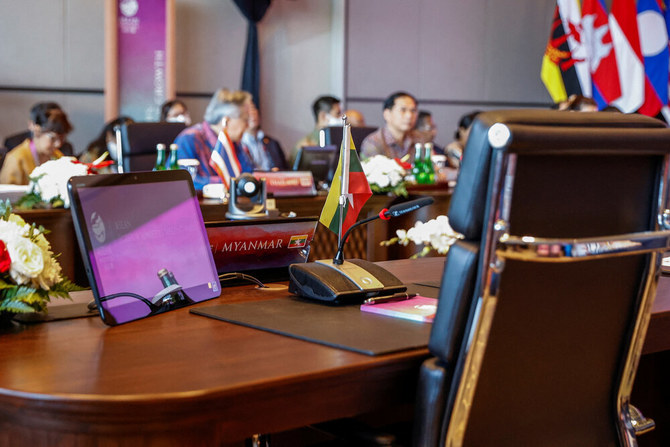
JAKARTA: Southeast Asian nations are “at a crossroads,” a senior Indonesian minister said on Tuesday, as top envoys of the Association of Southeast Asian Nations convened for the bloc’s biannual summit amid a series of challenges, including increasing deadly violence in Myanmar.
Myanmar has been gripped by escalating violence, which started when the military junta seized power from the elected government of Aung San Suu Kyi in 2021 and unleashed a bloody crackdown on dissent.
The crisis in Myanmar has put ASEAN’s role under the spotlight over the last two years as fallout from the coup worsened, with the bloc’s chair Indonesia and member state Singapore condemning an attack on Sunday on an aid convoy that included their diplomats.
“ASEAN is now at a crossroads. Crisis after crisis is testing our power as a community. If we fail to overcome them it risks endangering our relevance,” Indonesia’s chief security minister, Mahfud MD, said during the ASEAN Political Security Community council meeting on Tuesday.
“Externally, we are faced with rivalry between big powers that could potentially divide our group … internally, we face the prolonged crisis in Myanmar and the humanitarian crisis it brings.”
Indonesia is hosting the first of the biannual ASEAN summits in Labuan Bajo, East Nusa Tenggara, this week. Myanmar’s junta leaders have been barred from attending over their lack of progress in implementing a peace plan endorsed by the regional bloc in 2021.
Mahfud’s remarks come as ASEAN foreign ministers finalize the agenda ahead of a leaders’ meeting on Wednesday.
“The foreign ministers also discussed the Myanmar issue, including the recent attack that occurred when AHA Center and the ASEAN monitoring team was about to deliver humanitarian aid,” Indonesian Foreign Minister Retno Marsudi said in a press briefing, without elaborating further.
She said last week that Indonesia has been quietly engaging Myanmar’s junta, shadow government and armed ethnic groups in an effort to start a peace process.
While it remained unclear who was behind Sunday’s attack on the aid convoy that included Indonesian and Singaporean diplomats, Human Rights Watch warned that it “should serve as a wake-up call for ASEAN.”
HRW Deputy Asia Director Phil Robertson told Arab News that the group’s statements of condemnation only “mask the reality that they still have not figured any way to meaningfully pressure the Myanmar military junta to come to the bargaining table.”


ASEAN ‘at a crossroads’ as leaders convene amid escalating Myanmar violence
https://arab.news/v2xvp
ASEAN ‘at a crossroads’ as leaders convene amid escalating Myanmar violence

- Indonesian, Singaporean envoys were in aid convoy attacked in Myanmar on Sunday
- Bloc leaders are meeting in Indonesia’s Labuan Bajo this week for biannual summit


South Sudan officers face court martial over civilian massacre
- The increasingly unstable country is seeing a surge of fighting between government and opposition forces
JUBA: South Sudanese soldiers, including two officers, will face a court martial over a civilian massacre last month, the army spokesman said Wednesday.
The increasingly unstable country is seeing a surge of fighting between government and opposition forces, much of it in eastern Jonglei state where at least 280,000 people have been displaced since December according to the UN.
At least 25 civilians, including women and children, were killed in Ayod County in Jonglei state on February 21, according to the opposition.
Army spokesman Lul Ruai Koang said that two officers, including a major, and several non-commissioned officers, had been arrested and would face charges in the capital Juba, “before they are arraigned before a competent military court martial.”
He said the deaths were attributed to “some elements” under Gen. Johnson Olony, who was filmed in January ordering troops to “spare no lives” in Jonglei.
Koang said the soldiers had “moved out without the knowledge or authorization of the division commander.”
He also said they had been part of a militia group allied to opposition forces, parts of which had not yet been fully integrated into the army.
Military integration was among the core principles of a peace agreement that ended South Sudan’s five-year civil war in 2018 between President Salva Kiir and his long-time rival, Riek Machar, but it was never implemented.
Koang said the army regretted the loss of lives, adding: “We would like to once again remind our forces that their mandate is to protect civilians and their property, not to do the opposite.”
It followed an impassioned plea from the Sudan and South Sudan Catholic Bishops’ Conference on recent civilian killings — in Ayod, and also in Abiemnom County near the Sudan border where at least 169 people were killed on Sunday.
“We implore you to deploy resources to protect vulnerable populations and foster a climate of dialogue and reconciliation instead of violence and revenge, consoling the bereaved and supporting the afflicted,” it said in a statement.


