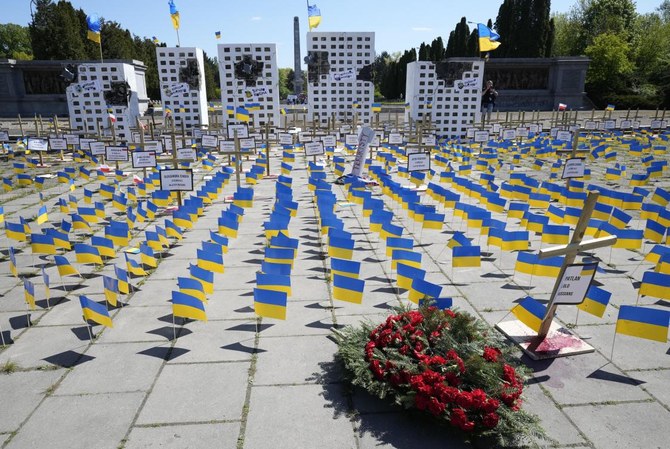
WARSAW: A large installation representing Russian atrocities in Ukraine blocked the path of Russia’s ambassador to Poland as he sought Tuesday to place a wreath at a Warsaw memorial to Soviet soldiers on Russia’s Victory Day holiday.
The installation included hundreds of fluttering blue and yellow Ukrainian flags and crosses serving as symbolic grave markers for Ukrainians killed by Russians during the full-scale war launched by Moscow last year.
A pool of fake blood below the crosses underlined the stark message of the protest, which was created by Euromaidan-Warszawa, a citizens’ initiative that supports Ukraine.
Organizer Viktoria Pogrebniak said the installation, set up for the day at the entrance to the Red Army memorial site, was meant to fight back against Russian propaganda, and “show the real picture to the world.”
“We are bombed, we are killed, we are raped,” Pogrebniak said. “We are killed just because we are Ukrainians.”
She said the ambassador and other Russian diplomats would have to walk over the symbolic corpses of Ukrainians “or will need to go through the bushes,” if they wanted to reach the memorial.
With his path blocked, Ambassador Sergey Andreev instead left a wreath of red carnations in front of the hundreds of Ukrainian flags as loudspeakers blasted the sounds of bombs and air sirens.
The installation also included large mock-ups of bombed buildings and the names of Ukrainian cities where Russia has carried out atrocities against Ukrainians: Bucha, Irpin, Mariupol, Bakhmut.
The protesters surrounded Andreev and his entourage and yelled “Ruscists,” an insult that combines the words “Russians” and “fascists.”
Andreev, who was doused with a red liquid at the same place on Victory Day last year, vowed to return later in the day.
Some Poles also showed up through the morning and did make their way across the symbolic cemetery or through the bushes to reach the Red Army memorial to leave flowers. That triggered the anger of the protesters who denounced them as “provocateurs” serving the Kremlin’s interests.
“They are traitors to Poland,” shouted one activist, Katarzyna Augustynek. She seized a bouquet of white carnations left by a woman and threw it to the ground, triggering an angry exchange with the other woman.
The Red Army soldiers died in the fight against Nazi Germany during World War II. But many Poles also remember how they carried out rapes and other crimes, and they resent the decades of Soviet control that came next for their nation.
Poland threw off Moscow-backed communism in 1989 and today is a strong ally of Ukraine. Poland is supplying weapons to Kyiv and giving refuge to many Ukrainians, and there are very few who actually support Moscow.


![]()

Ukraine flags block Russian ambassador’s path on Victory Day
Short Url
https://arab.news/6wxh4
Ukraine flags block Russian ambassador’s path on Victory Day
- The installation included hundreds of fluttering blue and yellow Ukrainian flags and crosses serving as symbolic grave markers for Ukrainians killed by Russians
- Organizer Viktoria Pogrebniak said the installation, set up for the day at the entrance to the Red Army memorial site, was meant to fight back against Russian propaganda


Latest updates


© 2026 SAUDI RESEARCH & PUBLISHING COMPANY, All Rights Reserved And subject to Terms of Use Agreement.