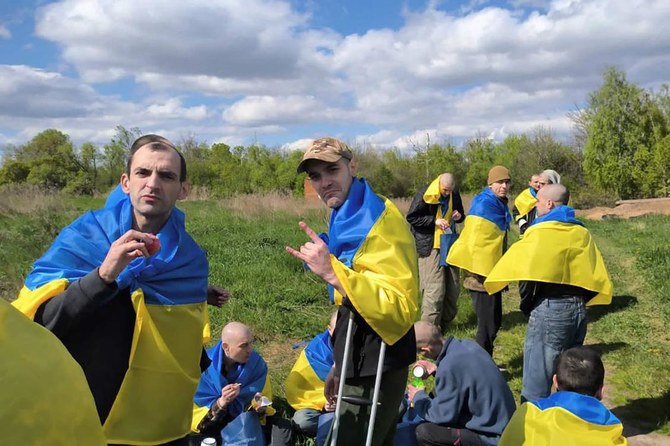
KYIV: Ukraine on Saturday hailed the return of 45 Azov battalion fighters captured during the battle for Mariupol while Russia said three of its pilots had been released by Kyiv, but neither side gave a full account of the apparent prisoner swap.
The freed Ukrainian prisoners included 42 men and three women from the Azov battalion, said Andriy Yermak, the head of President Volodymyr Zelensky’s office.
Azov battalion fighters, who did much of the fighting in the failed defense of the port city of Mariupol, have been lionized as heroes by many Ukrainians but are widely vilified in Russia.
“Excellent news on this sunny day. We are returning home 45 of our people. Thirty-five privates and sergeants, 10 officers,” Yermak said on the telegram app in a post that did not mention the release of Russian prisoners.
The Russian Defense Ministry said in a statement that three pilots had been returned and were being provided with medical and psychological assistance.
“As a result of a difficult negotiation process, three Russian pilots of the Russian Aerospace Forces, who had been in mortal danger while in captivity, were returned from Kyiv-controlled territory,” said the statement, which did not mention the 45 Ukrainian prisoners. There were no reports on Russian state media of additional Russian prisoner releases.
Ukraine’s military intelligence agency, which coordinates prisoner exchanges with Russia, did not immediately respond to a request for more details.
Moscow and Kyiv have agreed a number prisoner exchanges since Russia’s full-scale invasion in February last year.
Russia says it launched its “special military operation” to counter a threat from Kyiv’s relations with the West, while Ukraine and its Western partners say it was an unprovoked land grab.

Ukraine hails return of 45 Azov fighters, Russia says 3 pilots released
Short Url
https://arab.news/57bmt
Ukraine hails return of 45 Azov fighters, Russia says 3 pilots released
- The freed Ukrainian prisoners included 42 men and three women from the Azov battalion
- Azov battalion fighters have been lionized as heroes by many Ukrainians but are widely vilified in Russia
Protesters storm offices of leading Bangladesh dailies after a 2024 uprising activist dies
DHAKA: Angry protesters stormed the offices of Bangladesh’s two leading newspapers late Thursday after the death of a prominent activist in last year’s political uprising in Bangladesh. The crowds set fire to the building of one of the dailies, trapping journalists and other staff inside.
Hours later, the journalists and other staff were evacuated, and the fire was brought under control early Friday.
It was not clear why the protesters attacked the newspapers whose editors are known to be closely connected with the country’s interim leader, Nobel Peace Prize laureate Muhammad Yunus. Protests were organized in recent months outside the offices of the dailies by Islamists who blamed the newspapers for their alleged link with India.
Sharif Osman Hadi, a spokesperson for the Inqilab Moncho culture group, died in hospital in Singapore early Thursday evening after a weeklong battle for his life.
He was shot on the streets of Dhaka, the capital of Bangladesh, last Friday while riding on a rickshaw. Two men on a motorbike followed Hadi and one shot him before they fled the scene. After days of treatment in Dhaka, Hadi was flown to Singapore in critical condition.
Authorities have said they identified the suspects and that the shooter had most probably fled to India — remarks that sparked a new diplomatic squabble with India and prompted New Delhi this week to summon Bangladesh’s envoy to express its condemnation. Bangladesh also summoned the Indian envoy to Dhaka and sought clarification.
Hadi was a fierce critic of both neighboring India and former Prime Minister Sheikh Hasina, whose 15-year rule of Bangladesh ended in last year’s uprising.
The Inqilab Moncho group, formed after the ouster of Hasina last year, has been organizing street protests and campaigns denouncing Hasina and India. The country’s Islamists and other Hasina opponents have blamed her government for being subservient to India during her rule.
Hadi had planned to run as an independent candidate in a major constituency in Dhaka in the next national elections which the country’s interim government has announced for February.
Since Hasina’s ouster, the Inqilab Moncho group has promoted anti-Indian sentiment in the Muslim-majority country. Hasina now lives in self-imposed exile in India.
Witnesses and media reports said hundreds of protesters took to the streets of Dhaka immediately after the news of Hadi’s death, rallying on Shahbagh Square near the Dhaka University campus where many chanted slogans such as Allahu Akbar, or God is great in Arabic. There were also similar protests elsewhere in the country.
Later, a group of protesters gathered outside the head office of the country’s leading Bengali-language Prothom Alo daily in Dhaka’s Karwan Bazar area. They then surged into the building, according to online portals of various leading media outlets.
A few hundred yards away, another group of protesters pushed into the premises of the country’s leading English-language Daily Star and set fire to the building, according to footage from Kaler Kantha, another mainstream newspaper.
Soldiers and paramilitary border guards deployed outside the two buildings but did not take any action to disperse the protesters. Security officials tried to convince them to leave peacefully as firefighters arrived at the scene outside the Daily Star building.
The blaze trapped the newspaper’s staff working inside the building late Thursday. One of the Daily Star’s journalists, Zyma Islam, wrote on Facebook that she was inside the building.
“I can’t breathe anymore. There’s too much smoke,” she said.
By early Friday, the fire was brought under control.
The protesters Thursday night also targeted Chhayanaut, a leading cultural institution widely respected by liberals, in Dhaka’s Dhanmondi neighborhood.
Dozens of protesters were still at Shahbagh Friday morning and vowed to continue the protests.
Hadi’s body would be brought to Dhaka from Singapore on Friday evening, authorities said.
The attack on Hadi is still being investigated, but the shooting has set off tensions. Human Rights Watch and Amnesty International have recently expressed concerns over violations of human rights in Bangladesh.
Yunus, who took over three days after Hasina’s ouster in August 2024, promised in a televised address to the nation late Thursday to punish Hadi’s killers.
He announced that Saturday would be a day of mourning and urged the citizens to stay calm.
Yunus’ critics and Hasina’s former Awami League party have blamed the interim government for the rise of Islamists in Bangladesh, a parliamentary democracy with a history of political violence.
The interim government has banned all activities by Hasina’s party, including its running in the February election. Last month, a Bangladesh court sentenced Hasina to death on charges of crimes against humanity involving the uprising.
On Wednesday, anti-India protesters attempted to march toward the Indian High Commission in Dhaka, prompting it to close its visa section. After Hasina’s ouster India stopped issuing tourist visas to Bangladeshis, citing security concerns, but continued giving visas for medical treatment in India.
On Thursday, protesters in the southwestern city of Rajshahi tried to march toward the office of a regional Indian diplomat. Police stopped both marches.
Hours later, the journalists and other staff were evacuated, and the fire was brought under control early Friday.
It was not clear why the protesters attacked the newspapers whose editors are known to be closely connected with the country’s interim leader, Nobel Peace Prize laureate Muhammad Yunus. Protests were organized in recent months outside the offices of the dailies by Islamists who blamed the newspapers for their alleged link with India.
Sharif Osman Hadi, a spokesperson for the Inqilab Moncho culture group, died in hospital in Singapore early Thursday evening after a weeklong battle for his life.
He was shot on the streets of Dhaka, the capital of Bangladesh, last Friday while riding on a rickshaw. Two men on a motorbike followed Hadi and one shot him before they fled the scene. After days of treatment in Dhaka, Hadi was flown to Singapore in critical condition.
Authorities have said they identified the suspects and that the shooter had most probably fled to India — remarks that sparked a new diplomatic squabble with India and prompted New Delhi this week to summon Bangladesh’s envoy to express its condemnation. Bangladesh also summoned the Indian envoy to Dhaka and sought clarification.
Hadi was a fierce critic of both neighboring India and former Prime Minister Sheikh Hasina, whose 15-year rule of Bangladesh ended in last year’s uprising.
The Inqilab Moncho group, formed after the ouster of Hasina last year, has been organizing street protests and campaigns denouncing Hasina and India. The country’s Islamists and other Hasina opponents have blamed her government for being subservient to India during her rule.
Hadi had planned to run as an independent candidate in a major constituency in Dhaka in the next national elections which the country’s interim government has announced for February.
Since Hasina’s ouster, the Inqilab Moncho group has promoted anti-Indian sentiment in the Muslim-majority country. Hasina now lives in self-imposed exile in India.
Witnesses and media reports said hundreds of protesters took to the streets of Dhaka immediately after the news of Hadi’s death, rallying on Shahbagh Square near the Dhaka University campus where many chanted slogans such as Allahu Akbar, or God is great in Arabic. There were also similar protests elsewhere in the country.
Later, a group of protesters gathered outside the head office of the country’s leading Bengali-language Prothom Alo daily in Dhaka’s Karwan Bazar area. They then surged into the building, according to online portals of various leading media outlets.
A few hundred yards away, another group of protesters pushed into the premises of the country’s leading English-language Daily Star and set fire to the building, according to footage from Kaler Kantha, another mainstream newspaper.
Soldiers and paramilitary border guards deployed outside the two buildings but did not take any action to disperse the protesters. Security officials tried to convince them to leave peacefully as firefighters arrived at the scene outside the Daily Star building.
The blaze trapped the newspaper’s staff working inside the building late Thursday. One of the Daily Star’s journalists, Zyma Islam, wrote on Facebook that she was inside the building.
“I can’t breathe anymore. There’s too much smoke,” she said.
By early Friday, the fire was brought under control.
The protesters Thursday night also targeted Chhayanaut, a leading cultural institution widely respected by liberals, in Dhaka’s Dhanmondi neighborhood.
Dozens of protesters were still at Shahbagh Friday morning and vowed to continue the protests.
Hadi’s body would be brought to Dhaka from Singapore on Friday evening, authorities said.
The attack on Hadi is still being investigated, but the shooting has set off tensions. Human Rights Watch and Amnesty International have recently expressed concerns over violations of human rights in Bangladesh.
Yunus, who took over three days after Hasina’s ouster in August 2024, promised in a televised address to the nation late Thursday to punish Hadi’s killers.
He announced that Saturday would be a day of mourning and urged the citizens to stay calm.
Yunus’ critics and Hasina’s former Awami League party have blamed the interim government for the rise of Islamists in Bangladesh, a parliamentary democracy with a history of political violence.
The interim government has banned all activities by Hasina’s party, including its running in the February election. Last month, a Bangladesh court sentenced Hasina to death on charges of crimes against humanity involving the uprising.
On Wednesday, anti-India protesters attempted to march toward the Indian High Commission in Dhaka, prompting it to close its visa section. After Hasina’s ouster India stopped issuing tourist visas to Bangladeshis, citing security concerns, but continued giving visas for medical treatment in India.
On Thursday, protesters in the southwestern city of Rajshahi tried to march toward the office of a regional Indian diplomat. Police stopped both marches.
© 2025 SAUDI RESEARCH & PUBLISHING COMPANY, All Rights Reserved And subject to Terms of Use Agreement.


