ISLAMABAD: Some Afghan women employed by the United Nations have been detained, harassed and had restrictions placed on their movements since being banned by the Taliban from working for the world body, the UN said Tuesday.
Afghanistan’s Taliban rulers informed the United Nations early last month that Afghan women employed with the UN mission could no longer report for work.
“This is the most recent in a series of discriminatory – and unlawful – measures implemented by the de facto authorities with the goal of severely restricting women and girls’ participation in most areas of public and daily life in Afghanistan,” the UN said in a report on the human rights situation in the south Asian country.
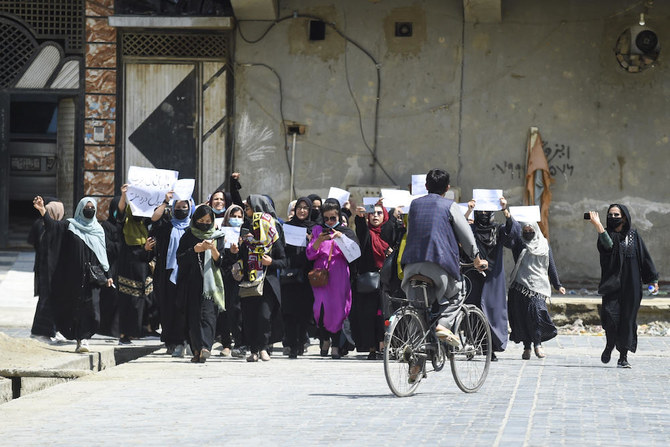
Taliban authorities continued to crack down on dissenting voices this year, in particular those who speak out on issues related to the rights of women and girls, the report said.
The UN report cited the March arrest of four women who were released the following day during a protest demanding access to education and work in the capital of Kabul and the arrest of Matiullah Wesa, head of PenPath, a civil society organization campaigning for the reopening of girls’ schools.
It also pointed to the arrest of a women’s rights activist Parisa Mobariz and her brother in February in the northern Takhar province.
Several other civil society activists have been released — reportedly without being charged — following extended periods of arbitrary detention by the Taliban Intelligence service, the report said.
The measures will have disastrous effects on Afghanistan’s prospects for prosperity, stability and peace, the United Nations Assistance Mission in Afghanistan, UNAMA said in the report.
“UNAMA is concerned by increasing restrictions on civic space across Afghanistan,” said Fiona Frazer, the agency’s human rights chief.
The Taliban previously banned girls from going to school beyond the sixth grade and blocked women from most public life and work. In December, they banned Afghan women from working at local and non-governmental organizations — a measure that at the time did not extend to UN offices.
The report also pointed to ongoing extrajudicial killings of individuals affiliated with the former government. On March 5 in southern Kandahar, Taliban forces arrested a former police officer from his home, then shot and killed him, according to the report. During the same month in northern Balkh, a former military official was killed by unknown armed men in his house, it said.
“Arbitrary arrests and detention of former government officials and Afghanistan National Security and Defense Force members also occurred throughout February, March and April,” added the report.
In a separate report released Monday, the UN strongly criticized the Taliban for carrying out public executions, lashings and stonings since seizing power in Afghanistan, and called on the country’s rulers to halt such practices.
In the past six months alone, 274 men, 58 women and two boys were publicly flogged in Afghanistan, said the report.
The Taliban foreign ministry said in response that Afghanistan’s laws are determined in accordance with Islamic rules and guidelines, and that an overwhelming majority of Afghans follow those rules.
The Taliban began carrying out such punishments shortly after coming to power almost two years ago, despite initial promises of a more moderate rule than during their previous stint in power in the 1990s.
Under the first Taliban regime from 1996 to 2001, public corporal punishment and executions were carried out by officials against individuals convicted of crimes, often in large venues such as sports stadiums and at urban intersections.


UN report: Female Afghan UN employees harassed, detained
https://arab.news/8bj9g
UN report: Female Afghan UN employees harassed, detained

- Taliban rulers informed the UN early last month that Afghan women employed with the UN mission could no longer report for work
- Taliban authorities continued to crack down on dissenting voices this year


Families mourn those killed in a Congo mine landslide as some survivors prepare to return
GOMA, Congo: After a landslide last week killed at least 200 people in eastern Congo at a rebel-controlled coltan mine, families of the deceased and survivors are mourning their lost loved ones, and some survivors prepared to head back to the reopened mines.
On Wednesday, following heavy rains in eastern Congo, a network of hand-dug tunnels at the Rubaya mining complex collapsed, killing at least 200 artisanal miners and trapping an unknown number who remain missing. The mine, located around 25 miles (40 kilometers) to the west of the regional capital of Goma, has been under the control of Rwandan-backed M23 rebels since early 2024 and employs thousands of miners who work largely by hand.
Family members grieve
In the Mugunga neighborhood in Goma, the family of Bosco Nguvumali Kalabosh, 39, mourned his death Monday.
Since last Thursday, relatives, neighbors and loved ones have been gathering at the family home, sitting around a photograph of him placed up against a wall.
“He was supposed to return to Goma on Thursday,” said his older brother, Thimothée Kalabosh Nzanga.
Kalabosh had been a miner for more than 10 years. He owned his own mines on the site and came from a family where artisanal mining — mining for minerals using basic hand tools — had been passed down from generation to generation. He leaves behind a widow and four children, the eldest of whom is 5 years old.
Survivors head back to Rubaya
For survivors trickling back into town, the pressure to return to the mines is clear — despite the constant danger.
Tumaini Munguiko, a survivor of the collapse, came to offer his condolences to Kalabosh’s family. “Seeing our peers die is very painful. But despite the pain, we are forced to return to the mines to survive,” he said.
Munguiko calmly explained that he had already experienced several similar disasters. “It has almost become normal. We accept it because it is our means of survival. I was saved this time, but I lost five friends and my older brother.”
According to him, landslides are common in Rubaya, especially during the rainy season. “When it rains, the clay soils become unstable. Some take shelter, others perish, others survive, and others watch from afar,” he said.
Miners dig long tunnels, often parallel to one another, with limited support and no safe evacuation route in case of a collapse.
A former miner at the site told The Associated Press that there have been repeated landslides because the tunnels are dug by hand, poorly constructed and not maintained.
“People dig everywhere, without control or safety measures. In a single pit, there can be as many as 500 miners, and because the tunnels run parallel, one collapse can affect many pits at once,” former miner Clovis Mafare said.
“The diggers don’t have insurance,” said Mafare. Of potential compensation for families, he said: “It’s a whole legal process, and it’s very long. They might receive some money for the funerals, but that small amount isn’t compensation.”
Kalabosh’s family has not received compensation for their loss.
However, both Munguiko and Nzanga say they will return to the mines soon despite the risks.
“I have no choice. Our whole life is there,” said Munguiko.
Rare earth minerals
The Rubaya mines have been at the center of the recent fighting in eastern Congo, changing hands between the Congolese government and rebel groups. For over a year now, the site has been controlled by the M23 rebels.
The mines produce coltan — short for columbite-tantalite — an ore from which the metals tantalum and niobium are extracted. Both are considered critical raw materials by the United States, the European Union, China and Japan. Tantalum is used in mobile phones, computers and automotive electronics, as well as in aircraft engines, missile components and GPS systems. Niobium is used in pipelines, rockets and jet engines.
The mines at Rubaya are massive and attract people from across the region. Artisanal miners and workers have been flocking there for years, drawn to the site to earn a steady income in a region plagued by poverty and chronic insecurity. A disaster like this affects people across eastern Congo and the grief has spread to regional hubs like Goma.
For the last two weeks, Rubaya has been virtually cut off from the world. The mining town has no mobile network or Internet connection. Poor infrastructure, coupled with persistent conflict, means cellular service and electricity are unreliable. To communicate with the outside world, residents must pay around 5,000 Congolese francs — just over $2 — for 30 minutes of connection via a private Starlink system.
Congo’s government, in a statement on X, expressed solidarity with the victims’ families and accused the rebels of illegally and unsafely exploiting the region’s natural resources while blaming Rwanda. An M23 spokesperson accused the government of politicizing the tragedy and listed other collapses at government-controlled mines.


