

UN Security Council demands Taliban ‘swiftly reverse’ women bans
UN Security Council demands Taliban ‘swiftly reverse’ women bans/node/2294206/world
UN Security Council demands Taliban ‘swiftly reverse’ women bans
1 / 2
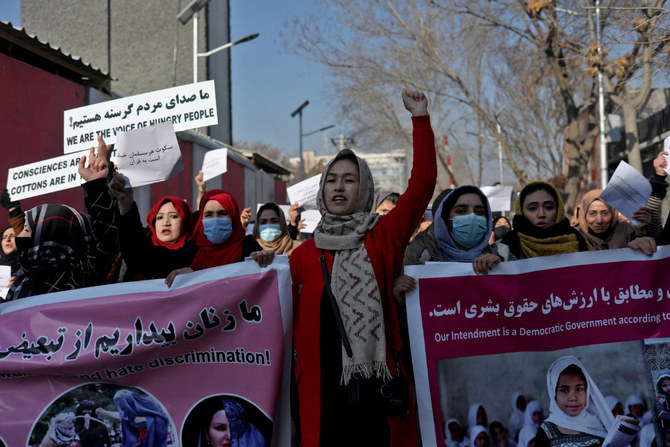
Afghan women protest in Kabul on December 28, 2021 against Taliban restrictions on women. (REUTERS/File Photo)
2 / 2
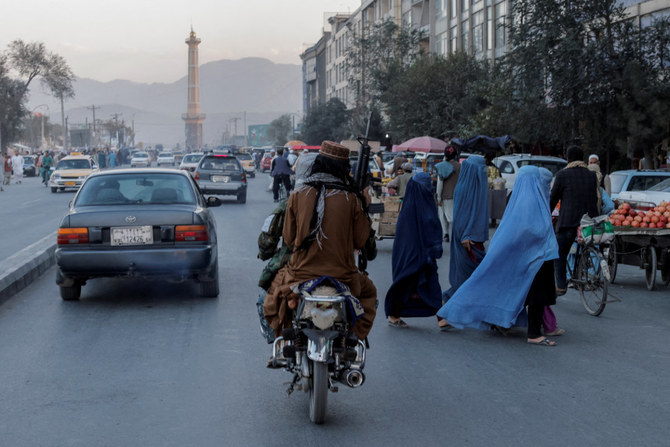
A group of women wearing burqas crosses the street as members of the Taliban drive past in Kabul, Afghanistan, on October 9, 2021. (REUTERS/File Photo)
UN Security Council demands Taliban ‘swiftly reverse’ women bans
Resolution adopted unanimously by 15 Council members says the Taliban restriction “undermines human rights and humanitarian principles”
UAE and Japan drafted the resolution backed by 90 others
Updated 28 April 2023
T.J. Kremer III
UNITED NATIONS: The UN Security Council on Thursday passed a resolution unanimously urging the Taliban to lift all restrictions on female citizens including women working for the world body in Afghanistan. The resolution was passed without any discussion during a meeting to update members on developments in the Middle East.
Russian Federation diplomat Vasily Nebenzya opened Thursday’s meeting with the announcement that the resolution was passed but did not further discuss it before quickly moving on to an update regarding humanitarian and political efforts in Syria.
The resolution called on Taliban leaders to “swiftly restore (women’s and girl’s) access to education, employment, freedom of movement and equal participation in public life,” according to a report from The Associated Press, which stated it received a copy of the resolution Wednesday.
“UN national personnel — women and men — have been instructed not to report to UN offices, with only limited and calibrated exceptions made for critical tasks,” according to documents on the UN website.
The draft obtained by AP reportedly urged all other UN member nations to work toward “an urgent reversal” of the Taliban’s policies and practices toward women and girls.
The restrictions by the Taliban forced the UN “into having to make an appalling choice between staying and delivering in support of the Afghan people, and standing by the norms and principles we are duty-bound to uphold,” according to the body’s website.
The UN Assistance Mission in Afghanistan stated on its website on April 11: “The ban is unlawful under international law, including the UN Charter, and for that reason the United Nations cannot comply.”
The resolution was drafted by the UAE and Japan, and backed by 90 co-sponsors from the Muslim world and beyond, according to the UN website. It was scheduled to be voted on during Thursday’s Security Council meeting but video live-streamed by the UN at the time did not appear to show any such vote taking place.
The 3,300 Afghans who work for the UN have been instructed to remain home since April 5, according to the AP report. Of those, 2,700 are men and 600 are women. All are still being paid by the UN, a UN spokesperson told AP.
The UN Special Representative for Afghanistan Roza Otunbayeva, has opened an “operational review period” regarding the Taliban’s actions, according to the UN. The review will remain open until May 5.
“During this period, the UN in Afghanistan will conduct the necessary consultations, make required operational adjustments and accelerate contingency planning for all possible outcomes,” according to a statement posted to the UN’s website.
The UN will “maintain principled and constructive engagement with all possible levels of the Taliban de facto authorities.”
UN Secretary-General Antonio Guterres will host a closed international meeting on May 1 and 2 in Qatar on Afghanistan, according to the UN statement. The meeting will aim to seek a “durable way forward” for the country and will be attended by various envoys from multiple countries, according to the AP report.
The Taliban held significant power in Afghanistan from 1996 to 2001, and again returned to power in 2021 following the withdrawal of US and NATO forces stationed there. The return of the Taliban has brought with it severe restrictions on women and girls in the country.
Trump’s racist post about Obamas is deleted after backlash despite White House earlier defending it
Updated 2 sec ago
WASHINGTON: President Donald Trump’s racist social media post featuring former President Barack Obama and his wife, Michelle Obama, as primates in a jungle was deleted Friday after a backlash from both Republicans and Democrats who criticized the video as offensive. The Republican president’s Thursday night post was blamed on a staffer after widespread backlash, from civil rights leaders to veteran Republican senators, for its treatment of the nation’s first Black president and first lady. A rare admission of a misstep by the White House, the deletion came hours after press secretary Karoline Leavitt dismissed “fake outrage” over the post. After calls for its removal — including by Republicans — the White House said a staffer had posted the video erroneously. The post was part of a flurry of overnight activity on Trump’s Truth Social account that amplified his false claims that the 2020 election was stolen from him, despite courts around the country and Trump’s first-term attorney general finding no evidence of systemic fraud. Trump has a record of intensely personal criticism of the Obamas and of using incendiary, sometimes racist, rhetoric — from feeding the lie that Obama was not a native-born US citizen to crude generalizations about majority-Black countries. The post came in the first week of Black History Month and days after a Trump proclamation cited “the contributions of black Americans to our national greatness” and “the American principles of liberty, justice, and equality.” An Obama spokeswoman said the former president, a Democrat, had no response. ‘An Internet meme’ Nearly all of the 62-second clip appears to be from a conservative video alleging deliberate tampering with voting machines in battleground states as 2020 votes were tallied. At the 60-second mark is a quick scene of two jungle primates, with the Obamas’ smiling faces imposed on them. Those frames originated from a separate video, previously circulated by an influential conservative meme maker. It shows Trump as “King of the Jungle” and depicts Democratic leaders as animals, including Joe Biden, who is white, as a jungle primate eating a banana. “This is from an Internet meme video depicting President Trump as the King of the Jungle and Democrats as characters from the Lion King,” Leavitt said by text. Disney’s 1994 feature film that Leavitt referenced is set on the savannah, not in the jungle, and it does not include great apes. “Please stop the fake outrage and report on something today that actually matters to the American public,” Leavitt added. By noon, the post had been taken down, with responsibility placed on a Trump subordinate. The White House explanation raises questions about control of Trump’s social media account, which he’s used to levy import taxes, threaten military action, make other announcements and intimidate political rivals. The president often signs his name or initials after policy posts. The White House did not immediately respond to an inquiry about how posts are vetted and when the public can know when Trump himself is posting. Mark Burns, a pastor and a prominent Trump supporter who is Black, said Friday on X that he’d spoken “directly” with Trump and that he recommended to the president that he fire the staffer who posted the video and publicly condemn what happened. “He knows this is wrong, offensive, and unacceptable,” Burns posted. Congressional Black Caucus Chairwoman Yvette Clarke, D-N.Y., told The Associated Press she does “not buy the White House’s commentary.” “If there wasn’t a climate, a toxic and racist climate within the White House, we wouldn’t see this type of behavior regardless of who it’s coming from,” Clarke said, adding that Trump “is a racist, he’s a bigot, and he will continue to do things in his presidency to make that known.” Condemnation across the political spectrum Trump and White House social media accounts frequently repost memes and artificial intelligence-generated videos. As Leavitt did Friday, Trump allies typically cast them as humorous. This time, condemnations flowed from across the spectrum — along with demands for an apology that had not come by late afternoon. At a Black History Month market in Harlem, the historically Black neighborhood in New York City, vendor Jacklyn Monk said Trump’s post was embarrassing even if it was eventually deleted. “The guy needs help. I’m sorry he’s representing our country. ... It’s horrible that it was this month, but it would be horrible if it was in March also.” In Atlanta, Rev. Bernice King, daughter of the assassinated civil rights icon Martin Luther King Jr., resurfaced her father’s words: “Yes. I’m Black. I’m proud of it. I’m Black and beautiful.” Black Americans, she said, “are beloved of God as postal workers and professors, as a former first lady and president. We are not apes.” The US Senate’s lone Black Republican, Tim Scott of South Carolina, called on Trump to take down the post. “Praying it was fake because it’s the most racist thing I’ve seen out of this White House,” said Scott, who chairs Senate Republicans’ midterm campaign arm. Another Republican, Sen. Roger Wicker of Mississippi, is white but represents the state with the largest percentage of Black residents. Wicker called the post “totally unacceptable” and said the president should apologize. Some Republicans who face tough reelections this November voiced concerns, as well. The result was an unusual cascade of intraparty criticism for a president who has enjoyed a stranglehold over fellow Republicans who stayed silent during previous Trump’s controversies for fear of a public spat with the president or losing his endorsement in a future campaign. NAACP President Derrick Johnson called the video “utterly despicable” and pointed to Trump’s wider political concerns that could help explain Republicans’ willingness to speak out. Johnson asserted that Trump is trying anything to distract from economic conditions and attention on the Jeffrey Epstein case files. “You know who isn’t in the Epstein files? Barack Obama,” he said. “You know who actually improved the economy as president? Barack Obama.” A long history of racism There is a long history in the US of powerful white figures associating Black people with animals, including apes, in demonstrably false, racist ways. The practice dates to 18th century cultural racism and pseudo-scientific theories used to justify the enslavement of Black people, and later to dehumanize freed Black people as uncivilized threats to white people. Thomas Jefferson, author of the Declaration of Independence, wrote in his famous text “Notes on the State of Virginia” that Black women were the preferred sexual partners of orangutans. President Dwight Eisenhower, discussing school desegregation in the 1950s, suggested white parents were rightfully concerned about their daughters being in classrooms with “big Black bucks.” Obama, as a candidate and president, was featured as a monkey or other primates on T-shirts and other merchandise. In his 2024 campaign, Trump said immigrants were “poisoning the blood of our country,” language similar to what Adolf Hitler used to dehumanize Jews in Nazi Germany. During his first White House term, Trump called a swath of majority-Black, developing nations “shithole countries.” He initially denied saying it but admitted in December 2025 that he did. When Obama was in the White House, Trump pushed false claims that the 44th president, who was born in Hawaii, was born in Kenya and constitutionally ineligible to serve. Trump, in interviews that helped endear him to conservatives, demanded that Obama prove he was a “natural-born citizen” as required to become president. Obama eventually released birth records, and Trump finally acknowledged during his 2016 campaign, after having won the Republican nomination, that Obama was born in Hawaii. But immediately after, he said, falsely, that his Democratic rival Hillary Clinton started the birtherism attacks.