OSCE ‘disappointed’ after Turkiye bars two vote observers

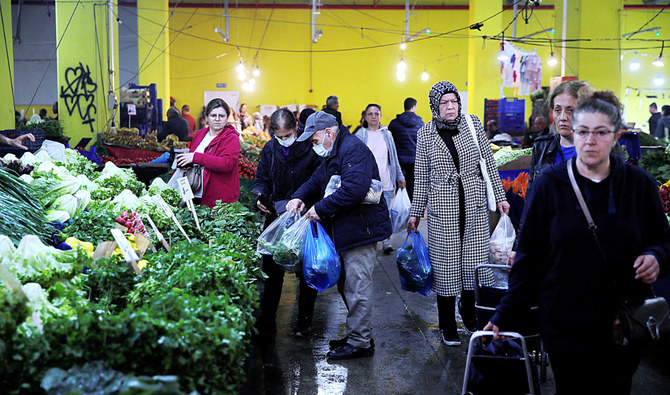
People shop at a market in Istanbul. Turks vote in Sunday’s elections seen as among the most consequential in the country’s modern history. (Reuters)
Short Url
Updated 08 May 2023
Follow

OSCE ‘disappointed’ after Turkiye bars two vote observers

  • Turkish authorities have denied accreditation to Danish MP Soren Sondergaard and Swedish MP Kadir Kasirga

ISTANBUL: The parliamentary assembly of the world’s largest security organization, the OSCE, has voiced disappointment after Turkiye barred two lawmakers from a 100-strong mission to monitor the Sunday’s elections.

Turkish authorities have denied accreditation to Danish MP Soren Sondergaard and Swedish MP Kadir Kasirga, said the parliamentary assembly of the 57-member Organization for Security and Cooperation in Europe.

“We are disappointed with this step taken by the Turkish authorities, which could impact negatively on the work of the international observer mission,” the assembly said.

It said Turkiye “should not — directly or indirectly — influence the composition of the mission,” adding that Sondergaard and Kasirga had been refused entry because of statements made “as independent members of parliament.”

The 100-strong team is made up of lawmakers from OSCE member countries.

Another OSCE body is sending a separate team of almost 400 people to observe Turkiye’s presidential and parliamentary vote, in which President Recep Tayyip Erdogan faces the toughest challenge of his two-decade rule.

Sondergaard, from Denmark’s Socialist-Green Alliance, said last week that Turkiye had denied him access because he had previously visited the Kurdish-led Syrian Democratic Forces or SDF.

He told Danish public television TV2 that Ankara had accused him of “promoting a terrorist organization.”

The SDF spearheaded the fight against the Daesh group in Syria. Turkiye regards it as an offshoot of the Kurdistan Workers’ Party or PKK, which it classifies as “terrorist.”

In 2018, Ankara barred a German and a Swedish lawmaker from an election observer mission sent by the OSCE’s parliamentary assembly.

The OSCE was founded in 1975 to foster relations between the West and the Eastern Bloc. 

Its current members include both NATO countries and Russia.

More than 6 million first-time voters are expected to cast ballots in the election. 

Roughly 10 percent of the electorate, their votes could prove critical in deciding whether Erdogan’s rule continues into a third decade or comes to an end.

Research conducted by pollster Konda last year showed that 57 percent of the first-time voters described themselves as modern, 32 percent described themselves as traditional conservatives, and the remainder described themselves as religious conservatives.

Turkish university student Yunus Efe has known only one leader of his country — Erdogan. 

As he prepares to vote for the first time in elections this month, the 22-year-old says it is time for change.

Efe is one of the first-time voters. A toddler when Erdogan came to power in 2003, Efe said his vote will go to the opposition’s Kemal Kilicdaroglu, who he believes will strengthen rule of law, human rights and freedom of expression — which critics say have suffered under Erdogan.

“I am definitely concerned about freedom of expression. In fact, I experience this every day but we do not realize it because we got used to living this way,” said Efe, describing how he thinks twice before liking or sharing social media posts.

Human Rights Watch, in a 2022 report, said thousands of people have faced arrest and prosecution every year in Turkiye for social media posts, typically charged with defamation, insulting the president, or spreading terrorist propaganda.

Ankara says its measures are necessary to fight disinformation spreading on media and internet.

Efe said he had been apathetic about the elections and politics “like many young people,” but was now excited to vote and attracted by the promises of Kilicdaroglu and his Republican People’s Party o CHP, one of six parties allied against Erdogan.

“I think that the rights can be restored and justice can be re-established,” Efe said, speaking in central Istanbul.

The sentiment points to the challenge facing Erdogan and his AK Party as they try to rally support for the presidential and parliamentary polls, with their popularity hit by a cost-of-living crisis and dizzying inflation.

Sensing their best chance yet of unseating Erdogan, his opponents are promising to reverse many of his signature policies, including abolishing the all-powerful presidency seen by critics as a symbol of his drive to wield ever greater control.

Erdogan’s share of the vote among young and first-time voters is forecast to be lower than among other age groups, said Erman Bakirci from pollster Konda Arastirma.

Describing young voters as a “very angry and hopeless” segment of Turkiye’s 85 million people, Bakirci said they would be crucial to the result because they are such a large block.

“They see via Internet and social media what their peers in Europe are doing and what opportunities they have,” Bakirci said. 

“They see that the difference between them widened ... They lack social, economic and legal security. They want to get out of this situation.”

Erdogan has championed the youth in his campaign while also criticizing them for failing to appreciate how Turkiye’s economy has developed on his watch, harking back to more difficult times before the AK Party came to power.

Emre Orgun, a 22-year-old who works in the information technology department of a textile company in Istanbul, said he would be voting for Erdogan because he did not think the opposition could manage Turkiye as well as the veteran leader.

“Of course I want the current government to continue. We want them to continue with some changes in some officials and policies,” Orgun said. He said his main problems are high prices and job opportunities.


Lifting sanctions on Syria will prevent Daesh resurgence and strengthen the nation, experts say

Updated 5 sec ago
Follow

Lifting sanctions on Syria will prevent Daesh resurgence and strengthen the nation, experts say

  • Conference in Washington discusses effects US policies are having on post-Assad Syria, and the continuing economic hardships in the country that could fuel terrorism
  • Participants praise US President Donald Trump for taking the right steps to help the war-torn nation move towards recovery and stabilization

Syria faces serious challenges in the aftermath of the fall of the Assad regime a year ago, including rebuilding its economy, lifting refugees and civilians out of poverty, and preventing a resurgence of Daesh terrorism.

But experts in two panel discussions during a conference at the Middle East Institute in Washington, D.C., on Wednesday, attended by Arab News, agreed that US President Donald Trump had so far taken all the right steps to help the war-torn nation move toward recovery and stabilization.

One of the discussions explored the effects American policies are having on the rebuilding of Syria, including the lifting of sanctions and efforts to attract outside investments and stabilize the economy. Moderated by the institute’s vice president for policy, Kenneth Pollack, the participants included retired ambassadors Robert Ford and Barbara Leaf, and Charles Lister, a resident fellow at the institute.

The other discussion focused on the continuing economic hardships in Syria that could fuel terrorism, including a resurgence of Daesh. Moderator Elizabeth Hagedorn, of Washington-based Middle East news website Al-Monitor, was joined by Mohammed Alaa Ghanem of the Syrian American Council, Celine Kasem of Syria Now, and Jay Salkini from the US-Syria Business Council.

“As we went into a transitional era, US diplomacy took a back step for a while as the Trump administration came into office,” Lister noted during the first panel discussion.

Everyone has been “super skeptical” of where the new government led by President Ahmad Al-Sharaa, a former commander with the Syrian opposition forces, would lead the country, he said, but Trump had stepped up through policies and support.

“Frankly, I think in January none of us expected that President Donald Trump would be shaking hands with Ahmad Al-Sharaa” a few months later, he added.

“Despite the obvious challenges, this new (Syrian) government has to be engaged.”

The US had maintained strong ties to the Syrian Democratic Forces, and with Al-Sharaa’s Hayat Tahrir Al-Sham, Lister said, in the decade leading up to the collapse of Syrian President Bashar Assad’s regime on Dec. 8, 2024.

“Of course, we’ve had 10 years of a superb partnership with the Syrian Democratic Forces, but they were a non-state actor not a sovereign government,” he continued.

“Now, we have a sovereign government that we could test, we can engage, and we can see where that goes. And in working through a sovereign government, there is no comparison that comes anywhere close to what we’ve seen on Syria.”

Lister praised Trump, saying: “I think a lot of that goes down to President Trump’s own kind of gut instinct of the way to do things.

“But there is a deeper, deeper government bench that has worked on this through Treasury and State and elsewhere. I think they all deserve credit for moving so rapidly and so boldly to give Syria a chance, as President Trump says.”

Ford said a key aspect of the process as Syria moves forward will be the removal of all sanctions imposed by the US against the Assad regime under the 2019 Caesar Act, an effort that is now underway in Congress.

He said Trump recognizes that the future of Syria and the wider Middle East lies in the hands of the Arab people, and has pursued policies based on “shared interests” including a “national security

strategy” to help the war-torn country shift away from extremism and violence toward a productive economy and safer environment for its people.

The Trump administration recognizes this reality, Ford added, and will “work on a practical level towards shared interests.”

However, he cautioned that “Syria is not out of the woods, by any stretch of the imagination” in terms of ensuring there is no resurgence of violence driven by desperate people burdened by the harsh economic realities in the country.

“If they can work with the Syrian government, and with more and more important regional actors as the United States retrenches — like Israel, Turkiye, Saudi Arabia, the United Arab Emirates, Qatar and Egypt; it’s a long list — it will become more important,” Ford said.

“There is still a way for the Americans to work with all of them, even if we don’t have big boots on the ground, or if we’re not providing billions of dollars.”

Nonetheless, “America’s voice will still be heard,” he added, thanks to the interest Trump is taking in Syria.

Adopted by Congress six years ago, toward the end of Trump’s first term as president, the Caesar Act imposed wide-ranging sanctions on Syria, including measures that targeted Assad and his family in an attempt to ensure his regime would be held accountable for war crimes committed under its reign. The act was named after a photographer who leaked images of torture taking place in Assad’s prisons.

Lister noted that the removal of the US sanctions has been progressing at “record-breaking speeds.”

In pre-taped opening remarks to the conference, which took place at the institute’s offices in Washington, Adm. Brad Cooper, commander of the US Central Command, said the Trump administration’s priority in Syria is the “aggressive and relentless pursuit” of Daesh, while working on the integration of the Syrian Democratic Forces with the new Syrian government through American military coordination.

“Just to give an example, in the month of October, US forces advised, assisted and enabled Syrian partners during more than 20 operations against (Daesh), diminishing the terrorists’ attacks and export of violence around the world,” he said. “We’re also degrading their ability to regenerate.”

Cooper added that the issue of displacement camps in northeastern Syria must also be addressed. He said he has visited Al-Hawl camp four times since his first meeting with Al-Sharaa, “which reinforced my view of the need to accelerate repatriations.”

He continued: “The impact on displaced persons devastated by years of war and repression has been immense. As I mentioned in a late-September speech at the UN, continuing to repatriate displaced persons and detainees in Syria is both a humanitarian imperative and a strategic necessity.”

The US is working with Syrian forces to “supercharge” this effort, Cooper said, noting that the populations of Al-Hawl and Al-Roj camps have fallen from 70,000 to about 26,000.

The second panel discussion painted a very bleak picture of the economic challenges the Syrian people face, with the average income only $200-$300 a month, a level that the experts warned could push desperate people to violence just to survive.

The US-Syria Business Council’s Salkini said many major companies and factories that once operated in Syria had relocated to neighboring countries such as Lebanon, Iraq and Turkiye.

“We’re looking at about 50 percent-plus unemployment,” he said. “Let me give you statistics on the wages: A factory worker today, his salary is $100-$300 a month. A farmer makes $75-$200 a month in salary. A manager (or) a private in the military makes $250 a month.

“So you can imagine how these people are living on these low wages, and still have to buy their iPhone, their internet, pay for electricity.”

Many displaced people are unable to return to their former homes, the panelists said, because they were destroyed during the war and there is no accessible construction industry to rebuild them.

The capital, Damascus, faces many challenges they added, and the situation is even worse in the country.