British Muslim charity chief ‘honored’ to be invited to ‘stupendous’ King Charles coronation

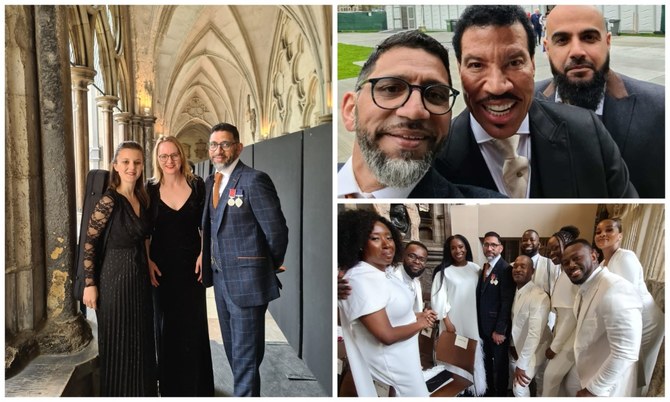
Clockwise from left: Idris Patel at Westminster Abbey for the coronation; Patel with fellow guest Lionel Richie who performed at the coronation concert, Patel with gospel choir who performed a newly composed “Alleluia.” (Supplied/Idris Patel)
Short Url
Updated 08 May 2023
Follow

British Muslim charity chief ‘honored’ to be invited to ‘stupendous’ King Charles coronation

  • Idris Patel, CEO of Supporting Humanity, was among 2,000 guests inside Westminster Abbey
  • Patel was awarded the British Empire Medal for services to the community during the COVID-19 pandemic

LONDON: A Muslim charity chief has told Arab News that it was an “honor” to attend King Charles III’s coronation at Westminster Abbey.

Idris Patel, CEO of Supporting Humanity, was among 2,000 guests inside the abbey as Charles was crowned at the weekend.

“Honestly, it was a very, very special and auspicious occasion, and something that will live long in my memory for me, and my kids will be able to say: ‘My dad went to the coronation,’” he told Arab News.

“The day itself was absolutely brilliant, I loved the way they respected everyone from all different religions and faiths, whereby the (order of service) they gave us said only kneel if you wish to kneel, you don’t have to sing certain hymns, it’s absolutely fine but please just respect those who do wish to by not talking.

“I have to respect them for that, as they did understand that, given it was a Christian (ceremony), some people may not feel comfortable saying ‘Jesus is lord’, and said only say if you feel you agree,” he added.

Patel said he was particularly impressed with the organization and how inclusive the invitation list was.

“They took everything into account, planned everything to a tee and respected other people’s sensitivities, it was a privilege, it was stupendous,” he said.

“It felt like a rainbow in the abbey, as they did invite people of every ethnicity, every background, so it wasn’t about how poor or rich you were, or what color you were, and it felt like they’d made sure you were invited no matter where you were from,” he added.

Patel rejected criticism of the timing and cost of the coronation, with taxpayers footing its estimated £100 million ($126.4 million) bill during a cost-of-living crisis.

He said people should see how they can help the needy, the homeless and more vulnerable members of society themselves, rather than criticizing the event.

“I’ve heard all the criticism, it doesn’t matter what they say about the Royal family, for me it was an honor to be invited,” he said.

“Yes the monarchy has spent a lot of money, but on the day of judgment, everyone will be responsible for themselves, for the way they spent money, and it’s quite a big occasion for (the monarchy) and they believe it brings in billions of pounds in tourism every year,” he said.

Patel’s invitation was in recognition of his work as founder of the Supporting Humanity charity, which was formed during the coronavirus pandemic initially to help provide food and support communities in the Greater London area.

And he has big expansion plans for the charity and how it can help even further, especially in growing its focus on the provision of mental health, suicide prevention and bereavement fields.

“From where we were and where we’re at now, we’ve grown dramatically, we hope to get bigger and better,” he said.

“One of the things we’re looking at is mental health, in the South Asian and Caribbean communities it’s something seen more as ‘black magic,’ so we’re trying to change that attitude and trying to get people to understand, respect and believe that mental health (issues) are an illness that needs professional help.

“We’re focusing on places of worship, not just mosques, but also churches, synagogues, temples and gurdwaras and looking to increase engagement and build networks with these sort of places so that it becomes less of an issue.”

Patel was awarded the British Empire Medal for services to the community during the COVID-19 pandemic in 2021. He was also the recipient of a British Citizen Award Medal of Honour for his services to the community.

The medals are awarded to people who have carried out “meritorious” actions for their community.


Junta leader Gen. Mamdi Doumbouya is declared winner of Guinea’s election, provisional results show

Updated 31 December 2025
Follow

Junta leader Gen. Mamdi Doumbouya is declared winner of Guinea’s election, provisional results show

  • Mamady Doumbouya took power in 2021 coup

CONAKRY, Guinea: Guinea coup leader ​Mamady Doumbouya has been elected president, according to provisional results announced on Tuesday, completing the return to civilian rule in the bauxite- and iron ore-rich West African nation.
The former special forces commander, thought to be in his early 40s, seized power in 2021, toppling then-President Alpha Conde, who had been in office since 2010. It was one in a series of nine coups that have reshaped politics in West and Central Africa since 2020.
The provisional results announced ‌on Tuesday showed Doumbouya ‌winning 86.72 percent of the December 28 vote, ‌an ⁠absolute majority ​that allows ‌him to avoid a runoff.
The Supreme Court has eight days to validate the results in the event of any challenge.
Doumbouya’s victory, which gives him a seven-year mandate, was widely expected. Conde and Cellou Dalein Diallo, Guinea’s longtime opposition leader, are in exile, which left Doumbouya to face a fragmented field of eight challengers.
Doumbouya reversed pledge not to run
The original post-coup charter in Guinea barred junta members from running ⁠in elections, but a constitution dropping those restrictions was passed in a September referendum.
Djenabou Toure, the ‌country’s top election official who announced the results on ‍Tuesday night, said turnout was 80,95 percent. However ‍voter participation appeared tepid in the capital Conakry, and opposition politicians rejected ‍a similarly high turnout figure for the September referendum.
Guinea holds the world’s largest bauxite reserves and the richest untapped iron ore deposit at Simandou, officially launched last month after years of delay.
Doumbouya has claimed credit for pushing the project forward and ensuring Guinea benefits ​from its output.
His government this year also revoked the license of Emirates Global Aluminium’s subsidiary Guinea Alumina Corporation following a refinery dispute, ⁠transferring the unit’s assets to a state-owned firm.
The turn toward resource nationalism — echoed in Mali, Burkina Faso and Niger — has boosted his popularity, as has his relative youth in a country where the median age is about 19.
Political space restricted, UN says
Political debate has been muted under Doumbouya. Civil society groups accuse his government of banning protests, curbing press freedom and restricting opposition activity.
The campaign period was “severely restricted, marked by intimidation of opposition actors, apparently politically motivated enforced disappearances, and constraints on media freedom,” UN rights chief Volker Turk said last week.
On Monday, opposition candidate Faya Lansana Millimono told a press conference the election was marred by “systematic fraudulent practices” and ‌that observers were prevented from monitoring the voting and counting processes.
The government did not respond to a request for comment.