

Saudi Arabia is the most dynamic place in the world of hospitality, says King Faisal Foundation official 

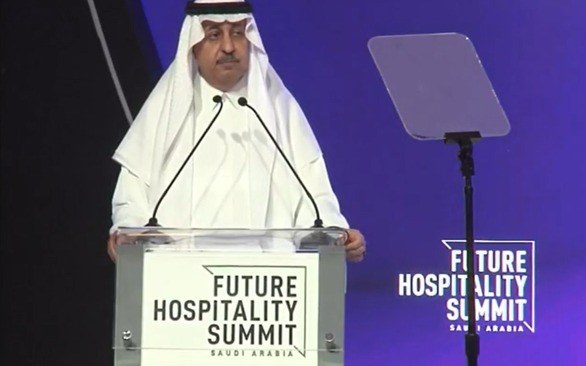
Speaking at the Future Hospitality Summit in Riyadh, Prince Bandar bin Saud bin Khalid, secretary-general of the King Faisal Foundation and chairman of hospitality investment firm Al Khozama (Screenshot)
Short Url
Updated 08 May 2023
Follow

Saudi Arabia is the most dynamic place in the world of hospitality, says King Faisal Foundation official 

RIYADH: Saudi Arabia has become the most dynamic place for hospitality in the world thanks to the initiatives put forward by the Vision 2030 economic diversification strategy, according to a top official from the Kingdom. 

Speaking at the Future Hospitality Summit in Riyadh, Prince Bandar bin Saud bin Khalid, secretary-general of the King Faisal Foundation and chairman of hospitality investment firm Al Khozama, said that tourism is driving the future of the Saudi economy.  

“The long tradition of hospitality in Saudi Arabia has, within the last few years, taken an exciting and ambitious new form. Saudi Arabia is perhaps the most dynamic place today in the world of hospitality. It is truly a privilege for all of us in the hospitality industry in Saudi Arabia to be able to work in such exciting times and in a sector so central to the culture and traditions,” said the official. 

He added: “Hospitality has always been an essential element of Arabian culture, identity and tradition. In the present era, with Vision 2030, and the emphasis placed by King Salman and Crown Prince Mohammed bin Salman, tourism has become a cornerstone of the Saudi Arabian economy.”  

Tourism is a key strategic area outlined in Saudi Arabia’s Vision 2030, as the Kingdom aims to attract 100 million visitors by the end of this decade.  

The top official of the King Faisal Foundation further outlined the progress Saudi Arabia will make in the coming years.  

“Riyadh will double its population within the next few years. Diriyah will develop dozens of new hotels, tourist and sports attractions. Qiddiya will offer entertainment and will become a community of 650,000 people. Resorts are being built on the Red Sea. In NEOM, an all-new kind of sustainable city is being created that will challenge existing assumptions about what makes communities successful,” he added.  

Earlier this month, Saudi Minister of Economy and Planning Faisal Al-Ibrahim said the Kingdom would not “shy away” from boosting its tourism and tourism-related sectors as it seeks to become a global hub for travelers.  

“These are sectors that did not exist in the past, and we’re trying to catch up,” said Al-Ibrahim, speaking at the Milken Institute Global Conference in Beverly Hills, California.  

The ongoing edition of FHS is being held under the theme “Invest in Change,” focusing on the importance of sustainability, innovation, startups and human capital development. 


Saudi Arabia, Japan trade rises 38% between 2016 and 2024, minister says

Updated 11 January 2026
Follow

Saudi Arabia, Japan trade rises 38% between 2016 and 2024, minister says

RIYADH: Trade between Saudi Arabia and Japan has increased by 38 percent between 2016 and 2024 to reach SR138 billion ($36 billion), the Kingdom’s investment minister revealed.

Speaking at the Saudi-Japanese Ministerial Investment Forum 2026, Khalid Al-Falih explained that this makes the Asian country the Kingdom’s third-largest trading partner, according to Asharq Bloomberg.

This falls in line with the fact that Saudi Arabia has been a very important country for Japan from the viewpoint of its energy security, having been a stable supplier of crude oil for many years.

It also aligns well with how Japan is fully committed to supporting Vision 2030 by sharing its knowledge and advanced technologies.

“This trade is dominated by the Kingdom's exports of energy products, specifically oil, gas, and their derivatives. We certainly look forward to the Saudi private sector increasing trade with Japan, particularly in high-tech Japanese products,” Al-Falih said.

He added: “As for investment, Japanese investment in the Kingdom is good and strong, but we look forward to raising the level of Japanese investments in the Kingdom. Today, the Kingdom offers promising opportunities for Japanese companies in several fields, including the traditional sector that links the two economies: energy.”

The minister went on to note that additional sectors that both countries can also collaborate in include green and blue hydrogen, investments in advanced industries, health, food security, innovation, entrepreneurship, among others.

During his speech, Al-Falih shed light on how the Kingdom’s pavilion at Expo 2025 in Osaka achieved remarkable success, with the exhibition receiving more than 3 million visitors, reflecting the Japanese public’s interest in Saudi Arabia.

“The pavilion also organized approximately 700 new business events, several each day, including 88 major investment events led by the Ministry of Investment. Today, as we prepare for the upcoming Expo 2030, we look forward to building upon Japan’s achievements,” he said.

The minister added: “During our visit to Japan, we agreed to establish a partnership to transfer the remarkable Japanese experience from Expo Osaka 2025 to Expo Riyadh 2030. I am certain that the Japanese pavilion at Expo Riyadh will rival the Saudi pavilion at Expo Osaka in terms of organization, innovation, and visitor turnout.”

Al-Falih also shed light on how Saudi-Japanese relations celebrated their 70th anniversary last year, and today marks the 71st year of these relations as well as how they have flourished over the decades, moving from one strategic level to an even higher one.