

China reiterates commitment to ensure ‘timely completion’ of CPEC despite India’s objections

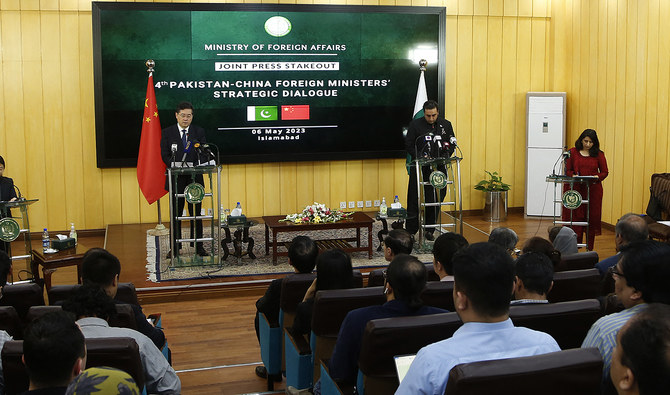
Chinese Foreign Minister Qin Gang (L) addresses a joint press conference along with his Pakistani counterpart Bilawal Bhutto Zardari (C) at the foreign ministry in Islamabad on May 6, 2023. (Photo courtesy: AFP)
Short Url
Updated 07 May 2023
Follow

China reiterates commitment to ensure ‘timely completion’ of CPEC despite India’s objections

  • In meeting with Chinese foreign minister, Pakistan army chief pledges ‘full support’ for CPEC project
  • India’s foreign minister said earlier this week that CPEC violated its territorial integrity, sovereignty 

ISLAMABAD: Chinese Foreign Minister Qin Gang on Sunday reiterated his country’s commitment to ensure the “timely completion” of an economic corridor connecting Pakistan and China, despite India’s recent objections to it. 

The China-Pakistan Economic Corridor (CPEC) is a central part of Beijing’s Belt and Road Initiative, under which it has pledged over $65 billion for energy and infrastructure projects in Pakistan since 2013. Through the corridor, China aims to access land and sea routes to markets in the Middle East and Europe. 

A key part of the CPEC runs through Gilgit-Baltistan, a northern mountainous region administered by Pakistan, which is the South Asian country’s only land link to China. It is also part of the disputed Kashmir territory which both Pakistan and India have been claiming since gaining independence in 1947, and over which they have fought two wars.

India, which claims Gilgit-Baltistan is part of its territory occupied by Pakistan, has said any development in these areas would be tantamount to violation of its territorial integrity and sovereignty. 

Speaking to reporters in Goa after the Shanghai Cooperation Organization’s (SCO) Council of Foreign Ministers’ meeting earlier this week, India’s External Affairs Minister S. Jaishankar repeated the corridor would violate India’s territorial integrity, adding that he had informed all SCO members of New Delhi’s longstanding policy on the matter. 

Pakistan’s army chief Syed Asim Munir met Gang on Sunday to discuss matters of regional security and defense, among other issues, the media’s military wing said. 

“Foreign Minister Qin Gang underscored the importance of the longstanding strategic relationship between the brotherly nations and expressed his satisfaction over the progress made on the CPEC while reiterating China’s commitment to its timely completion,” the Inter-Services Public Relations (ISPR) said. 

Munir also pledged “full support” for CPEC and thanked China for its “unwavering support” for Pakistan on regional and international issues.

Gang appreciated Pakistan’s efforts in maintaining regional peace and stability, especially the support of its armed forces in providing security to Chinese nationals and projects in Pakistan, the ISPR added. 

“The two dignitaries also discussed the evolving security situation in the region. COAS acknowledged China’s role in promoting peace and stability in the region, and both sides agreed to enhance their existing cooperation in defense and security domains to effectively counter common security challenges,” the ISPR said. 


Pakistan minister calls for integrating ocean awareness into education to preserve ecosystems

Updated 14 min 43 sec ago
Follow

Pakistan minister calls for integrating ocean awareness into education to preserve ecosystems

  • Pakistan’s maritime sector posted a record $360 million profit in 2025 following a year of sweeping reforms
  • Junaid Anwar Chaudhry says education equips youth to make informed decisions, contribute to blue economy

KARACHI: Pakistan’s Maritime Affairs Minister Junaid Anwar Chaudhry has urged integrating ocean awareness into formal education systems and empowering youth as active partners in order to preserve marine ecosystems, his ministry said on Saturday.

Chaudhry said this at a meeting with Minister of State for Education and Professional Training, Wajiha Qamar, who called on him and discussed strategies for enhancing marine education, literacy, and youth engagement in sustainable ocean management.

Pakistan’s maritime sector posted a record Rs100 billion ($360 million) profit in 2025 following a year of sweeping reforms aimed at improving port efficiency, cost-cutting, and safeguarding marine ecosystems to boost the blue economy.

“Understanding our oceans is no longer optional, it is essential for climate resilience, sustainable development, and the long-term health of our maritime resources,” Chaudhry said, highlighting the critical role of marine literacy.

The minister said education equips youth to make informed decisions and actively contribute to marine conservation and the blue economy, urging inclusion of marine ecosystems, conservation and human-ocean interactions into curricula, teacher training and global citizenship programs.

“Initiatives like ‘Ocean Literacy for All’ can mainstream these elements in national policies, school programs, and community workshops to build proactive citizenship on marine challenges,” he added.

Ocean Literacy for All is a UNESCO Intergovernmental Oceanographic Commission–coordinated global initiative under the UN Ocean Decade (2021–2030) that promotes ocean awareness, education, and conservation.

Chaudhry announced reforms in maritime education, including granting degree-awarding status to the Pakistan Marine Academy, and the establishment of the Maritime Educational Endowment Fund (MEEF) to provide scholarships for deserving children from coastal communities.

“The scholarship program promotes inclusive development by enabling access to quality education for youth from over 70 coastal and fishing communities, particularly in Sindh and Balochistan,” he said.

The discussions underscored raising awareness about oceans, coastal ecosystems and marine resources, according to the Pakistani maritime affairs ministry. Both ministers stressed the need to integrate climate and marine education from classrooms

to community programs, addressing risks like rising sea temperatures, coastal erosion, biodiversity loss and pollution.

“Incorporating marine science and ocean literacy into curricula can help students connect local challenges with global trends,” Qamar said, underscoring education’s transformative power in building social resilience.

The meeting explored translating complex marine science into accessible public knowledge through sustained, solution-oriented awareness campaigns, according to the maritime affairs ministry.

With coastline facing pressures from climate change, pollution, and overexploitation, the ministers called for a coordinated approach blending formal education, informal learning and youth-led advocacy.

“A joint effort by the Ministries of Maritime Affairs and Education can cultivate an ocean-literate generation, transforming vulnerability into resilience and ensuring the long-term sustainability of coastal and marine ecosystems,” Chaudhry said.