Pakistan, China and Afghanistan discuss trade, security at tripartite dialogue in Islamabad

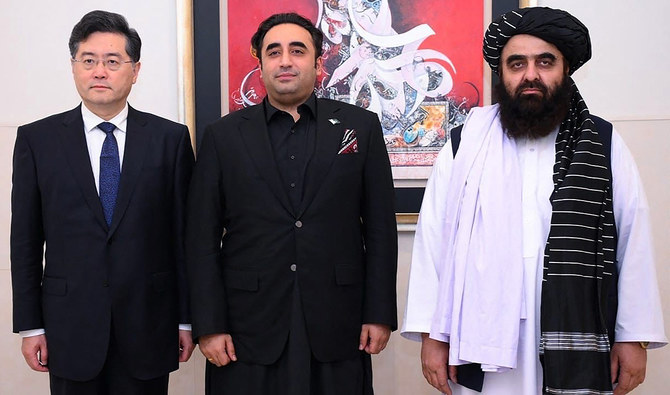
This handout photograph taken on May 6, 2023 and released by the Pakistan Information Department (PID) shows (from L to R ) Chinese Foreign Minister Qin Gang, Pakistan's Foreign Minister Bilawal Bhutto Zardari and Afghanistan’s foreign minister Amir Khan Muttaqi posing after a meeting in Islamabad. (Photo courtesy: PID)
Short Url
Updated 06 May 2023
Follow

Pakistan, China and Afghanistan discuss trade, security at tripartite dialogue in Islamabad

  • The dialogue comes at a time when Pakistan is witnessing growing number of militant attacks along its border with Afghanistan
  • The three countries also discussed political engagement and enhanced regional connectivity for greater economic prosperity

ISLAMABAD: Pakistan’s foreign minister Bilawal Bhutto-Zardari on Saturday discussed trade, regional connectivity and counterterrorism with his counterparts from Kabul and Beijing while hosting a tripartite dialogue on Afghanistan, said a brief statement issued by the foreign office in Islamabad.

The event took place just a few days after the United Nations held a meeting in Doha in which various countries, including Pakistan, participated to find ways to pressure the Taliban to provide more rights to women.

The interim Afghan foreign minister, Amir Khan Muttaqi, came to Islamabad to attend the tripartite meeting at a time when Pakistan is witnessing growing number of militant attacks along its 2,600-kilometer-long frontier with Afghanistan.

China, the third participant of the dialogue, also has interests in Afghanistan and the overall neighborhood. Beijing has invested about $60 billion in the ambitious China-Pakistan Economic Corridor (CPEC) project which is part of a larger scheme to enhance regional connectivity.
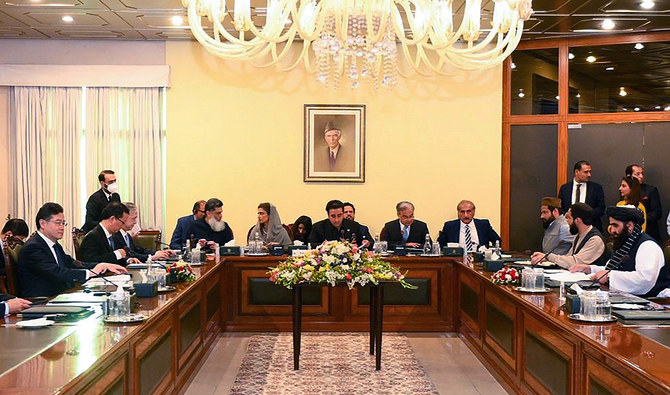


This handout photograph taken on May 6, 2023 and released by the Pakistan Information Department (PID) shows Pakistan's Foreign Minister Bilawal Bhutto Zardari (C) speaking during a metting with Chinese Foreign Minister Qin Gang (L) and Afghanistan’s foreign minister Amir Khan Muttaqi (R) during a meeting in Islamabad. (Photo courtesy: PID)

“[Pakistan] hosted 5th China-Pakistan-Afghanistan Trilateral [Foreign Ministers’] Dialogue at [the Ministry of Foreign Affairs] today,” said a foreign office Twitter post. “Held Productive discussions on political engagement, counter terrorism, trade & connectivity. [Pakistan] looks forward to advancing our common agenda for regional cooperation under trilateral framework.”

Earlier, Chinese foreign minister Qin Gang held a strategic dialogue with Bhutto-Zardari wherein the two officials discussed the situation in Afghanistan.

While the Pakistani minister emphasized the significance of Afghanistan’s stability for the overall betterment of the region, his Chinese counterpart hoped Kabul’s interim administration would show sensitivity toward the security of its neighbors.

They also reiterated the need for a more inclusive government in Kabul.

Afghanistan fires at Pakistani jets over Kabul as conflict intensifies

Updated 3 sec ago
Follow

Afghanistan fires at Pakistani jets over Kabul as conflict intensifies

  • Violence follows ‌air strikes inside Afghanistan this week Pakistan says ​targeted militant infrastructure
  • Pakistan says operation against Afghan forces ongoing, security forces destroyed Afghan posts, camps

KABUL: Afghanistan said it was firing at Pakistani jets in Kabul after blasts and gunfire rocked the capital on Sunday, compounding instability in a region rattled by US–Israeli strikes on Iran and retaliatory attacks on US targets in Gulf states.

The Taliban-ruled state has suffered Pakistani strikes against government installations over the past week following accusations, which it denies, that it harbors militants.

The heaviest fighting in years between the neighbors has raised fears of a protracted conflict ‌along their 2,600-km (1,615-mile) ‌border, with several countries including Qatar and Saudi ​Arabia ‌calling ⁠for restraint ​and ⁠offering to help mediate a ceasefire.

Explosions echoed across parts of Kabul before sunrise, followed by bursts of gunfire, a Reuters witness said. It was not clear what had been targeted or whether there were casualties.

Taliban administration spokesperson Zabihullah Mujahid said the sounds were the result of Afghan forces targeting Pakistani aircraft over the capital.

“Air defense attacks were carried out in Kabul against Pakistani aircraft. Kabul residents should not be concerned,” Mujahid ⁠said.

Pakistan’s prime minister’s office, information ministry and military did not ‌respond to requests for comment.

The violence follows ‌air strikes inside Afghanistan this week that Pakistan said ​targeted militant infrastructure. Afghanistan described the ‌strikes as a violation of sovereignty and announced retaliatory operations along their shared ‌border.

Iran, which shares borders with both Afghanistan and Pakistan, had offered to help facilitate dialogue before itself coming under attack on Saturday from Israel and the US bent on diminishing Iran’s military capability.

ACCUSATION AND ESCALATION

Pakistan has said Afghanistan harbors Tehreek-e-Taliban Pakistan (TTP) militants, which it ‌said are waging an insurgency inside Pakistan.

Afghanistan has denied the accusation, saying it does not allow Afghan territory to be ⁠used against other ⁠countries and that Pakistan’s security challenges are an internal matter.

Pakistani security sources have said operation “Ghazab Lil Haq,” meaning “Wrath for the Truth,” was ongoing and that Pakistani forces had destroyed Afghan posts and camps.

Both sides have reported heavy losses, issuing differing casualty figures for each other.

Reuters could not independently verify the claims.

Diplomatic efforts have intensified, with Saudi Arabia, Russia, China, the European Union and United Nations urging restraint and calling for talks.

The US said it supports Pakistan’s right to defend itself.

Pakistan Defense Minister Khawaja Muhammad Asif described the fighting as “open war.”

Afghanistan Interior Minister Sirajuddin Haqqani said the conflict would be “very costly.” He said only ​front-line forces were engaged in fighting that ​the country has yet to fully deploy its military.