Satellite images show tankers Iran seized off Bandar Abbas

1 / 2
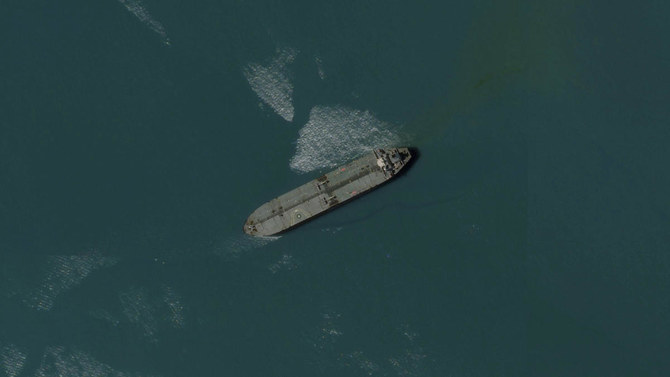
This satellite image from Planet Labs PBC shows the seized oil tanker Niovi off the coast of Bandar Abbas, Iran, Saturday, May 6, 2023. Satellite images analyzed Sunday, May 7, 2023, by The Associated Press showed the location of two oil tankers recently seized by Iran amid tensions with the West. (Planet Labs PBC via AP)
2 / 2
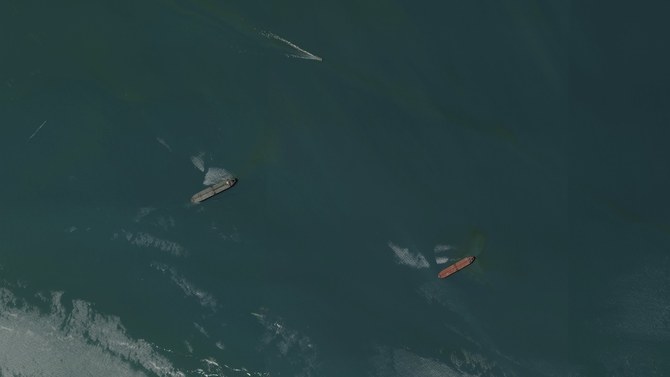
This satellite image from Planet Labs PBC shows the seized oil tankers Niovi, left, and Advantage Sweet, right, off the coast of Bandar Abbas, Iran, Saturday, May 6, 2023. (AP)
Short Url
Updated 07 May 2023
Follow

Satellite images show tankers Iran seized off Bandar Abbas

  • The photos show two tankers as they anchored just south of Bandar Abbas near a naval base in Iran’s Hormozgan province Saturday
  • Their capture represents just the latest ship seizure conducted by Iran amid tensions with the West over its rapidly advancing nuclear program

DUBAI: Satellite images analyzed Sunday by The Associated Press show two oil tankers recently seized by Iran off the coast of one of its key port cities on the strategic Strait of Hormuz.
The photos from Planet Labs PBC showed the Advantage Sweet and the Niovi anchored just south of Bandar Abbas near a naval base in the port city in Iran’s Hormozgan province Saturday. Their capture represents just the latest ship seizure conducted by Iran amid tensions with the West over its rapidly advancing nuclear program, though it appears the two ships may have been taken for different reasons.
Iran seized the Marshall Islands-flagged Advantage Sweet, staffed by 23 Indians and one Russian, on April 27 as it traveled in the Gulf of Oman. Tehran claimed the vessel had struck another ship, though tracking data for the Advantage Sweet showed no erratic behavior on its trip. Iran has made claims in the past over ship seizures to cover for the vessels being taken to use as pawns in negotiations with the West.
The Advantage Sweet carried Kuwaiti crude oil for American energy firm Chevron Corp. of San Ramon, California, at the time of its capture. And its seizure comes as another tanker believed to be carrying Iranian crude disappeared from anchorage off Singapore a year after being identified as trying to evade US sanctions.
The Financial Times, as well as the maritime intelligence firm Ambrey, both have reported that ship named Suez Rajan was seized on order of American authorities. US officials and those associated with the Suez Rajan have not responded to questsions about the tanker’s disappearance while on a path heading West.
The Niovi, a Panama-flagged tanker, was seized by Iran’s paramilitary Revolutionary Guard on Wednesday as it left a dry dock in Dubai, United Arab Emirates, bound for Fujairah on the UAE’s eastern coast. While not carrying any cargo, data from S&P Global Market Intelligence seen by the AP showed the Niovi in July 2020 received oil from a ship known then as the Oman Pride.
The US Treasury in August 2021 sanctioned the Oman Pride and others associated with the vessel over it being “involved in an international oil smuggling network” that supported the Quds Force, the expeditionary unit of the Revolutionary Guard that operates across the Mideast.
Separately, purported emails published online by Wikiran, a website that solicits leaked documents from the Islamic Republic, suggest that cargo carried by the Niovi was sold onto firms in China without permission.
United Against a Nuclear Iran, which has tracked sanctioned crude shipments by Tehran, “strongly suspects the seizure of the Niovi is related to a dispute over a shipment of Iranian oil,” said Claire Jungman, the chief of staff of the organization. Iran has said it seized the Niovi over an unspecified court order in Tehran.
The managers of the Niovi did not respond to repeated telephone calls for comment. The Greek Coast Guard have said the Niovi was staffed by Greek, Filipino and Sri Lanka sailors.


Progress for Ukraine talks in Paris uncertain with US focus shifting to Venezuela

Updated 06 January 2026
Follow

Progress for Ukraine talks in Paris uncertain with US focus shifting to Venezuela

  • Ukraine’s allies are meeting in Paris to discuss security guarantees after a potential ceasefire with Russia. The Trump administration’s focus on Venezuela could complicate progress
  • France and the UK lead efforts to strengthen post-ceasefire defenses for Ukraine, possibly with European forces

PARIS: Ukraine’s allies are meeting Tuesday in Paris for key talks that could help determine the country’s security after a potential ceasefire with Russia. But prospects for progress are uncertain with the Trump administration’s focus shifting to Venezuela.
Before the US capture of Venezuelan leader Nicolás Maduro, French President Emmanuel Macron had expressed optimism about the latest gathering of so-called “coalition of the willing” nations. For months, they have been exploring how to deter any future Russian aggression should it agree to stop fighting Ukraine.
In a Dec. 31 address, Macron said that allies would “make concrete commitments” at the summit “to protect Ukraine and ensure a just and lasting peace.”
Macron’s office said Tuesday’s meeting will gather an unprecedented number of officials attending in person, with 35 participants including 27 heads of state and government. The US will be represented by President Donald Trump’s envoys, Steve Witkoff and Jared Kushner.
Macron’s office said the US delegation was initially set to be led by Secretary of State Marco Rubio, who changed his plans for reasons related to the military intervention in Venezuela.
Participants seek concrete outcomes on five key priorities once fighting ends: ways to monitor a ceasefire; support for Ukraine’s armed forces; deployment of a multinational force on land, at sea and in the air; commitments in case there’s another Russian aggression; and long-term defense cooperation with Ukraine.
But whether that’s still achievable Tuesday isn’t so clear now, as Trump deals with the aftermath of his decision to effect leadership change in Venezuela.
Ukraine seeks firm guarantees from Washington of military and other support seen as crucial to securing similar commitments from other allies. Kyiv has been wary of any ceasefire that it fears could provide time for Russia to regroup and attack again.
Recent progress in talks
Before the US military operation targeting Maduro, Witkoff had indicated progress in talks about protecting and reassuring Ukraine.
In a Dec. 31 post, Witkoff tweeted that “productive” discussions with him, Rubio, and Kushner on the US side and, on the other, national security advisers of Britain, France, Germany and Ukraine had focused on “strengthening security guarantees and developing effective deconfliction mechanisms to help end the war and ensure it does not restart.”
France, which with the United Kingdom has coordinated the monthslong, multination effort to shore up a ceasefire, has only given broad-brush details about the plan’s scope. It says Ukraine’s first line of defense against a Russian resumption of war would be the Ukrainian military and that the coalition intends to strengthen it with training, weaponry and other support.
Macron has also spoken of European forces potentially being deployed away from Ukraine’s front lines to help deter future Russian aggression.
Important details unfinalized
Ukraine’s President Volodymyr Zelensky said during the weekend that potential European troop deployments still face hurdles, important details remain unfinalized, and “not everyone is ready” to commit forces.
He noted that many countries would need approval from parliament even if leaders agreed to military support for Ukraine. But he recognized that support could come in forms other than troops, such as “through weapons, technologies and intelligence.”
Zelensky said that post-ceasefire deployments in Ukraine by Britain and France, Western Europe’s only nuclear-armed nations, would be “essential” because some other coalition members ”cannot provide military assistance in the form of troops, but they do provide support through sanctions, financial assistance, humanitarian aid and so on.”
“Speaking frankly as president, even the very existence of the coalition depends on whether certain countries are ready to step up their presence,” Zelensky said. “If they are not ready at all, then it is not really a ‘coalition of the willing.’”