

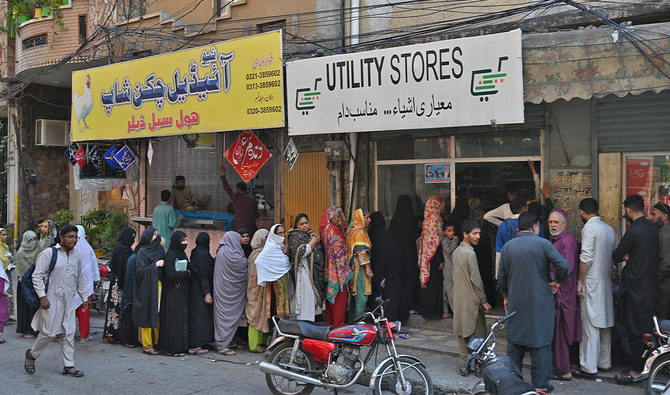

KARACHI: The dramatic rise in inflation in Pakistan was taking a significant toll on the economic well-being of many families, said financial experts on Saturday, adding even middle-class households with a monthly earning of Rs100,000 ($353) were finding it difficult to save and found themselves compelled to seek alternative income sources.
Inflation in Pakistan more than tripled within a year and was recorded at 36.4 percent in April, its peak rate since 1964. People across the country are reeling from the surge in food and energy prices amid a massive currency depreciation.
Given the current economic circumstances, some Pakistani analysts said the inflationary pressure had made it “impossible” for people to save anything.
“Considering the inflation in Pakistan, somebody whose earning is Rs100,000 a month and has four or five dependents, which is usually the case in our country, it is impossible for them to feed the family and save at the same time,” Muhammad Sohail, chief executive officer of Topline Securities, told Arab News. “This is because food inflation has gone up almost 50 percent in the last twelve months while the overall inflation is between 30 to 35 percent.”
Samiullah Tariq, research director at the Pakistan-Kuwait Investment Company, said saving and consumption varied from person to person.
“It depends on person to person how much disposable income they have in the current circumstances,” he told Arab News. “If a person has a family of, for example, one wife and two children, obviously it will be very difficult for that person, with an income of Rs100,000, to save anything because it is a little more than $300,” he continued. “So, it seems very difficult that such a person will be able to save anything.”
However, he said single individuals who lived with their parents were in a position to save money and invest in mutual funds, gold or foreign currency.
Pakistanis falling into the middle-income groups said they could not think about saving since they were caught between fixed income and rising prices.
“My wife used to save some money through ballot committees until a few months ago, but now we have stopped since it is not even possible to do that anymore,” Abdullah Taqi, an office worker, said, referring to a local money-lending mechanism that requires a group of friends or acquaintances to pool in a certain amount every month while waiting to benefit from the accumulated sum when their turn arrived.
While there are limited saving options available to Pakistani people, the absence of the saving habit also makes things difficult for many individuals.
However, some bankers pointed out it was precisely a high-inflation and high-interest context like this in which Pakistanis should try to save some money.
“I would urge every Pakistani, particularly low-income groups, to increase their savings,” Muhammad Asad, senior executive vice president and chief investment officer of Al Meezan Investment Management, told Arab News.
“They should rationalize their consumptions and prioritize their needs on a monthly basis,” he continued. “They should increase their propensity to save, instead of propensity to consume, for long-term benefits.”
Asad informed that mutual funds were offering an annual return of nearly 18 percent, including his investment management company, which offered 18.5 percent on fixed income plans.
In Pakistan, the government has taxed monthly income between Rs50,000 and Rs600,000 per year at 2.5 percent.
However, Pakistani experts said they expected the government to relax taxation during the election year to attract voters, which could create some space for savings.


