IAEA chief warns of dangers around Ukraine’s Zaporizhzhia nuclear plant

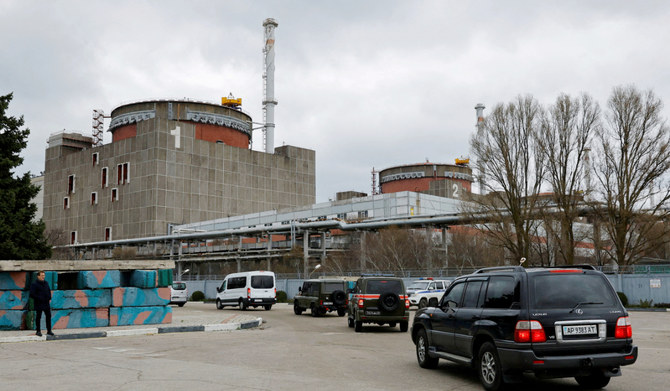
A motorcade transporting the International Atomic Energy Agency (IAEA) expert mission, escorted by the Russian military, arrives at the Zaporizhzhia Nuclear Power Plant in the course of Russia-Ukraine conflict outside Enerhodar in the Zaporizhzhia region, Russian-controlled Ukraine, March 29, 2023. (REUTERS)
Short Url
Updated 07 May 2023
Follow

IAEA chief warns of dangers around Ukraine’s Zaporizhzhia nuclear plant

  • Russian forces seized the Zaporizhzhia plant days after President Vladimir Putin ordered the invasion of his neighbor in February 2022

SWITZERLAND: The head of the UN’s nuclear power watchdog warned on Saturday that the situation around the Russian-held Zaporizhzhia nuclear station had become “increasingly unpredictable and potentially dangerous” and called for measures to ensure its safe operation.
Rafael Grossi, director general of the International Atomic Energy Agency, issued the warning in view of what he said were evacuations under way in the nearby town of Enerhodar, ordered by the local Russian-installed governor.
“The general situation in the area near the Zaporizhzhia nuclear power plant is becoming increasingly unpredictable and potentially dangerous,” Grossi said on the agency’s website.
“I’m extremely concerned about the very real nuclear safety and security risks facing the plant. We must act now to prevent the threat of a severe nuclear accident and its associated consequences for the population and the environment.”
Russian forces seized the Zaporizhzhia plant days after President Vladimir Putin ordered the invasion of his neighbor in February 2022. Exchanges of fire have frequently occurred near the facility, with each side blaming the other.
Grossi last visited the Zaporizhzhia station, Europe’s largest nuclear power installation, in March, as part of efforts to speak to both sides to secure an agreement on safeguards to ensure the plant’s safe operation.
He has repeatedly warned of the dangers of military operations around the plant.
Russia last September proclaimed the annexation of four Ukrainian regions, including Zaporizhzhia region.
The plant is located in the part of that region under Russian control, with many of the staff operating it living in Enerhodar on the south bank of the Dnipro River.
Yevgeny Balitsky, Russian-installed governor of the Russia-controlled part of Zaporizhzhia region, said on Friday he had ordered the evacuation of villages close to the front line with Ukrainian forces there. He said Ukrainian shelling had intensified in the area in recent days.
A widely expected Ukrainian spring counter-offensive against Russian forces viewed as likely to take in the Zaporizhzhia region, around 80 percent of which is held by Moscow.


Sweden plans to tighten rules for gaining citizenship

Updated 2 sec ago
Follow

Sweden plans to tighten rules for gaining citizenship

STOCKHOLM: Sweden said Monday it planned to tighten rules to acquire citizenship, introducing “honest living” and financial requirements, a language and general knowledge test and raising the residency requirement from five to eight years.
If approved by parliament, the new rules would enter into force on June 6, Sweden’s national holiday, and would apply even to applications already being processed.
Migration Minister Johan Forssell, whose right-wing minority government holds a majority with the backing of the far-right Sweden Democrats, told reporters it was currently too easy to acquire Swedish citizenship.
“Citizenship needs to mean more than it does today,” he said.
“Pride is something you feel when you’ve worked hard at something. But working hard is not something that has characterised citizenship.
“It has been possible to become a citizen after five years without knowing a single word of Swedish, without knowing anything about our Swedish society, without having any own income.”
Referring to a case that recently made headlines, he said: “You can even become one while you’re sitting in custody accused of murder.
“This obviously sends completely wrong signals, both to those who do right by themselves and those who are already citizens.”
Following a large influx of migrants to Sweden during the 2015 migrant crisis, successive left- and right-wing governments have tightened asylum and migration rules.
The country has for years struggled to integrate migrants, with many not learning the language and living in disadvantaged areas with higher crime and jobless rates.
Under the new rules, those who have criminal records — in their home country or in Sweden — and who have served their sentence would have to wait up to 17 years before being allowed to apply for citizenship, up from the current 10 years.
In addition, those deemed to not adhere to “honest living” requirements would not be granted citizenship.
That could include racking up mountains of debt, being served restraining orders or even having a drug addiction.
Applicants would also have to have a monthly pre-tax income of 20,000 kronor ($2,225), excluding pensioners and students.
The citizenship tests would be similar to those used in neighboring Denmark and the United States, the government said, with the first tests due to be held in August.