

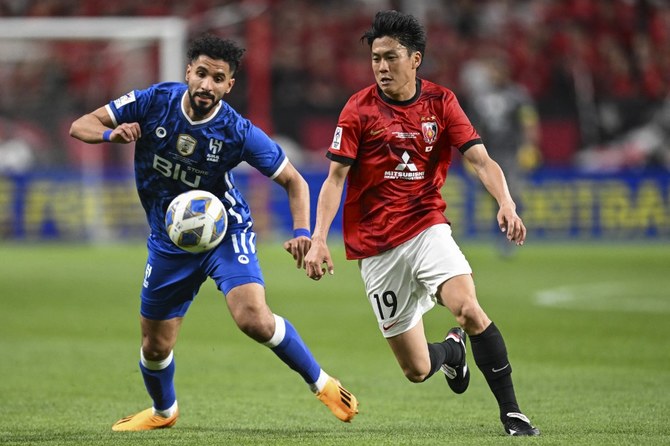
Final heartbreak for Al-Hilal who wonder what might have been

Urawa Reds' Ken Iwao (R) and Hilal's Saleh al-Shehri fight for the ball during the second leg of the AFC Champions League final between Urawa Red Diamonds and Al-Hilal at Saitama Stadium in Saitama on May 6, 2023. (AFP)
Short Url
Updated 06 May 2023
Follow

Final heartbreak for Al-Hilal who wonder what might have been

On Saturday, Al-Hilal lost the Asian Champions League final for the third time in a decade. The record books will show that Urawa Reds won the second leg 1-0 to take the tie 2-1 on aggregate but what won’t be as clear was that — just as in 2014 against Western Sydney Wanderers and three years later against the same Japanese opposition — the Riyadh giants could have been the ones lifting the trophy.

Such is football and the Saudi champions have four continental titles, still more than anyone else. But this was a case of what might have been for the title-holders.

What would have happened if, with Al-Hilal comfortably leading 1-0 at home last week, Ali Al-Bulaihi’s attempted clearance in the first leg had not somehow ended up hitting the post, allowing Shinzo Koroki to score a goal that came out of nothing? What would have happened had Salem Al-Dawsari, scorer of the opening goal, not seen red later in the game leaving him out of the second leg? What would have happened had Ramon Diaz’s men simply made more use of their prodigious possession in both games?

If the 1-1 draw from the first leg had been frustrating it was also costly, with Al-Dawsari absent and captain Salman Al-Faraj injured for the second leg. Full-back Yasser Al-Shahrani was also unavailable which meant that Diaz had to ring the changes. He brought in experienced midfielder Abdullah Al-Otayf, young forward Abdullah Al-Hamdan and Peruvian winger Andre Carrillo.

The visitors had the first sight of goal and were claiming a penalty in the fourth minute. Al-Hamdan and Urawa goalkeeper Shusaku Nishikawa both went down going for the ball and Odion Ighalo had a subsequent shot cleared off the line.

The opening stages continued in a similar vein as the Saudi Arabian champions asked questions of the hosts and quietened the crowd. After 21 minutes, Michael dribbled along the edge of the area and forced a flying save from Nishikawa.

It was a reflection of the first leg in which Al-Hilal had the possession and chances but were unable to make them count, which meant Urawa were always just seconds away from scoring against the run of play. And that is what very nearly happened on the half-hour mark. Hiroki Sakai waltzed down the right and sent over a perfect cross for Koroki, the goalscorer in Riyadh last week, to launch a spectacular flying volley against the crossbar.

 Soon after, Mohamed Kanno was shooting just over from inside the area at the end of a passage of play in which Ighalo got round the goalkeeper but, surrounded by defenders, could not get a shot off. That wasn’t a problem for Carrillo, who collected the ball far from goal but fired a shot that was curling into the top corner before Nishikawa, the busier of the two goalkeepers, flew to his right to make the save.

For the second successive Saturday, Al-Hilal went in at half-time with a possession percentage that was into the seventies, but there were concerns that not enough clear chances were not being created. And compared to the previous leg, Urawa carried a threat on the counter.

The Reds took the lead just three minutes after the restart with a soft goal. Marius Hoibraten headed a free-kick back across goal and the wind seemed to take it the ball out of the reach of Abdullah Al-Mayouf and it bounced off the leg of Carrillo and into the net.

It lifted the fans and gave new energy into the Japanese team. Al-Hilal continued to push forward but still struggled to make meaningful opportunities. Urawa went close on a couple of occasions but with 10 minutes remaining, a cross from Michael on the left curled all the way past the Red defense and almost into the far corner. It signaled the start of intense pressure from the Blues, with balls flying into the area.

And then there was the chance in the 90th minute. Ighalo, who was unable to make an impact in either leg of the final, made a little space inside the area, turning three defenders the wrong way before getting off a low shot. Nishikawa was equal to the challenge. Indeed, Urawa’s defense had been equal to all that Al-Hilal could throw at them and it was the Japanese team’s defense, as well as Al-Hilal’s missing players, that ultimately made the difference.

Al-Hilal now return home with no trophy but with plenty of regret. They have shown after past painful final defeats, however, that they have what it takes to bounce back and lift the trophy again. They will be desperate to return to the final, though they may prefer to avoid Urawa Reds next time.


History-chasing Djokovic and Alcaraz to meet in Australian Open final after epic semifinal wins

Updated 4 sec ago
Follow

History-chasing Djokovic and Alcaraz to meet in Australian Open final after epic semifinal wins

  • Carlos Alcaraz striving to become the youngest man ever to complete a career Grand Slam
  • Novak Djokovic is aiming to be the oldest man in the Open era to win a Grand Slam title
MELBOURNE: Novak Djokovic finally beat one of the two men who have been blocking his path to an unprecedented 25th Grand Slam singles title when he edged Jannik Sinner in five sets Friday to reach the Australian Open final.
To get that coveted No. 25, he’ll next have to beat the other: top-ranked Carlos Alcaraz.
They’re both chasing history in Sunday’s championship decider, with the 22-year-old Alcaraz striving to become the youngest man ever to complete a career Grand Slam.
The top-ranked Alcaraz also had to come through a grueling five-setter. He fended off No. 3 Alexander Zverev 6-4, 7-6 (5), 6-7 (3), 6-7 (4), 7-5 in a match that started in the warmth of the afternoon Friday and, 5 hours and 27 minutes later, became the longest semifinal ever at the Australian Open.
That pushed the start of Djokovic’s match against Sinner back a couple of hours, and the 38-year-old Djokovic finally finished off a 3-6, 6-3, 4-6, 6-4, 6-4 win just after 1:30 a.m.
“It feels surreal,” Djokovic said of his 4-hour, 9-minute triumph. “Honestly, it feels like winning already tonight. I know I have to come back … and fight the No. 1 of the world. I just hope that I’ll have enough gas to stay toe-to-toe with him.
“That’s my desire. Let the God decide the winner.”
Djokovic was at the peak of his defensive powers, fending off 16 of the 18 breakpoints he faced against the two-time defending Australian Open champion. It ended a run of five losses to Sinner, and a run of four semifinal exits for Djokovic at the majors.
“Had many chances, couldn’t use them, and that’s the outcome,” Sinner said. “Yeah, it hurts, for sure.”
Alcaraz and Sinner have split the last eight major titles between them since Djokovic won his last title at the 2023 US Open.
Nobody knows how to win more at Melbourne Park than Djokovic. He has won all 10 times he’s contested the Australian Open final.
He said he saw Alcaraz after the first of the semifinals was over and he congratulated him on reaching his first final at Melbourne Park.
“He said sorry to delay,” Djokovic later explained. “I told him ‘I’m an old man, I need to go earlier to sleep!”
Djokovic, aiming to be the oldest man in the Open era to win a Grand Slam title, was kept up late.
“I’m looking forward to meeting him on Sunday,” he said.
Final 4
With the top four seeds reaching the Australian Open men’s semifinals for just the fifth time, Day 13 was destined to produce some drama. The season-opening major had been a relatively slow burn, until the back-to-back five-setters lasting a combined 9 hours and 36 minutes.
Alcaraz and Zverev, the 2025 runner-up, surpassed the 2009 classic between Rafael Nadal and Fernando Verdasco as the longest ever Australian Open semifinal.
Medical timeout
Alcaraz was as close as two points from victory in the third set but was hampered by pain in his upper right leg and his medical timeout became contentious.
He said initially it didn’t feel like cramping because the pain seemed to be just in one muscle, the right adductor, and he needed an assessment.
He navigated the third and fourth sets and was behind in the fifth after dropping serve in the first game. He kept up the pressure but didn’t break back until Zverev was serving for the match. He then won the last four games.
“I think physically we just pushed each other to the limit today. We pushed our bodies to the limit,” Alcaraz said. “Just really, really happy to get the win, that I came back. I just rank this one in the top position of one of the best matches that I have ever won.”
Believe
Asked how he was able to recover despite being so close to defeat, Alcaraz admitted he was struggling but said kept “believing, believing, all the time.”
“I’ve been in these situations, I’ve been in these kinds of matches before, so I knew what I had to do,” he said. “I had to put my heart into the match. I think I did it. I fought until the last ball.”
Zverev was demonstrably upset about the time out out in the third set, taking it up with a tournament supervisor, when his rival was given the three-minute break for treatment and a massage on the leg.
After the match, he maintained that he didn’t think it was right, but he didn’t think it should overshadow the match.
“I don’t want to talk about this right now, because I think this is one of the best battles there ever was in Australia,” he said “It doesn’t deserve to be the topic now.”