

Crunch time for Madrid with Copa final and Man City game

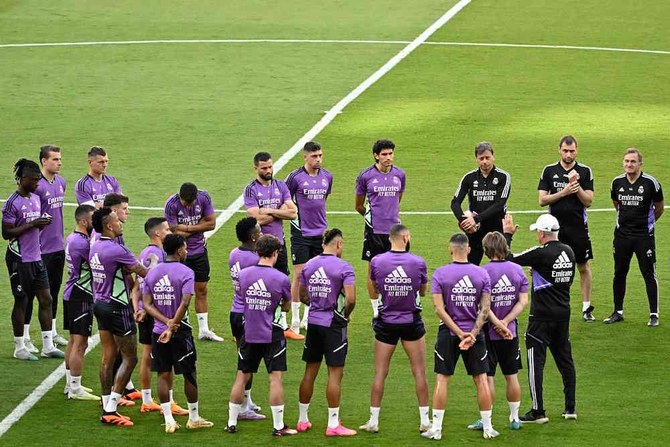
Real Madrid's Italian coach Carlo Ancelotti (Front-R) talks to his players during a training session at la Cartuja stadium in Seville on Friday, on the eve of the Spanish Copa del Rey (King's Cup) final football match between Real Madrid and Osasuna. (AFP)
Short Url
Updated 06 May 2023
Follow

Crunch time for Madrid with Copa final and Man City game

  • Carlo Ancelotti’s players have been playing far from their best with their focus clearly on the game in Seville against Osasuna
  • Three days later, Madrid will play the first leg of their highly anticipated Champions league semifinal rematch against Manchester City

BARCELONA: It’s time for Real Madrid to switch into championship mode for the last part of an inconsistent season.

Madrid will play Osasuna in the Copa del Rey final on Saturday following a stretch of poor showings in the Spanish league, where the title has long been out of reach.

Carlo Ancelotti’s players have been playing far from their best with their focus clearly on the game in Seville against Osasuna — and on what’s to come just after.

Three days later, Madrid will play the first leg of their highly anticipated Champions league semifinal rematch against Manchester City. The second leg in England will be on May 17.

While Madrid’s top priority is to defend their continental title and lift a record-extending 15th European Cup, a victory over Osasuna would secure their first Spanish cup in nearly a decade and give them the chance for a pair of titles this campaign.

“Being honest, our season will be decided in the coming two weeks,” Madrid defender Dani Carvajal said on Friday. “The league has gotten away from us, and our first big test is tomorrow. It is a final against a difficult rival and we want to win the title. Once that is over, we will think about our next rival, but our focus is now on Osasuna.”

Madrid have produced convincing wins over Liverpool and Chelsea in the Champions League knockout rounds, but they have lost four of their last eight Spanish league games. Their 2-0 defeat at Real Sociedad this week let Atlético Madrid move ahead of their crosstown rivals and into second place behind runaway leaders Barcelona.

Karim Benzema sat out the Sociedad game, while attack partner Vinicius Junior was suspended for an accumulation of yellow cards. So both should be rested for the critical week ahead.

Madrid are trying to win their first Copa since 2014, when Gareth Bale scored a late winner to beat Barcelona 2-1. They have won the cup 19 times, third most behind Barcelona (31) and Athletic Bilbao (23).

But when it comes to pure motivation, Osasuna most likely have the advantage over their star-studded opponent.

The modest club based in Pamplona has been waiting almost two decades for another shot at winning its first major trophy.

This will be just the second Copa final in Osasuna’s history. They reached the 2005 final, only to lose to Real Betis 2-1 in extra time.

“Playing this game means everything for me,” said Osasuna defender David García, who debuted for Spain in March at the age of 29. “This is the most important game in my career of 20 years with this club. All my teammates have made a huge effort to get here. We fully believe that we can win it.”

Ancelotti should have all his first-choice players available after Luka Modric returned to practice recently after having injured his left thigh.

The main question is whether Eduardo Camavinga could play at left back or in midfield instead of France teammate Aurelien Tchouameni. The other choice for Ancelotti could be whether he starts Rodrygo or Federico Valverde up front.

In his four seasons with Osasuna, coach Jagoba Arrasate has forged a team that few like to play against. Their up-tempo pace and bruising defending have led them past Betis, Sevilla and Athletic Bilbao to reach the final, while also keeping them in the top half of the league.

Osasuna’s defense is anchored by Garcia and fellow center back Aridane Hernandez. Forwards Chimy Avila and Abde Ezzalzouli are fast one-on-one threats on the break; Moi Gomez has emerged as one of the league’s top midfielders; and Sergio Herrera can have inspired nights in goal.

In the league, Osasuna drew 1-1 at the Santiago Bernabeu in October and lost 2-0 at home to Madrid in February.

The final will be played in La Cartuja Stadium in Seville, a municipal venue that has been used by Spain and hosted group games for the last European Championship.


Middle East war puts Asian Football Confederation in a tricky situation

Updated 6 sec ago
Follow

Middle East war puts Asian Football Confederation in a tricky situation

  • Asian football has long been structured around regions, with competitions split between East and West
  • With conflict in the Middle East escalating on Feb. 28, the AFC was forced into emergency mode as the knockout stages of its club competitions approach

DAMMAM: Football in Asia has never been an easy task to manage. Long flights, numerous time zones, conflicting calendars, vastly different football cultures and — perhaps more than any other confederation in the world — politics.
While the war in the Middle East falls under the AFC’s umbrella, its direct effects have so far been limited to the clubs in West Asia. Asian football has long been structured around regions, with competitions split between East and West, although for a period, the second-tier AFC Cup operated in five separate regions.
As a result, AFC club competitions in East Asia continued uninterrupted in the first week of March. A crowd of 31,225 watched Johor Darul Ta’zim’s historic 3-1 victory over Sanfrecce Hiroshima in the AFC Champions League Elite round of 16. Bangkok United defeated Tampines Rovers in the AFC Champions League Two quarter-final, and an all-Cambodian clash between Phnom Penh Crown and PKR Svay Rieng in the AFC Challenge League ended in a 4-1 victory for the visitors.
The situation in West Asia, however, is vastly different.
With the conflict in the Middle East escalating on Feb. 28, the AFC was forced into emergency mode as the knockout stages of its club competitions approach.
Within 24 hours, the confederation announced that all first-leg matches involving West Asian clubs in AFC competitions would be rescheduled until further notice. The same decision was taken for the second-leg matches fixtures just 48 hours later.
Domestic football has also been heavily disrupted. Leagues in Qatar, Bahrain, Kuwait and Lebanon have been postponed indefinitely, with matches continuing behind closed doors in Jordan.
Leagues in Saudi Arabia, Oman, Iraq and Syria continue to operate, but flights in the region are limited.
With the season already compressed by the FIFA Arab Cup, FIFA Intercontinental playoffs and the upcoming FIFA World Cup, member associations throughout the Middle East now find themselves scrambling alongside the AFC to solve a problem that ultimately lies outside their control.
Another issue looms on the horizon. The AFC Champions League final stage will be hosted in Saudi Arabia next month for the second year in a row. While football has not halted in the Kingdom and the security situation is stable, it remains to be seen whether East Asian clubs will be willing to travel if the conflict continues.
What is the real solution, fans ask?
One proposal that has been circulated is to centralize the knockout rounds from the Round of 16 stage instead of the quarter-finals. That option, however, presents its own challenges. East Asian clubs have already begun their journey in the round of 16, and the idea of centralized hosting has historically not been popular across the continent.
When Saudi Arabia and Qatar were selected to host the AFC World Cup Qualifiers fourth round last year, the decision sparked backlash from Indonesia, Iraq, Oman and the UAE. More recently, journalist Ali Al-Marshoud claimed on Saudi sports program “In the 90” that the UAE’s Al-Wasl rejected a proposal for their AFC Champions League Two quarter-final against Al-Nassr as a single-leg match in Jeddah.
The AFC therefore finds itself in a difficult position. It cannot control regional geopolitics, nor can it influence government policies. At the same time, there is no guarantee that East Asian clubs will travel to the region, or that West Asian clubs will agree to surrender their right to play matches at home.
The conflict has also begun to affect international football.
With the FIFA World Cup intercontinental playoffs scheduled for later this month and Iraq facing a crucial qualifier in Mexico on March 31, uncertainty continues to grow.
In a statement released by the Iraqi Football Association, officials confirmed they were in constant contact with FIFA and the AFC regarding potential travel complications.
Head coach Graham Arnold is currently unable to leave the UAE, while several players and staff have struggled to obtain visas to Mexico due to embassy closures. All the while flights through Iraqi airspace have been suspended.
Political complications are not new to Asian football. For years, Saudi and Iranian clubs played each other at neutral grounds. Conflicts in Syria, Palestine, Iraq and Lebanon also forced the AFC to adopt special arrangements at various times. And of course, the COVID-19 pandemic, which fundamentally reshaped the state of football in Asia.
Yet the current situation presents a different scale of challenge.
For the first time in modern history, the AFC must navigate a regional conflict that touches nearly every part of the confederation. With the season entering its decisive stages and the largest World Cup in history approaching, solutions must be found quickly, or Asian football risks a crisis that could reshape the continental game.