

Saudi Arabia, US welcome dialogue between Sudan’s warring sides in Jeddah

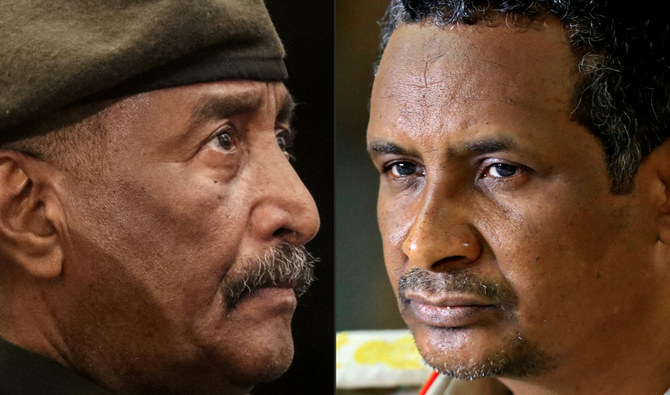
Head of Sudan’s military Gen. Abdel-Fattah Burhan, left, and commander of Gen. Mohammed Hamdan Dagalo. (AFP)
Short Url
Updated 06 May 2023
Follow

Saudi Arabia, US welcome dialogue between Sudan’s warring sides in Jeddah

RIYADH: Saudi Arabia and the US urged the warring sides in Sudan’s conflict to engage in working toward a cease-fire, and welcomed the start of pre-negotiation talks in Jeddah.

They urged both parties to “actively engage in the talks toward a cease-fire and end to the conflict,” a joint statement said early on Saturday.

“The Kingdom of Saudi Arabia and the United States urge both parties to take in consideration the interests of the Sudanese nation and its people and actively engage in the talks towards a ceasefire and end to the conflict, which will spare the Sudanese people the suffering and assure the availability of humanitarian aid to affected areas.” 

Saudi Arabia and the United States also said they would like to stress the efforts of the countries and organizations that supported these talks, including the United Arab Emirates, the United Kingdom, the League of Arab States, and partners from the Trilateral Mechanism.

In a statement, the leader of Sudan's paramilitary Rapid Support Forces, Gen. Mohamed Hamdan Dagalo, confirmed participation in Jeddah talks. 

He expressed his appreciation towards Saudi Arabia for hosting the talks between the Sudanese parties. He also added that he hopes the talks will “reach their intended targets” of allowing a safe passage for civilians, and adhere to what he called his firm position on the need to reach a civilian transitional government in Sudan.

Also, Saudi Foreign Minister Faisal bin Farhan said the Kingdom welcomes the presence of Sudanese representatives of the from the Armed Forces and the Rapid Support Forces in Jeddah, to engage in dialogue. He said we hope this will lead to the end of the conflict and the return of security and stability.

“This dialogue comes as a result of international collaboration and vigorous efforts by the Kingdom with the United States of America, in partnership with the Quad countries and partners from the Trilateral Mechanism,” the statement added. 

Sudan’s Forces of Freedom and Change, a political grouping leading an internationally backed plan to transfer to civilian rule, also welcomed the Jeddah talks on Saturday.
The Jeddah initiative is the first serious attempt to end the fighting that has crippled the Sudanese government and endangered the country’s political transition following years of unrest and uprisings.
The conflict erupted on April 15 between the army of Abdel Fattah Al-Burhan and the RSF of commander Dagalo, a former militia leader known as Hemedti, following the collapse of an internationally-backed plan for a new transition with civilian parties.
Despite multiple cease-fire declarations, the fighting has showed no sign of abating.
However, Sudanese broadcasters said there was no exchange of gunfire in and around Khartoum in the early hours of Saturday.
Saudi Arabia’s foreign minister, Prince Faisal bin Farhan, and US Secretary of State Antony Blinken on Friday discussed a plan for the warring parties to reduce tensions, the kingdom said.
A group of countries led by Britain, the United States, Germany and Norway is set to request an urgent meeting of the UN Human Rights Council on the Sudan crisis next week, a document showed on Friday.

(with inputs from AP and Reuters)


Trump warns Iran of ‘very traumatic’ outcome if no nuclear deal

Updated 5 sec ago
Follow

Trump warns Iran of ‘very traumatic’ outcome if no nuclear deal

WASHINGTON: US President Donald Trump threatened Iran Thursday with “very traumatic” consequences if it fails to make a nuclear deal — but Israeli Prime Minister Benjamin Netanyahu said he was skeptical about the quality of any such agreement.
Speaking a day after he hosted Netanyahu at the White House, Trump said he hoped for a result “over the next month” from Washington’s negotiations with Tehran over its nuclear program.
“We have to make a deal, otherwise it’s going to be very traumatic, very traumatic. I don’t want that to happen, but we have to make a deal,” Trump told reporters.
“This will be very traumatic for Iran if they don’t make a deal.”
Trump — who is considering sending a second aircraft carrier to the Middle East to pressure Iran — recalled the US military strikes he ordered on Tehran’s nuclear facilities during Israel’s 12-day war with Iran in July last year.
“We’ll see if we can get a deal with them, and if we can’t, we’ll have to go to phase two. Phase two will be very tough for them,” Trump said.
Netanyahu had traveled to Washington to push Trump to take a harder line in the Iran nuclear talks, particularly on including the Islamic Republic’s arsenal of ballistic missiles.
But the Israeli and US leaders apparently remained at odds, with Trump saying after their meeting at the White House on Wednesday that he had insisted the negotiations should continue.

- ‘General skepticism’ -

Netanyahu said in Washington on Thursday before departing for Israel that Trump believed he was laying the ground for a deal.
“He believes that the conditions he is creating, combined with the fact that they surely understand they made a mistake last time when they didn’t reach an agreement, may create the conditions for achieving a good deal,” Netanyahu said, according to a video statement from his office.
But the Israeli premier added: “I will not hide from you that I expressed general skepticism regarding the quality of any agreement with Iran.”
Any deal “must include the elements that are very important from our perspective,” Netanyahu continued, listing Iran’s ballistic missile program and its support for armed groups such as the Palestinian movement Hamas, Yemen’s Houthi rebels and Hezbollah in Lebanon.
“It’s not just the nuclear issue,” he said.
Despite their differences on Iran, Trump signaled his strong personal support for Netanyahu as he criticized Israeli President Isaac Herzog for rejecting his request to pardon the prime minister on corruption charges.
“You have a president that refuses to give him a pardon. I think that man should be ashamed of himself,” Trump said on Thursday.
Trump has repeatedly hinted at potential US military action against Iran following its deadly crackdown on protests last month, even as Washington and Tehran restarted talks last week with a meeting in Oman.
The last round of talks between the two foes was cut short by Israel’s war with Iran and the US strikes.
So far, Iran has rejected expanding the new talks beyond the issue of its nuclear program. Tehran denies seeking a nuclear weapon, and has said it will not give in to “excessive demands” on the subject.
