

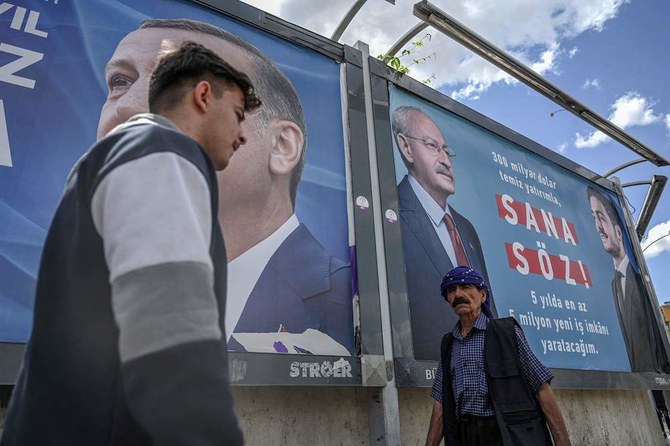

ANKARA: With only a few days until the critical ballot in Turkiye on May 14, the issue of refugees has again resurfaced during the election campaigns of candidates.
The main opposition presidential candidate Kemal Kilicdaroglu recently released a video outlining his plans for refugees if the Nation Alliance is victorious.
Kilicdaroglu’s position is that normalization will be pursued with the Bashar Assad regime and a protocol signed to protect refugees.
The UN and the EU will also be included in this protocol and more funds will be asked from them for the reconstruction process, with Turkish companies tasked with rebuilding Syria.
Both in his video speech and during his previous rallies across the country, Kilicdaroglu has pledged to repatriate about 3.6 million Syrians registered in Turkiye back to their homeland within at least two years.
Turkiye cannot be Europe’s “buffer zone” for refugees, Kilicdaroglu said.
If essential measures are not taken, “hungry and thirsty” refugees from these countries would flock over Turkey’s borders, he cautioned. “The refugee issue is not a racial issue, but a resource one,” he added.
As anti-refugee sentiment has intensified in campaign rhetoric, experts argue that it is not realistic to send all Syrians back to their countries in a short time because international law has to be taken into account.
During the upcoming elections, some 167,000 Syrians will be eligible to cast their vote.
Friedrich Puttmann, doctoral researcher at the European Institute of London School of Economics, thinks that the opposition’s plans to send Syrian refugees back home within two years would inevitably lead to a new row with Brussels. This is because the European Council’s conclusions from April 2018 oppose any forced returns of the Syrian refugees or voluntary returns that are used to change the local ethnic demographics in Syria.
“Moreover, most Syrian refugees would like to stay in Turkiye, where they have built a life over the past years, and not to return to Syria, which continues to be unsafe due to the continuing civil war and especially the Assad regime,” he told Arab News.
“That is true even if the next government reaches an agreement with Assad providing safety guarantees for returning Syrians, because Assad’s dictatorial regime must be profoundly mistrusted.”
As a result, Puttmann thinks that more Syrian refugees today are considering crossing into the EU again, which may lead to another refugee crisis on the EU’s shores, and many are hoping to keep the rights they have in Turkiye at the moment.
“That is also because, as Human Rights Watch has reported, not all returns that look voluntary on paper actually also are voluntary in practice,” he said.
Although President Recep Tayyip Erdogan uses softer language with regard to Turkiye’s Syrian refugees, Puttmann said that Erdogan’s aim is the same, which is to return them to Syria with the help of the EU.
“No matter the result of the elections, it is high time for the EU to take the perspective of the Turkish host society even more into account than until now, if it wants to prevent both the Syrians’ deportation to Syria and another refugee crisis on the EU’s borders.
“The EU should proactively seek dialogue with Turkiye on this and make a proposal on how it could support the welfare of both Syrian refugees and Turkish citizens as well as their integration with each other better in the future.”
According to Metin Corabatir, president of the Ankara-based Research Center on Asylum and Migration, or IGAM, it is unrealistic to send Syrians back to their homeland by reaching an agreement with the Assad regime under the current circumstances.
“The secure conditions laid down by the UN and the EU have not been reached yet in order to allow a safe return.
“Therefore, they would not be willing to be part of any protocol,” he told Arab News.
“The ongoing oppositional rhetoric against the Syrians should only be viewed as a political move to consolidate voters ahead of the elections, and nothing more,” he said.
Corabatir also emphasized that the Assad regime would require the withdrawal of Turkish troops from its territories.
“Therefore Syrians could not be sent to the so-called safe zones where Turkish troops would be absent as well,” he said.
Dr. Begum Basdas, researcher at the Centre for Fundamental Rights at the Hertie School in Berlin, thinks Kilicdaroglu’s commitment to international human rights standards and democratic values fall short of ensuring protection for refugees, asylum seekers and migrants because he uses discriminatory terms such as “illegal” and “burden.”
“However, it is not shocking, as everywhere around the world, including in the EU and the US, we see similar trends where anti-migration policies are disregarded by the progressives to appeal to rightwing voters,” she told Arab News.
According to Basdas, increased securitization of the borders and hostile asylum procedures do not actually stop people’s movements, it only results in more deaths and further human rights violations.
“Regardless of who succeeds in the elections, the problem we continue to face is the lack of clear and comprehensive migration policies that prioritize human rights of everyone in Turkiye,” she said.
Basdas also underlined that international human rights law and Turkiye’s national legislation prohibit the violation of the principle of non-refoulement, meaning individuals cannot be transferred to countries where they risk being subject to serious human rights violations.
“Each case for both Syrians and non-Syrians must be assessed individually before a return decision is made, otherwise it might amount to collective expulsion,” she said.
“This is a serious concern particularly for non-Syrians, who already experience challenges to access registration and asylum procedures in Turkiye,” she added.
It is therefore still unclear how the opposition presidential candidate will ensure voluntary and safe returns.
“The safeguards cannot be guaranteed merely through negotiations with other countries or rebuilding strategies,” Basdas said.
In his video statement on May 2, Kilicdaroglu also warned about what he argued were the effects of climate change in the Mediterranean basin that could lead to an influx of refugees to Turkiye.
With the UN predicting climate change and potential water scarcity displacing 700 million people globally by 2030, Basdas said that “a stronger collaboration in the region on climate change with mutual respect is crucial, however Kilicdaroglu’s framing of the problem risks further stigmatization and discrimination against migrants and asylum seekers.”
“In the end, as he said, climate change affects us all regardless of our status and we might all be displaced one day,” she added.
“For that reason, besides progressive climate policies, Turkiye must instead call on and lead the international community for a humanitarian approach to migration to ensure protection of rights in the long run, rather than proposals focused on returns and militarized borders,” she said.


