

Kuwait agrees to help Pakistan enhance disaster mitigation strategies

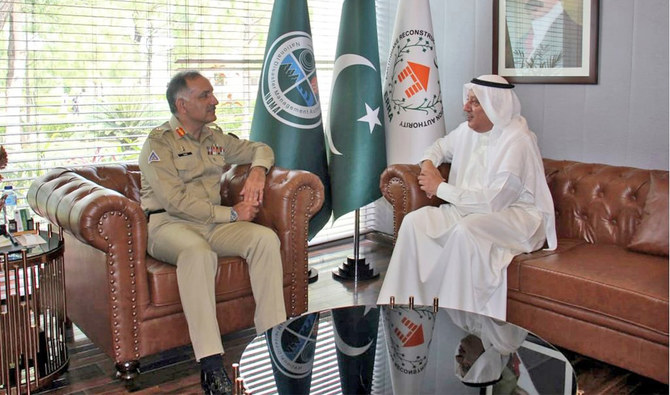
Kuwait’s Ambassador to Pakistan, Nassar Abdulrahman Al-Mutairi (right), calls on the Chairman of National Disaster Management Authority (NDMA), Lt General Inam Haider Malik, in Islamabad, Pakistan, on May 4, 2023. (Photo courtesy: NDMA)
Short Url
Updated 04 May 2023
Follow

Kuwait agrees to help Pakistan enhance disaster mitigation strategies

  • Pakistan hopes to get Kuwaiti support with satellite feeds and software for pre-disaster predictions
  • The two countries will also exchange academic experts to develop shared intellectual repository

ISLAMABAD: The Government of Kuwait has agreed to collaborate with Pakistan's National Disaster Management Authority (NDMA) to develop strategies aimed at lessening the impact of disasters in the South Asian country, according to a statement issued in Islamabad this week.

Pakistan experiences some of the highest disaster risk levels globally and was ranked 24th out of 191 countries by the 2023 Inform Risk Index. Last year, the country experienced the worst floods in its history, resulting in 1,700 deaths, damage to large swathes of agricultural land, displacement of large number of people, and estimated damages of over $30 billion.

“Nassar Abdulrahman Al-Mutairi, Kuwait’s Ambassador to Pakistan, called on the Chairman of National Disaster Management Authority (NDMA), Lt General Inam Haider Malik in his office on [Tuesday],” the NDMA said in the statement.

"The ambassador appreciated the envisioned NEOC [National Emergency Operation Center] of Pakistan’s NDMA and agreed to formulate strategies for participative investment in pre-disaster planning and management to reduce loss of human lives and infrastructure.”

During the meeting, the two sides discussed the necessity of continued support to Pakistan in the fields of disaster mitigation, specifically in terms of sharing satellite feeds and software for pre-disaster predictions. The two countries also agreed to exchange academic experts through the platform of the National Institute of Disaster Mitigation (NIDM) for developing a shared intellectual repository.

“The two sides reached consensus on expanding the capacity-building of Pakistan's national disaster response efforts,” the statement added.

After the end of the first Gulf War in 1991, Pakistani army engineers were involved in a program of mine clearance in the Arab country. During the COVID-19 pandemic, Islamabad also sent hundreds of doctors, nurses, and technicians to Kuwait, where a little over 100,000 Pakistanis live.

Kuwait has been a long-time supplier of white oil products to Pakistan on favorable terms of payment and the Kuwait Foreign Petroleum Exploration Company (KUFPEC) has also been investing in Pakistan for many decades.

“Our people are deeply indebted for the support by Pakistan, especially when medical professionals were sent to help combat COVID-19,” Ambassador Al-Mutairi said while ensuring possible cooperation.


Eight killed as protesters storm US Consulate in Karachi after Iran confirms Khamenei killed

Updated 6 sec ago
Follow

Eight killed as protesters storm US Consulate in Karachi after Iran confirms Khamenei killed

  • Protesters smashed doors, set fire to property as police used tear gas to disperse crowds
  • Protests spread to Shiite-majority areas of Gilgit-Baltistan, UN office torched, curfew imposed

ISLAMABAD: At least eight people were killed in clashes near the US Consulate in Karachi on Sunday, the Edhi Foundation said, as protests erupted across parts of Pakistan following Iran’s confirmation that Supreme Leader Ayatollah Ali Khamenei was killed in joint US–Israeli strikes.

Hundreds of protesters gathered outside the consulate on Sunday afternoon, with some attempting to storm the compound and vandalizing property, according to footage circulating on social media and international news reports.

Videos showed protesters armed with sticks smashing doors and windows. Separate footage appeared to show property inside the consulate premises set on fire. International media outlets reported that police used tear gas and baton charges to disperse the crowd.

“The number of people killed during the firing and unrest near the American Consulate on Mai Kolachi Road has risen to eight,” the Edhi Foundation, a major charity and rescue organization, said in a statement.

Sindh Home Minister Zia-ul-Hassan Lanjar directed authorities to strengthen security around sensitive installations as unrest intensified.

“No one will be allowed to take the law into their own hands,” Lanjar said in a statement issued by his office.

He added that law enforcement agencies were fully alert and monitoring the situation, and vowed that action would be taken in accordance with the law against those disturbing public order.

The violence came hours after Iranian authorities confirmed Khamenei was killed in coordinated strikes carried out by the United States and Israel, dramatically escalating tensions in the Middle East and triggering protests in several countries.

PROTESTS SPREAD

Demonstrations were also reported in Skardu, in Pakistan’s northern Gilgit-Baltistan region, where hundreds of people staged a sit-in on a main road to protest Khamenei’s killing.

Shabbir Mir, spokesperson for the Gilgit-Baltistan chief minister, told Arab News that a United Nations office in the district had been set on fire.

“The protesters have torched an UN office in Skardu,” Mir confirmed.

Gilgit-Baltistan Police announced on its official Facebook page that a curfew had been imposed in the predominantly Shiite district.

The unrest in Pakistan follows a sharp escalation in the Middle East after the United States and Israel launched coordinated strikes in Iran on Saturday.

According to US officials, the operation targeted Revolutionary Guard command facilities, air defense systems, missile and drone launch sites, and military airfields. The US military said it suffered no casualties and reported minimal damage to its bases despite what it described as “hundreds of Iranian missile and drone attacks.”

Iran retaliated by launching missiles and drones toward Israel and targeting US military installations in Bahrain, Kuwait and Qatar. Israeli ally UAE said its air defense systems intercepted dozens of Iranian missiles and drones, but debris from the interceptions caused material damage in Abu Dhabi and Dubai, and at least one civilian, including a Pakistani national, was killed.

The UAE government condemned the strikes as a “blatant violation of national sovereignty and international law,” and issued rare emergency alerts urging residents to seek shelter, underscoring how the conflict has rippled far beyond Iran’s borders. 

The Israeli military said dozens of Iranian missiles were fired toward Israeli territory, many of which were intercepted. Israel’s Magen David Adom rescue service said a woman in the Tel Aviv area died after being wounded in a missile strike.