Government-judiciary rift deepens as senior lawmaker asks National Assembly to summon top judge

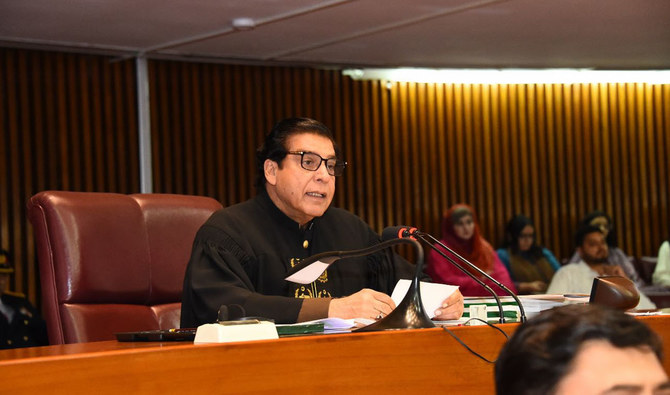
The file photo taken on April 27, 2023, shows the National Assembly Speaker Raja Pervez Ashraf gesturing during a session of the Parliament in Islamabad, Pakistan. (Photo courtesy: @NAofPakistan/Twitter)
Short Url
Updated 04 May 2023
Follow

Government-judiciary rift deepens as senior lawmaker asks National Assembly to summon top judge

  • Former PM Abbasi says the Supreme Court chief justice should be asked why he demanded record of parliamentary proceedings
  • NA Speaker Raja Pervez Ashraf calls the development ‘serious issue,’ promises not to compromise on parliamentary supremacy

ISLAMABAD: National Assembly Speaker Raja Pervez Ashraf ruled out the possibility of compromising on parliamentary supremacy on Wednesday after a senior lawmaker urged him to summon the country’s chief justice and ask him why he wanted record of the house proceedings related to a new law limiting his powers.

The uproar in the National Assembly began on Tuesday after an eight-member apex court bench instructed the attorney general to share the parliamentary proceedings while hearing petitions challenging the Supreme Court (Practice & Procedure) Bill, 2023.

The law limits the power of the chief justice of Pakistan, depriving him of the authority to solely initiate public interest litigation on his own through suo moto proceedings. It also dilutes his administrative power to constitute benches and determine their composition and involves more judges in the process.

Speaking on the floor of the house, former prime minister Shahid Khaqan Abbasi, who belongs to the ruling Pakistan Muslim League-Nawaz (PML-N) party, asked the National Assembly speaker to form a committee to debate the matter.

“This is not a small matter since it relates to the supremacy and sovereignty of the house,” he said while issuing a brief statement.

“The chief justice should be asked to come here and tell why he has asked for the record,” he added.

The speaker said he was aware of the sentiments of members of parliament while asking them to bring a resolution for the consideration of the house.

“It is a very serious issue,” he agreed. “There can be no compromise on the supremacy and sovereignty of this house. I can assure you of that as the custodian of the house.”

Tensions have been mounting between the government and the top court since the superior judiciary took up a case of election delay in Punjab and Khyber Pakhtunkhwa following the dissolution of the provincial legislatures by former prime minister Imran Khan and his allies in January.

The top court instructed the country’s election commission to hold the Punjab polls on May 14 and ordered the central bank to release the required funds for the purpose.

However, the government maintained the Supreme Court had gone beyond its constitutional mandate by issuing the rulings which challenged the principles of parliamentary supremacy and separation of powers.

Pakistan’s defense minister Khawaja Asif also spoke during the National Assembly debate on Wednesday, saying it was unfortunate that two constitutional institutions had come face to face with each other.

“We are not against the court but we are against this territorial trespassing,” he said.

Asif maintained whenever the constitution had been violated by military rulers, their actions were endorsed by the courts.

He added it was time Pakistan’s parliament held judges, “who aided and abetted constitutional violations,” accountable.


Pakistan reports decline in polio cases in 2025

Updated 4 sec ago
Follow

Pakistan reports decline in polio cases in 2025

  • Cases drop to 30 from 74 in 2024, with no new infections recorded since September
  • Authorities plan intensified targeted drives in 2026 to halt remaining transmission

ISLAMABAD: Pakistan reported a sharp decline in polio cases in 2025, with infections falling to 30 from 74 a year earlier, as intensified vaccination campaigns and improved surveillance helped curb the spread of the virus, health authorities said on Wednesday.

No new polio cases have been recorded anywhere in the country since September, said a statement, as Pakistan carried out six polio campaigns, including five nationwide drives, trying to reach children in high-risk areas and improve monitoring of virus circulation.

Despite the decline, the authorities cautioned that poliovirus continues to circulate in some districts, requiring sustained vigilance to prevent a resurgence.

“Targeted interventions, robust community engagement, and ongoing vaccination efforts remain essential to reach every missed child and prevent any resurgence,” the official statement said.

“Frontline health workers, security personnel, and local authorities continue to work in close coordination to maintain high immunity levels and ensure that Pakistan remains on course toward becoming polio-free,” it added.

The most recent nationwide campaign, conducted from Dec. 15 to 21, achieved more than 98 percent coverage across the country, including all four provinces, Azad Jammu and Kashmir, Gilgit-Baltistan and the capital, Islamabad.

Authorities reported an 18 percent reduction in the number of missed children compared with the previous round, with notable improvements in access and operations in southern Khyber Pakhtunkhwa, a longstanding challenge area.

Pakistan’s polio eradication drive relies on close coordination between health workers, security personnel and local authorities, amid ongoing resistance in some communities and access constraints in remote or insecure regions.

Officials said district-specific interventions, including improved microplanning, better deployment of vaccination teams and enhanced community outreach, were being used to address remaining gaps, particularly in parts of southern Khyber Pakhtunkhwa.

The statement said Pakistan plans to intensify targeted efforts in 2026 to interrupt the remaining transmission chains and move closer to eliminating the disease.